Everything Else

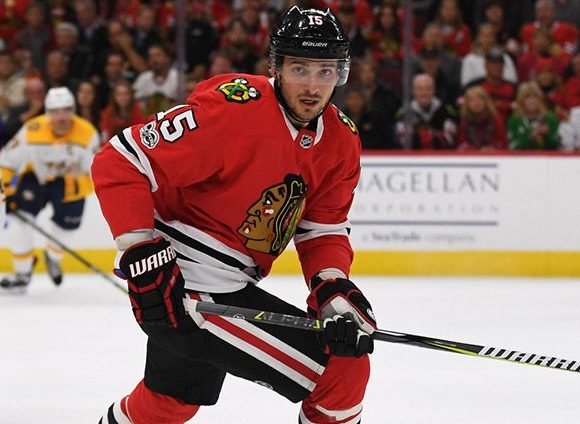
Did you guys miss me? It has been almost two full weeks since I wrote up a player preview because I was out of town most of last week. I return to bring you – wait, what? You barely noticed that I was gone? You mean to tell me that when I am here or when I am not you can hardly tell the difference? Well, that gives me something in common with today’s subject – John Hayden.

2017-18 Stats

47 GP – 4 G – 9 A

47.69 CF% – 44.37 oZS%

10:49 Avg. TOI

A Brief History: Okay, so maybe saying that you don’t notice when Hayden is or isn’t on the ice is a bit misleading. If you ever catch yourself thinking “holy shit this line is getting completely shelled in their own zone right now,” you probably will find number 40 on the screen if you look for it. I mean, you almost have to be impressively bad to have nearly 53% of the 5v5 shot attempts go against you when you’re averaging less than 10 minutes of 5v5 ice time per game. And it’s not like this guy was playing top competition either. Look, Hayden isn’t totally to blame there, because the Hawks bottom six was pretty weak in general last year, but good lord my dude you’re barely playing in the game and yet still getting your ass kicked when you’re out there.

It’s not hard to figure out why Hayden kept getting ice time (and will do so again this year) despite sucking out loud: he does “the little things” which is hockey speak for he is rough and tough or some shit. Spin the giant “hockey cliche wheel” and I’m sure you’ve heard just about everything in the book said about this due. Gets in the corners. Makes the ugly plays. Finishes his checks. Eats slop out of the garbage. Wait.

It Was the Best of Times: I’ve mentioned in the past that I really am not good at these best case scenario things, but ho boy is it hard to do it with Hayden. It’s like trying to find something positive about getting punched in the face. “Well, my jaw’s broken but it could’ve been worse!” Bitch, your jaw is still broken. Hayden is 23 years old and doesn’t have the profile of a player who will have any sort of real scoring breakout ever. We know what he is already, and really knew what he was before he got here. He’s fodder for a team that wants to at least look like it has depth.

So with that said, I guess the best case scenario is just that Hayden isn’t as bad as last year, or doens’t play much if he is. It can’t be that hard to inch closer to 50% of the shot shares, even if he’s unlikely to push north of that. Scoring wise, it’s not necessarily unrealistic to think he can climb toward 20 points, given that he had 13 in 47 games last year, but I wouldn’t expect much more than that even in the best outcomes. He also might not play in more than about 50 games again, so something in that 15 point range might be where he tops out.

It Was the BLURST of Times: At this point, I have very low expectations/hopes for the Hawks this season, so I don’t really see how a bad season from Hayden would really have any sort of major negative impact on their season. Still, there is a worst case scenario for him, especially as an individual. I’d say that if he doesn’t at least improve his shot share from last year, that’s a major issue. If he goes even more in the wrong direction, just cut your losses and buy him a house in Rockford so he knows his place.

Prediction: Is it clear yet that I think Hayden sucks? I think he will continue to suck this year. He might see more luck with the shot share, but I bet it still looks bad at the end of the year, still in the 47-48% range. I don’t think he should play more than about 50 games, which means he will probably be this year’s Bollig and play in every damn one. At least it might inch us closer to Jack Hughes/Kaapo Kakko territory next summer.

Previous Player Previews

Corey Crawford

Cam Ward

Duncan Keith

Connor Murphy

Brent Seabrook

Brandon Manning

Jan Rutta

Erik Gustafsson

Henri Jokiharju

Nick Schmaltz

Alex DeBrincat

Chris Kunitz

Artem Anisimov

Marcus Kruger

Victor Ejdsell

Jonathan Toews

Brandon Saad

Everything Else

It’s tough to put a lot of stock in preseason games, obviously, because you’re not getting a full squad run from either team, and players are still getting back into the rhythm of playing games and what have you. At this point in the preseason, though, we’re getting more toward real-ish hockey. The Hawks played most of the big names tonight, and the Wings played a number of their top guys as well (not that they have many left at this point, but you get me). Keith played. Seabrook played. Toews played.

What I am getting at here is that even with the context of it being a preseason game on a Tuesday night in gosh darn September, the Blackhawks defensive effort being so damn putrid tonight is pretty troublesome. There were just too many occasions where guys got beat, or turned the puck over badly, or were out of position, or were just plain bad. We already knew at the end of this year we’d look back at the blue line and realize it was more like a BLEW LINE (save that one for later, but make sure you credit me thanks), but for it to look so bad so early is not good.

Moreover, and we all already knew this, Cam Ward sucks major ass. He was scheduled to play the entirety of this game and still managed to get pulled after two periods. That’s how bad he was. Joel Quenneville felt the need to pull him out of a PRESEASON GAME because he was that bad in the PRESEASON GAME. One that he was scheduled to play the entirety of. And he still got pulled.

Folks.

Anyone with a brain has known since the charade the team put on last year that Crawford’s health status for this season was gonna be in question. We knew the backup situation was bad, and Stan might need to upgrade it. Cam Ward is not that. If Crawford doesn’t come back relatively early in the season, the damage done by playing Ward could literally be irreversible.

You might be thinking this has become less recap and more scorched earth takedown of Cam Ward. But really, this becoming a scorched earth takedown of Cam Ward is the ultimate recap of this game, because score the earth and take down Cam Ward is exactly what the Red Wings did tonight. They got him pulled from a preseason game in which he was supposed to play the whole damn thing. LMAO.

Photo by Jonathan Daniel/Getty Images, acquired via Second City Hockey

Everything Else

It has been a while since the Blackhwks last had a blue line prospect the caliber of Henri Jokiharju. He fell to the number 29 pick in the 2017 draft where StanBo quickly gobbled him up. He was instantly the best prospect in the organization, but really that’s just how things go when you hadn’t picked in the first round in the two drafts prior. Now, the Blackhawks hope he’s ready to make the leap from the WHL to the NHL at age 19, just one year after being drafted.

2017-18 Stats

With Portland Wintherhawks (WHL)

Regular Season: 63 Games – 12 G – 59 A – 71 P

Playoffs: 12 Games – 3 G – 5 A – 8 P

WJC (Finland): 5 Games – 2 G – 2 A – 4P

A Brief History: For those that don’t know, the WHL is the one of the three major junior hockey leagues that comprise the Canadian Hockey League. It’s essentially a semi-pro hockey league for teenagers who show a lot of promise at a young age, but typically it’s full of good ol’ boys from Canada and the odd American who spurns the idea of college. Jokiharju, of Finland, took a bit of an unconventional path for a Finnish player and decided not to honor a contract he signed to play in Finland’s top division prior to 2016-17 to head to Portland and the WHL, the CHL division considered to be the closest to NHL style, with tighter checking and lower scoring games than you’ll find in the other OHL leagues.

That’s a whole lot of background for me to give you just to say that Jokiharju scoring 71 points in 63 games from the blue line last year in the WHL might not sound all that impressive, but really it should probably make your pants tighter (or damper, for the ladies in the audience). I don’t really have the patience or time to dig through WHL stats history and draft position for blue-liners, but I am willing to guess that it’s not often that defensemen who put up that kind of production make it to the 29 pick in the draft. If he had done that in his draft year, he might’ve been top-10 pick. But, in Joker’s case (come on, that nickname was obvious) he had a bit of an adjustment after coming to North America and had a slightly less production 2016-17 with 48 points in 71 games for Portland (3 points in 11 playoff games as well) and with that he was there at 29. We call that one good fortune for the Hawks.

It Was The Best of Times: So what is the best case scenario for Jokiharju in 2018-19? In training camp, he shows that he is one of the three of four best blue liners the Blackhawks have available to choose from to fill their roster. He makes the squad and gets bumslaying minutes, maybe with Seabrook (though Nacho would have to play his offside, and we might not want that) or Forsling. He’ll probably struggle to pick up the defensive side of things, as nearly every young defenseman does, particularly the offensive-minded ones, but he shows the right instincts and grows as the game goes on. He holds his own in the shot attempts department with a 52 or better CF% and uses some PP time to pad his score sheet and ends up with 30 points in the NHL this year, more if he’s the real deal. Outside of lighting the world on fire or me bring unrealistically optimistic with this ideal scenario, I’d say that’s a damn good season for Joker.

It Was The BLURST of Times: There are two possible worst outcomes here. One, the Blackhawks keep Joker on the roster to open the season, and decide after ten games that they want to keep him around, meaning they don’t send him back to the W and burn a year of his entry level deal, but then a few months later decide he sucks and isn’t ready and then send him back. Burning a year of the ELC for no reason would be terrible asset management and worst talent evaluation, because if you can’t tell if he’s NHL ready or not after a training camp and nine NHL games, you need new evaluators. The other worst case scenario is that he stinks to high hell this year, regardless of where he plays. Maybe its the NHL and he is just a turnstyle in the defensive end who never finds his feet or hands on offense. Maybe he goes back to the W and forgets how to hockey. I don’t the latter scenario there is particularly likely, but if you wanna get dark, before talking injuries, starting to suck in the W would be troublesome.

Prediction: I think Joker has a real shot at making the Blackhawks out of training camp, in part because there are just so many question marks on the blue line right now. Is Gustav Forsling good? Is Erik Gustafsson good? Is Jan Rutta good? Is Brent Seabrook alive? All of these are up for debate. That leaves a big enough opening for Joker to make the team with a strong camp. If he can do that, all signs from his history point to him blooming where he’s planted, if you will. He took to the North American game very easily in his first WHL season, and then dominated that league the next year. I don’t think he’s like to do that in the NHL, but there’s no reason he can’t produce something like 15-20 points, and perhaps more like I said in the best case. If he’s not in the NHL, the Hawks have some options in terms of what they can do with him, but the best decision would probably be to send him back to Portland for a year. They might be able to exploit some loan loopholes and get him the AHL, but is that really the best place for him to develop? I am not convinced. Either way, Joker is at least one interesting player to keep an eye on, and might just be worth getting excited about.

Previous Player Previews

Corey Crawford

Cam Ward

Duncan Keith

Connor Murphy

Brent Seabrook

Brandon Manning

Jan Rutta

Erik Gustafsson

Everything Else

While he has one of the worst contracts in hockey, Brent Seabrook showed last season that while he is definitely not worth the ridiculous cap hit (and please lets not think about how long is left on it), he really isn’t bad either.

2017-18 Stats

81 GP – 7 G – 19 A

51.55 CF% – 55.58 oZS%

20:12 Avg. TOI

A Brief History: In a cap league with small revenue (relative to other sports) like the NHL, there are only a few defensemen worth nearly $7-million annually, and Nacho is not one of them. But he can still be useful, if effectively utilized, and Q started to do that a bit more last year. With a 51.55 CF% at 5v5 last year, Seabrook at least kept his team on offense more often than not when he was on the ice. He also started almost 56% of his faceoff-started shifts in the offensive zone, and rightfully so. It doesn’t take a genius to watch Seabrook at this point in his career and see that what’s missing is the legs. That’s a huge problem in today’s NHL if you’re gonna go against top competition. But Seabrook’s vision, passing, and shot have always been better than he got credit for, and last year that became obvious. He can still whip the puck up the ice and make things happen offensively as long as he isn’t getting torched defensively. The vitriol for Seabrook among Hawks fans has ramped up in recent years, and myself and others at this site are probably not without fault in spurring some of that on. But in a 2017-18 that saw Jordan Oesterle play way too many meaningful minutes for this squad, it didn’t become too difficult to start to appreciate what was still left of Seabrook’s game.

It Was the Best of Times: Much like Murphy over the weekend, how good Seabrook can be this season will ultimately come down to the utilization. Seabrook can still flip the ice for you somewhat well against teams’ less potent attackers, so as long as Q doesn’t start sending him out there against the McDavids and Crosbys and players of that ilk, Seabrook still has a decent shot at a solid season, at least within the context of this team. I know that the podcast guys brought up the way Zdeno Chara has been utilized in Boston for a few years now in reference to how Keith can still be effective for the Hawks, but I think the same kind of deployment – against lesser competition, mind you – could be the key to Seabrook still being a fixture for this team. Let him play with Gustafsson or Forsling, someone fast who can jump into the rush while he floats back and just flips the puck back up the ice when necessary, and things should be fine. He should still get some solid PP time so he can still flirt with 25-30 points as well.

It Was the BLURST of Times: In the other reality, Quenneville sees that Seabrook can still do the passing and the shooting well on offense and decides to try to generate that against the McDavids and the Crosbys and players of that ilk. This would be disastrous. The speed is no longer there, and if Seabs is asked to play too many meaningful minutes against too much strong competition, those wheels might just fall off. Even the best scenario here might be overly optimistic due to what Seabrook has left in the tank at this point, so trying to over exert that is certainly going to end up being a terrible idea.

Prediction: Based on what we saw from Q’s usage of Seabrook later in the season last year, I don’t think it’s unrealistic to think that he starts the season on the bottom pair in a bum-slaying role, as long there are other blue-liners who can find a way to stick out in training camp. You still have the obvious guys above him in Murphy and Keith, and with Gustafsson, Jokiharju, Hillman, Forsling, Rutta, etc. all there as options to make the team as well, Q will have some options at his disposal that he can get creative with to avoid stretching Seabrook too thin. But rest assured, if things don’t immediately go smoothly, Q will go back to what he knows and you will see Seabrook on the ice against players much better than him, and bad things will happen when he does. I still think Seabs gets around 25 points on the season, and if he can be in the 51.5-52.5 CF% range I will be pleased with his season.

Previous Player Previews

Corey Crawford

Cam Ward

Duncan Keith

Connor Murphy

Everything Else

If you had Connor Murphy picked as a guy who would end up being the Hawks best defenseman last year, please raise your hand. If you’re lying, please raise your other hand. There should be no one with only one hand in the air. That may be a bit of a contentious statement, though. After being brought into town as the return for StanBo’s not-discussed-with-his-head-coach trade of Niklas Hjalmarsson, Murphy had a bit of an uphill battle in front of him. He had to prove to be worth the Hawks losing one of the best defensemen in team history (not that hot of a take on Hjammer and if you think it is you are wrong) while also serving a coach that saw that defenseman leave without any say in the matter. While he didn’t always pass the Q test, ultimately Murphy showed he can be building block for this team while playing meaningful minutes – if his coach lets him.

2017-18 Stats

76 GP – 2 G – 12 A

53.39 CF% – 49.71 oZS%

16:22 Avg TOI

A Brief History: The Murphy trade was one that was really hard to diagnose at first. For years in the desert it seemed like Murphy was always primed to take the next step but never really did (at least according to scouting reports I’ve seen since his acquisition). He had sky high potential (and in some ways still does) but we know that potential is an ever fickle bitch and she promises nothing. It was a major gamble on Stan’s part to bring him in and trust that he could be your new Seabrook, but his contract is favorable and the fact that he’s an RHD meant that if he ended up even slightly above average it could look fine. Murphy proved to be more than just fine, though with his shot share of 53.39 the 3rd best on the team among players who played at least 30 games. Only future Norris Trophy winner Erik Gustafsson and Michal Kempny (I cry at the mere mention of his name anymore) were above him. That will certainly play. On paper, Murphy doesn’t exactly look like someone you want on your top pair, but given the state of this team’s blue line and Duncan Keith’s descent into a shell of himself, Murphy looks like he could end up being the Hawks best blue liner yet again.

It Was The Best of Times: When you’re talking best-scenarios, there really is no limit to how optimistic you can be, and for a guy like me that’s really hard. “What’s Murphy’s best case scenario?” you ask me, and I say “He suddenly explodes and posts a 60 point season from the blue line and is a Norris candidate.” You should then proceed to look at me like I have four heads. In reality, the best case scenario for Murphy is that we get more of the same from him with slight improvements rather than a step back. He’s never eclipsed 20 points in his career, so even hoping any sort of scoring outbreak is on the horizon is misguided, but it may not be unrealistic to think that with more ice time he may be able to break the 20 barrier, and with some good fortune on his shots he can maybe touch 25. But he is now 25 years old so at this point he is what he is. Oh, and also best case scenario is that Q stops holding the Hjammer trade against Murphy, at least until he’s fired at Thanksgiving.

It Was The BLURST of Times: How extreme do we wanna be here? Obviously an injury would be awful. Basically anything that keeps Murphy out of the lineup will cripple this team like bad knees on a race horse. If Murphy is out, just take the team to the shed with a shotgun. Barring injury, I think the worst possible outcome for Murphy this year is that Q sticks around the whole year and never really trusts Murphy for more than bullshit second and third pair duty. Q will probably have to loosen his tether on Murphy a bit for this team to have any semblance of success early on, at least enough for the team not to fire him before Christmas, but in the event that Q holds Murphy to bottom pair shitwork, somehow this doesn’t crumble around him to the point of losing his job, and he continues to hold Murphy down, that would be bad news. Not necessarily because I just wanna see Murphy play the bigger role, but also because you’re gonna need him to do it for the next 4 years until Boqvist or Jokiharju are ready to do it, and if you can’t even trust him with this blueline, when will you?

Prediction: I’m bad at these parts, but ultimately I think Murphy can have a year similar to last year’s with some slight improvements. I’d say he hovers around 53.7-54 CF%, pots 5 goals, and adds at least 15 assists to get that 20 point mark for the first time ever. I also predict he will end up playing less minutes than Brent Seabrook in way too many games.

Previous Player Previews

Corey Crawford

Cam Ward

Duncan Keith

Everything Else

After a season marred in large part by bad goalie play after Corey Crawford went down to injury, the Blackhawks decided to attempt to address their bad backup goalie problem by signing…. a bad backup goalie. Cam Ward probably wasn’t the worst option available on the market, but he wasn’t exactly far from it.

2017-18 Stats

43 GP (42 starts) – 23 W, 14 L, 4 OTL

.906 SV%, 2.27 GAA, 2 shutouts

.914 EV, .846 PP, .858 SH

28 SA per game

A Brief History: Cam Ward has had one of the cushiest gigs in professional sports over the past decade, as he has been living out the true American Dream of making a lot of money to be not that good at his job. He’s done that by living off the glory of a Stanley Cup win in 2006 as a rookie, despite the fact that he was pretty much dogshit during that regular season, posting a .882 SV% in 28 games that year.

It’s really a wonder Ward has even made it this long into an NHL career, now a veteran of 13 seasons, because in his first two years he couldn’t even crack a .900 SV% and even when he did get there in year 3, it was by the thinnest of margins with a .904 mark. Something seemed to click for him between the 2008-09 and 2011-12 seasons, as he went .916, .916, .923, and .915 over that stretch, finally lending some credence to his place as an NHL goalie. Since then, it’s been less rosy.

Since the start of the 2012-13 season, Ward has yet to get post a save rate north of .910, and only got to that number once. The last two years he’s gone back to barely scraping hockey’s Mendoza Line, with .905 in ’16-’17 and the above mentioned .906 mark last year. He’s also posted negative or worse Goals Saved Above Average marks every year in that same stretch, even getting as low as -13.93 in ’16-’17. Less than ideal.

In an attempt to be fair to Ward, it’s probably not all his fault, as Bill Peters system is well known for hanging the goalies out to dry in the attempt to control possession. Still, GSAA at the very least makes an effort to adjust for outside factors, so the information that is out there about Ward is still not encouraging.

It Was The Best of Times: The ideal scenario for both Ward and the Blackhawks is that Ward doesn’t have to come off the bench more 30-35 times, ideally against bad teams. Maybe in limited outings Ward will be able to find some of the game that he showed earlier this decade rather than what he’s been showing recently. Quennville’s more risk averse system should at the very least take bit of the pressure off Ward’s shoulders that he’s been felt in Carolina, while perhaps giving him a bit more confidence. Even so, in a backup goalie you could do a lot worse than a guy hovering around .910, so if Ward gets in that range it could keep the Hawks in games even when Crawford isn’t there to bail them out.

It Was The Worst of Times: Believe it are not, there are pretty much two worst case scenarios here. On the other end of spectrum of possibilities to what’s above is that it turns out Ward can’t stop a puck unless he’s getting frequent playing time, and resorts back to the player he was early in his career and not even stop 90% of what’s thrown at him. If Ward turns into Swiss Cheese in net whenever he’s in there and can’t even give the Hawks a fighting chance in the games he backstops, the classic Stan Bowman NMC is going to really bite this team in the ass unless they can find a way to make up an injury and try Forsberg again.

The other worst case scenario is that Corey Crawford is no longer good or his brain is mush after all, and Ward turns into your starter. Sorry, but this Blackhawks roster with a .905 goalie behind them is probably gonna have top-3 odds at Jack Hughes next spring.

Prediction: I am awful at predictions, but I will use Pullega’s Crow prediction as a baseline for mine. If Crawford does come in and only miss 10 or so games before coming back and being his old self, Ward will do just enough to help the Hawks survive Crow’s brief absence without falling apart, then turn into a dependable-but-not-impressive backup goalie, which really is how all backup goalies probably should be.

Previous Player Previews

Corey Crawford

Everything Else

As Sam said yesterday about Ty Smith, and because this is the direction the game and league is really headed with the position, you could probably just copy and paste Quinn Hughes draft preview (or Smith’s from yesterday) to get this preview of Adam Boqvist out of Sweden done. Though not necessarily small at 5’11” and 170 lbs, he could probably benefit from adding some size in the form of muscle and weight, and his offensive game is incredibly advanced. In fact, reading some scouting reports on him makes him sound more like a dynamo forward than a blue liner.

His shot has been heralded as one of the best in the draft – not just among defensemen – and one scouting report said he might even have the quickest release of any player in the draft in that regard. That’s a major plus and definitely an indicator that he’s a future power play point man.

The movement is where he gets the most praise, though, both of himself and the puck. His vision and passing ability is top level, and he has drawn comparison’s to Erik Karlsson, which is maybe a combination of hyperbole and lazy player comparison, but also could be an absolutely huge boon for whoever ends up drafting him. It’s certainly a possibility that he has the offensive capability to match up to EK65, and even if he does that is not necessarily the kind of thing that would make him a certified top-3 pick.

That’s because his defensive game does still need some work. He’s got a bit of early Nick Leddy in him, where he’s quick to flee the zone and try to jump into rushes even at times he shouldn’t be. Some reports mentioned him looking to get up the ice before his team even retrieved the puck, causing some breakdowns in the zone. He still needs some work on positioning in the d-zone as well, though his active stick and ability to use his speed to keep up with opposing forwards helps him in that regard.

Boqvist also brings an added advantage that almost no other prospects in the draft does other than number one pick Rasmus Dahlin, and that is experience playing against actual grown men in a professional league. Although, in Boqvist’s case it significantly less – he played in just 15 games in the SHL last year and registered only one point in that time – but it’s still a valuable experience to build on. He also dominated the SuperElit league with Brynas IF’s U20 team before getting the call to the main squad, notching 14 goals and 10 assists for a 24 point total in 25 games.

There’s a decent chance Boqvist doesn’t even end up being available to the Hawks at 8, but if he is there he seems like a sensible pick. There’s a slight chance he could prove to be NHL ready next year, though most scouting reports say he’s a year away (but when you’re picking at 8, everyone is) while others say he’s at least “a few” years away. There’s some projection to Boqvist but his ceiling is high and his game is tailored to today’s NHL, and he’d be another high-level right shot blue line prospect for the Hawks to add to the system.

Everything Else

One of the stranger themes that is constantly present with the Hawks year in and year out is the Trade Guy. It seems like each offseason – or at least every other year – there has been at least one player whose combination of play, contract, and being surpassed by other players just proving to be better, leads to him being an extremely obvious trade candidate both from the sensibility standpoint and the fan outrage standpoint.

First it was Nick Leddy, then it was Patrick Sharp, followed by Bryan Bickell, and now it’s Artem Anisimov. Wide Dick proved to be the prize of the first Brandon Saad trade, and he really has been perfectly fine for the Hawks in the three years he’s been here. He’s netted at 20 goals in each of his three seasons in Chicago, a feat he had only achieved once prior to landing here. A good chunk of those are probably a direct result of playing with Patrick Kane for three years (and Artemi Panarin for two of those), but it’s still a decent selling point if your trying to build value on the trade market, which we are.

The analytically minded are not going to be as bullish on Anismov, and for good reason – he has only broken 50% shot share at 5v5 once in three years in Chicago, but he’s also never dipped below 49% so it’s not like he’s getting skulled out there. It’s basically a back and forth when he’s out there, which isn’t exactly ideal but is still adequate enough to not be maddening. Again folks, we’re going full on used car sales pitch here.

Anisimov does have some obvious shortcomings that are definitely less than ideal for a center, like the fact that is really slow and also terrible on the dot. He’s a perfectly fine player and one that might truly be able to contribute to a good team if used properly, or eat top six minutes for a middling or bad team and do a pretty good job. Basically, if Stan Bowman is worth his salt (and I think he is), he should be able to build a market for Anisimov. The question, though, is how good that market would be.

Back at the trade deadline, the Hawks were rumored to be considering trading him, but the best offer they got was a third round pick from Columbus. But the trade deadline doesn’t always bring out the full market because it seems like teams are always hesitant to players that aren’t the “biggest” names on the market at that time. The NHL Draft and free agency season has become the big event for major moves as teams try to restructure themselves for the new seasons by plugging holes or adding new elements, so Anismov’s market is probably going to have at least a few takers. But the market isn’t your only obstacle.

Anisimov has a full NMC that runs until July 1, so that throws a major wrench in any plans that Stan may have had to try and move him at Friday’s draft. And this is where it gets murky, because if you’re Anisimov you might be smarter to waive that NMC this week and give yourself a bit more control over where you play next year rather than handing in a 10-team list on June 30 only to have a 1-in-1o shot at your preferred location come July. Not that Stan would ask Wide Dick where he wants to go and then only try to make it work there, but if Stan gets a deal put together on Friday and calls up Anisimov’s agent, maybe it makes more sense to just say “yes” then and know you’re wanted where you’re headed rather than go into the new league year with only an inkling of an idea of where you’ll be come October.

I think the Hawks might be able to sell a team like Carolina on taking Anisimov as part of a package for Justin Faulk, and I genuinely think Carolina would be a nice landing spot for Wide Dick while also striking me as a nice place to play. Is that more attractive than trying to sort through which third of this league is desirable enough to play in to include them on an “okay” list?

Given that the Hawks are pretty much set at their top two center spots at this point with Toews and Schmaltz, while also being rumored to have interest in John Tavares, it’s starting to feel more like “when” Anisimov gets traded rather than “if” he gets traded. It doesn’t feel particularly likely that it happens this week, but stranger things have happened, and it’s all going to come down to what level of control Wide Dick wants on his future. It’s at least something to keep an eye on come Friday.

Everything Else

Anthony Duclair’s career thus far has a slight “Over Promise, Under Deliver” to it. He was considered a pretty good prospect before got to the NHL, one with high offensive upside because of his speed and shot. And while he does still flash that speed and shot occasionally, he’s only scored 37 goals in 213 NHL games thus far, and 2o of those goals game in 2015-16. Let’s take a look at his most recent campaign.

Anthony Duclair

Total – 56 games, 11 goals, 12 assists, 23 points, -5, 16 PIM

With Hawks – 23 games, 2 goals, 6 assists, 8 points, Even, 6 PIM

50.51 CF%, 1.99 CF% rel, 45.97 xGF%, 0.42 xGF% rel, 53.12 ZSR

Duclair wasn’t exactly over-the-top impressive this season, in general nor when he came to Chicago in exchange for drunk trespasser Richard Panik, but he was certainly not bad. His speed is evident the moment you lay eyes on him on the ice, and he puts it to work well at both ends of the ice. He’s got a decent frame for being for 5’11”, 191 lbs, so he’s able to cause some issues with that speed and his body in transition offensively, as well as defensively on the forecheck and backcheck. One of the podcast guys mentioned a while back that he has some Hossa-esque qualities to his defensive style, and at times that 91 on his jersey might make you think it’s Hossa’s 81.

While Duclair hasn’t exactly lit up score sheets so far in his NHL career, it doesn’t take too much investigating to fine out why – he doesn’t shoot enough. In his 56 appearances last year, Duclair only got 97 shots on goal total. He shot 11.3% for the season, not far off his career mark of 12.5%, which is a more than acceptable conversion rate. But it still doesn’t tell the whole story, as that number is buoyed a bit by his 19% rate in 2015-16, his only full season so far and also the one in which he accounted for more than half of his career goals. He followed that up with a tough 2016-17 in which he scored just 5 goals on 6.6% shooting. And even this past year, he shot 13.2% in his 33 games in the desert and just 6.9% (nice) in his 23 games with the Hawks. All of that suggests that we still don’t know what kind of shooter Duclair is, but the only way to really figure that out is going to be him getting more pucks to the net.

Given the positive qualities he possesses, and the fact that he is still just 22 years old, I still think it’s reasonable to believe there is some high-ceiling upside left for Duclair to tap into, but with each passing day the likelihood of him reaching that ceiling shrinks. If he can somehow have a breakout year next year, you might have a 55-point player on your hands. But that’s if you wanna be really optimistic about his climbing the ladder to that ceiling. More likely, you have a 35-45 point third liner on your hands who can contribute defensively, which is perfectly fine.

Dylan Sikura

College – 35 games, 22 goals, 32 assists, 54 points, +18, 22 PIM

NHL – 5 games, 0 goals, 3 assists, 3 points, +2, 0 PIM

NHL – 42.34 CF%, -4.81 CF% rel, 49.32 xGF%, 7.07 xGF% rel, 64.29 ZSR

Just about any NHL production you get from Dylan Sikura is a net positive, because it’s extremely rare that 6th round draft picks become NHL players. Sikura developed into one of the best college hockey players over the past few years, and he certainly got the Hawks brass excited about him, enough so that they signed his brother to an NHL deal to butter him up and make sure he signed at the conclusion of his college season. We call that the reverse Hayes.

Sikura looked fine when he got to the NHL, I guess. I am not sure how much you can read into five appearances in a lost season on a team made up of a lot of patchwork. His offensive ability was evident in college, and he flashed some of hit when got to Chicago, so we know it’s there. The question is whether or not that will come to mean anything, because we have seen plenty of good college performers become nothing NHL players in the past. I think Sikura can stick, but he probably projects similarly to Duclair – if it all clicks, you maybe have a second liner who will give you 50 points or more, but more than likely you’re looking at a third liner who can create some mismatches and get you 40ish points a year. Next year will be the true barometer for him.

Everything Else

For the second straight season, it felt like we watched Jonathan Toews go through a year in which he played very well, had solid underlying numbers, and yet due to voodoo or bad luck or the lack of lean meat in his diet he couldn’t find the score sheet. The hilarious part is he still put up 20 goals and 52 points in 74 games, which is still pretty damn good. But his paycheck and role demand more, and his play deserved it. Shall we?

Jonathan Toews

74 games, 20 goals, 32 assists, 52 points, -1, 47 PIM

56.14 CF%, 4.79 CF% rel, 53.09 xGF%, 4.19 xGF% rel, 55.15 Zone Start Ratio

I think there’s a lot of value in bookending the preview/review process with players as a writer, which is why I wanted to do this review for Toews after doing the preview earlier this year. Honestly, before looking into any of his numbers, I went back and read said player preview. That presented me with a problem – I, uh, think I might end up repeating myself from that post a lot.

That’s because, like I said to open this one, Toews had another year comparable to his 2016-17 campaign. He had elite shot metrics with that 56.14 CF, the expected goals was nicely in his favor as well at 53.09, and yet a career low shooting percentage drives the production numbers down. Compare those expected goals to his actual GF% of 50.57 and it gives you an even better scope of just how bad his luck was. Spending damn near the entire year with Brandon Saad, who was going through the same damn thing (TEASER: review coming tomorrow from Mr. Pullega), didn’t really help matters.

Let’s play a projection game. After shooting 9.5% this year, his first time below 10% in his career, Jonathan Toews’ career shooting percentage has now dropped to 14.1 percent. If he simply shot that rate this year, he’d have scored 10 more goals. 62 point year in 74 games. That’s good.

Before these last two years, Toews was shooting 15.1% on his career – and while a one percent drop probably doesn’t strike you as huge, to drop a goal per 100 shots after just two seasons is kind of insane. If Toews had shot at 15.1% this year, he has 32 goals. Again, good.

And again Brandon Saad’s career low shooting year definitely impacted Toews as well, likely on the assist side of the ledger. I won’t dig too much into the numbers so as not to steal Pullega’s thunder for tomorrow, but if Saad shot his career rate this year, I bet Toews added anywhere from 2-8 assists to his ledger as well.

So the ultra-optimistic side of this projection game puts Toews at 32 goals and 40 assists, and if you play slightly more conservative you have him at 30 and 32. Either way, you’re looking at somewhere in the 65-70 point range in 74 games played. That is damn near elite production in today’s NHL. “But Twitter told me the sky is falling on Jonathan Toews,” you say! Twitter is wrong. It is always wrong.

A while back I compared Toews to Anze Kopitar, and that comparison is still apt. Kopitar had a much worse 2016-17 than Toews in the luck department, but things swung his way in 2017-18 and he ended up with career highs in shooting percentage, goals, and points, and all of that earned him a Hart trophy nomination and he just might win the damn thing even though it should go to Nathan MacKinnon. But here’s the most encouraging part of Kopitar’s huge year as far as it applies to Toews – his combined shooting percentage from last year with a career low shooting percentage, and this year with the career high, sit right in line with his career numbers and his typical fluctuation of his career.

Obviously there are flaws to some of this numerology I’m doing, but the over-arching point is that things aren’t all bad for Toews unless there is more to this whole thing than shooting percentage. The overall numbers don’t indicate that there is, though, meaning that unless there is some lingering injury that is somehow leading to the decline in shot conversion, everything we know about numbers and regression indicates that Captain Vegan is due for a correction.

And if all else fails, maybe he should start eating steak again. How the fuck could anyone give up steak?