Everything Else

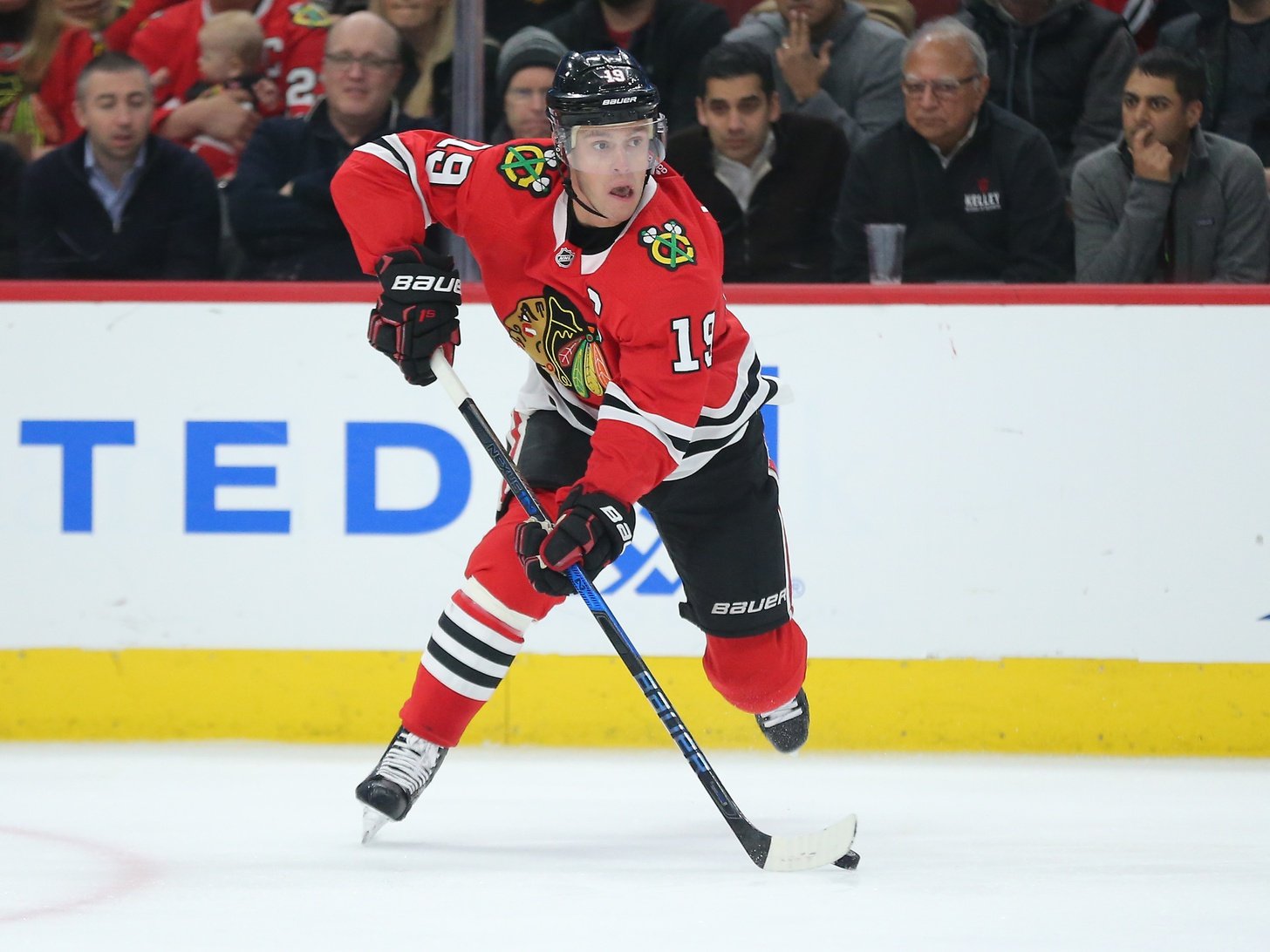
I haven’t made much of a secret about what I think Vinnie Hinostroza is and what he could be. There’s more here than we’ve seen, and I fear there’s more than even the team thinks. Let’s tease it out here.

Vinnie Hinostroza

50 games, 7 goals, 18 assists, 25 points, 10 PIM, +5

53.7 CF%, -1.53 CF% rel, 53.7 xGF%, +5.39 xGF% rel

Yeah, so on the surface, 25 points in 50 games is certainly a decent contribution. Even you can do the math to see that works out to 41 points over 82 games, which you’d take from a bottom-sixer in a goddamn heartbeat. And maybe that’s all he is. And that’s ok. You need contributing third and fourth liners to be good, and Vinnie can give you that.

Except…

There was a point this season, when Hinostroza was getting to run with Schmaltz and Kane or on the top six in general, that he was top-20 in the league in terms of attempts he took and chances he got himself. Vinnie Hinostroza was one of the best individual chance creators in the league. His problem is that he didn’t bury enough of them, as his 8.1 SH% and only seven goals kind of make clear. And that might be it for him, because he wasn’t a big goal-scorer at Notre Dame and his best year in the AHL saw 18 goals in 66 games.

Still, looking at his WOWYs, when Hinostroza skated with Saad and Toews they ran up a 60+ CF%, and a 57% scoring-chance percentage. That’s the best mark any winger managed with those two. He and Schmaltz ran a 52% mark in both as well.

This doesn’t mean that Vinnie Hinostroza should be on Toews’s line all next year and never moved. What I think it does say is that he’s a winger you can play anywhere in the lineup and get something from him. He can certainly get you out of a game or five in the top six. And there might be more there. His speed alone causes problems. He can get in on a forecheck, not by hitting people or being all that strong on the wall, but by simply making d-men play faster than they want to. He causes turnovers. He opens space by just zipping around. This is how things work in the NHL now.

Again, like other players, how the Hawks view Hinostroza going forward will say a lot about how they’re going to build this team going forward.

Outlook: I’m not going to claim that Hinostroza can be Jake Guenztel. The Hawks don’t have a Crosby to make him one anyway. But he’s got tools to be on the top six and if you have the rest of it set, he can be a real weapon. It depends what the Hawks want to be.

I’m afraid they see how small he is and think he can only be a penalty-killing gnat on the fourth line who they just let loose for 10-12 minutes per game. And keeping him on the bottom six is fine, especially if you have four wingers that are clearly better which the Hawks probably should. It would be even more pleasing if he’s on a third line on a team that’s decided it’s just going to pack as much speed as possible into the lineup and play as if their balls are being lightly singed for 60 minutes. Not as a checking forward, but just as a third line that’s trying to skate by you until you puke. This is what the Hawks should be doing, it’s what more and more teams are going to do, and Hinostroza is a piece that can do that.

I’d be a touch surprised if Vinnie Smalls ever got to 20 goals. He’d need to improve his shooting markedly, but that’s been done before. What he doesn’t have to improve is getting into the right spots, because he already does. The fear is that he can get buried in his own zone, which we saw at times with him and Schmaltz when they played together. But as the league gets smaller and faster, and it will, that’s less and less of a problem. And with his speed the other way he certainly keeps d-men from pinching too low.

There’s more here. I hope the Hawks and Vinnie see it.

Everything Else

For the second straight season, it felt like we watched Jonathan Toews go through a year in which he played very well, had solid underlying numbers, and yet due to voodoo or bad luck or the lack of lean meat in his diet he couldn’t find the score sheet. The hilarious part is he still put up 20 goals and 52 points in 74 games, which is still pretty damn good. But his paycheck and role demand more, and his play deserved it. Shall we?

Jonathan Toews

74 games, 20 goals, 32 assists, 52 points, -1, 47 PIM

56.14 CF%, 4.79 CF% rel, 53.09 xGF%, 4.19 xGF% rel, 55.15 Zone Start Ratio

I think there’s a lot of value in bookending the preview/review process with players as a writer, which is why I wanted to do this review for Toews after doing the preview earlier this year. Honestly, before looking into any of his numbers, I went back and read said player preview. That presented me with a problem – I, uh, think I might end up repeating myself from that post a lot.

That’s because, like I said to open this one, Toews had another year comparable to his 2016-17 campaign. He had elite shot metrics with that 56.14 CF, the expected goals was nicely in his favor as well at 53.09, and yet a career low shooting percentage drives the production numbers down. Compare those expected goals to his actual GF% of 50.57 and it gives you an even better scope of just how bad his luck was. Spending damn near the entire year with Brandon Saad, who was going through the same damn thing (TEASER: review coming tomorrow from Mr. Pullega), didn’t really help matters.

Let’s play a projection game. After shooting 9.5% this year, his first time below 10% in his career, Jonathan Toews’ career shooting percentage has now dropped to 14.1 percent. If he simply shot that rate this year, he’d have scored 10 more goals. 62 point year in 74 games. That’s good.

Before these last two years, Toews was shooting 15.1% on his career – and while a one percent drop probably doesn’t strike you as huge, to drop a goal per 100 shots after just two seasons is kind of insane. If Toews had shot at 15.1% this year, he has 32 goals. Again, good.

And again Brandon Saad’s career low shooting year definitely impacted Toews as well, likely on the assist side of the ledger. I won’t dig too much into the numbers so as not to steal Pullega’s thunder for tomorrow, but if Saad shot his career rate this year, I bet Toews added anywhere from 2-8 assists to his ledger as well.

So the ultra-optimistic side of this projection game puts Toews at 32 goals and 40 assists, and if you play slightly more conservative you have him at 30 and 32. Either way, you’re looking at somewhere in the 65-70 point range in 74 games played. That is damn near elite production in today’s NHL. “But Twitter told me the sky is falling on Jonathan Toews,” you say! Twitter is wrong. It is always wrong.

A while back I compared Toews to Anze Kopitar, and that comparison is still apt. Kopitar had a much worse 2016-17 than Toews in the luck department, but things swung his way in 2017-18 and he ended up with career highs in shooting percentage, goals, and points, and all of that earned him a Hart trophy nomination and he just might win the damn thing even though it should go to Nathan MacKinnon. But here’s the most encouraging part of Kopitar’s huge year as far as it applies to Toews – his combined shooting percentage from last year with a career low shooting percentage, and this year with the career high, sit right in line with his career numbers and his typical fluctuation of his career.

Obviously there are flaws to some of this numerology I’m doing, but the over-arching point is that things aren’t all bad for Toews unless there is more to this whole thing than shooting percentage. The overall numbers don’t indicate that there is, though, meaning that unless there is some lingering injury that is somehow leading to the decline in shot conversion, everything we know about numbers and regression indicates that Captain Vegan is due for a correction.

And if all else fails, maybe he should start eating steak again. How the fuck could anyone give up steak?

Everything Else

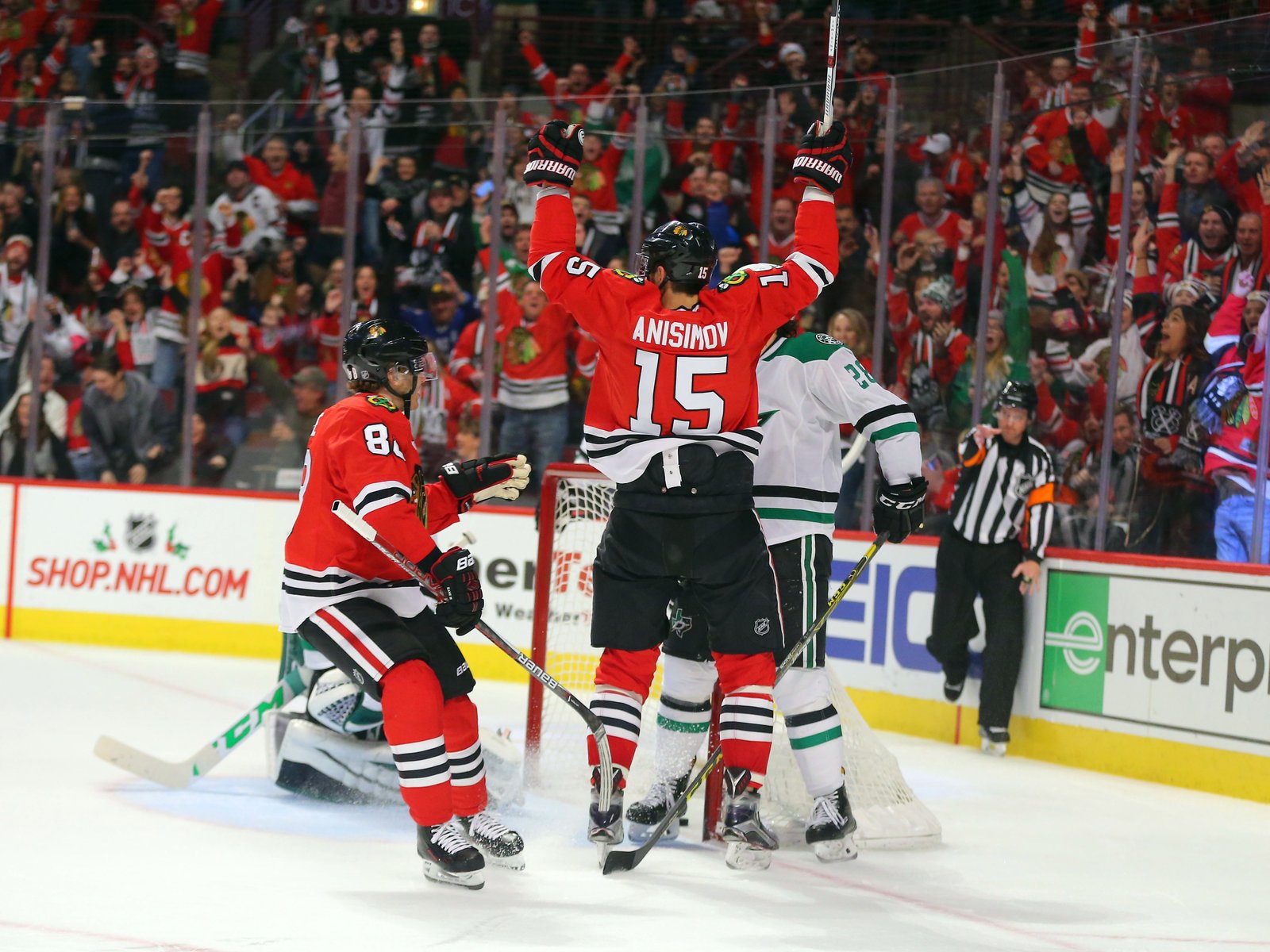
We’ve had three years of Artem Anisimov now. And we’re still not sure if he’s anything more than an obelisk. And a lot of offseason plans hinge on what the Hawks want to do with him, or think they can. It was something of an odd year, for everyone but Arty especially. Let’s do the thing.

Artem Anisimov

72 games, 20 goals, 11 assists, 31 points, -17, 22 PIM

49.3 CF%, -3.51 CF% rel, 45.5 xGF%, -4.81 xGF% rel

As far as goals go, this was pretty standard Arty stuff. 20 goals, as he’d put up 22 and 20 the tw years before. What didn’t go up, and went down, were the assists, as he wasn’t playing the entire year with Kane and Panarin. And what became clear this season is that Arty didn’t really add a lot to those two’s games when they were here and he was permanently the 2nd line center.

Anisimov spent most of his time with Kane, and Schmaltz, but spent more time away from Garbage Dick this year than he had in the two previous combined. And when you look over Arty’s WOWYs, you realize that just about everyone is better away from Anisimov than with him. Kane’s, Schmaltz’s, and Jurco’s, possession and chance-percentages all go up away from Anisimov, and those were the three most common wingers he had.

What became clearer and clearer this season is just how much Arty’s lack of speed hurts him. He doesn’t win any draws, as we know, and the fact that he doesn’t move much is fine when Kane or Panarin can just hold the puck for 10 seconds and let him get to the net. They also had the talent to just play without him. But the only way the Hawks could replicate that this season was having Kane and Schmaltz do it, and Schmaltz is better in the middle, which put Arty on a wing and no one wants to see that again either.

Anisimov and Jurco combined to form a nice bottom six line, whichever one you decide it is. But you also get the impression Jurco was doing most of the work, and you could find someone faster, cheaper, and younger to basically do the same job. You would lose a power play weapon of course if Arty goes, because he can be the obelisk in front as it doesn’t involve skating back really.

Perhaps the strangest part of the year was when Elliotte Friedman reported that teams had called about trading for Anisimov but the Hawks had refused to even discuss him. Really? Perhaps they didn’t want to ask to have him waive his full no-trade when it is now a partial and they can have him just submit a list, but that seemed weird. The Hawks need the cap space and in a league and especially division that is speeding up, Arty didn’t fit. We shall see.

Outlook: In a normal world, Arty’s ass would be grass and he would be moved no later than the draft. The Hawks need to get quicker everywhere they can, they could really use $4.5 million in space for the next three years that punting him would generate, and quite frankly you can just do better there. And maybe that’s the plan here.

But he can’t be traded under a partial NMC until July, and given how much Eddie and Pat–nothing if not the team’s bullhorn–bleat on about Annette Frontpresence all the goddamn time, you wonder if they don’t value Arty’s ability to stand up in one place more than they should. We’re almost sure the coach does. So the Hawks might genuinely think he’s a piece they have to keep, where they can watch oh, Turris, Little, Staal, Jost, and whatever other second and third center on opponents skate around him every night.

Arty is a lot like Dave Grohl. If he’s a support piece to much better players doing the work, you’re fine with it. If you’re asking him to be the lead guy, you’re going to get a lot of crap. Sadly, like millions, I think the Hawks might be mesmerized by the empty crap.

Everything Else

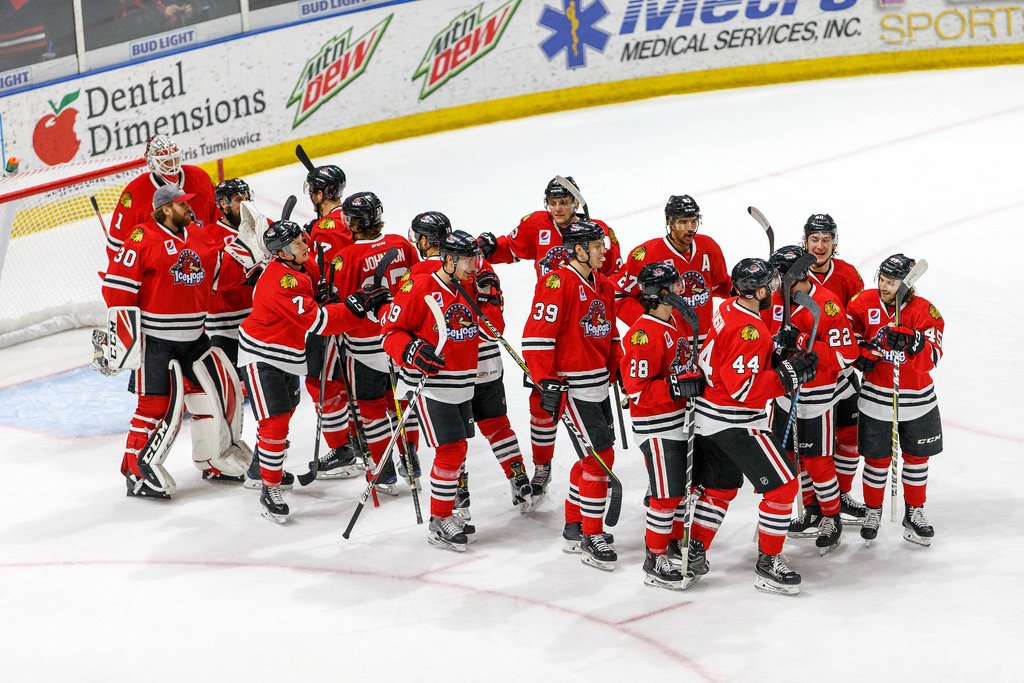
The Rockford IceHogs, AHL affiliate to the Chicago Blackhawks, are halfway to a Central Division Final victory over Manitoba. The Hogs have surged to a 2-0 series advantage of the strength of two wins on the road this past weekend.

Rockford took Game 1 Friday by a score of 4-2, then came back the next afternoon and beat the Moose 4-1. The IceHogs are 5-0 so far in the postseason. They can build upon that streak in the confines of the BMO Harris Bank Center with Wednesday night’s Game 3.

The Hogs special teams continued to be a difference-maker in the playoffs. Rockford was 3-10 in power play opportunities, while holding the Moose scoreless in five chances. The IceHogs controlled large stretches of action in Manitoba and were more effective physically to boot.

Here are a few thoughts to chew on as the action returns to Winnebago County in a couple of days.


A Team Transformed On The Fly

A lot has been made about the six players the Blackhawks sent to Rockford following the conclusion of their season. The broadcasters in Manitoba brought it up several times this weekend, as did the Chicago Wolves crew in the first round.

To suggest the Hogs are being led by mercenaries who arrived just to buoy a Rockford playoff run is not giving enough credit to the players who were around for the late-season push to the postseason. Yes, Victor Ejdsell has certainly been an x-factor so far. John Hayden and David Kampf have deepened the lineup for sure.

However, Andreas Martinsen spent most of his season toiling in Rockford. Jeff Glass, due to the strong play of Collin Delia, hasn’t seen the ice in the playoffs. The other goalie that came down, J.F. Berube, didn’t even report to Rockford after being re-assigned.

When the 2017-18 season began, the IceHogs were well-stocked with prospects but lacking in veteran leadership and physical know-how. At some point in the schedule, this glaring need was recognized and addressed in a host of moves.

This includes Cody Franson’s January assignment to Rockford, the acquiring of Chris DiDomenico in mid-February and Lance Bouma being assigned to the Hogs  to Rockford late in that month. Over the last half of the AHL season, the piglets got a year of experience under their belts. They also were reinforced in a way that added a physical, veteran element that is tailor-made for postseason staying power.


Short Handed Moose

Manitoba went into this series without its leading scorer. Mason Appleton, the league’s top rookie, has been out with an injury suffered in the previous round of playoff action.

Saturday, Bouma crunched AHL Defenseman Of The Year Sami Niku against the boards in the corner of the Manitoba zone in the second period. Niku was able to finish his shift but left the game. He did not return. Appleton and Niku were arguably the two best rookies in the league this season. Having them both out against Rockford is going to leave a lot of scoring slack for the Moose to pick up.


Hogs Of Note

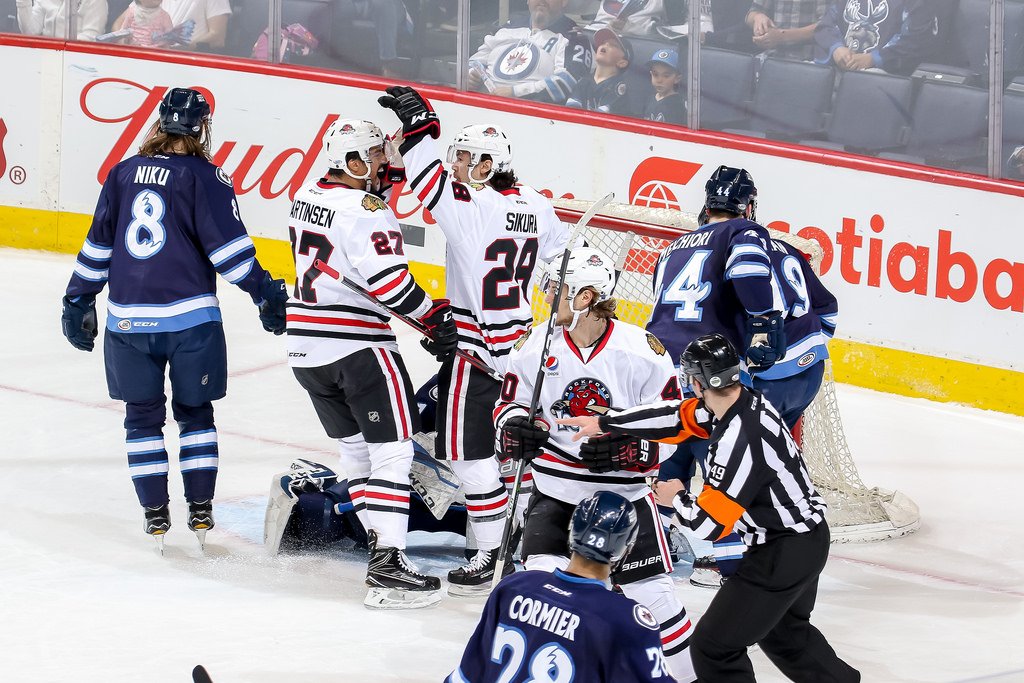
Tyler Sikura potted goals in both games and played strong hockey in his own end as well. The IceHogs MVP of the regular season has continued to do the dirty work needed to get pucks in the net. For the postseason, he’s tied for the team lead (with DiDomenico and Ejdsell) with three goals.

Rockford’s rookie goalie has been Deliariffic, stopping 57 of the 60 pucks sent to his net. He was instrumental in the Game 1 win, negating several Rockford turnovers that could have had the Hogs in a hole over the first 40 minutes. Delia owns a 1.52 GAA and a .949 save percentage in addition to a 5-0 postseason mark.


Packing The BMO…Or Not?

I am definitely interested in how the piglets will draw as the games take on more importance. The Moose, on a weekend, drew 3,816 and 3,955 fans to the Bell MTS Place for the opening pair of contests. That is more than a bit off their season average of 5,277; to be fair, Winnipeg does have an NHL team in the same building in action this spring.

In 2017-18, Rockford saw an average of 3,915 enter the BMO Harris Bank Center each game. This is the lowest season attendance for the IceHogs since the 2008-09 campaign and an 1,100-fan per game drop-off from two seasons ago, when Rockford drew over 5,000 a night.

Game 3 is Wednesday, which isn’t typically a big attendance night at the BMO. Back in the 2015 Calder Cup Playoffs, Rockford hosted three games against Grand Rapids in the second round. The IceHogs averaged 4,834 that season but had the following gates attend the playoff match-up:

Wednesday, May 13-1,780

Thursday, May 14-1,620

Sunday, May 17-1,624

Over 5,400 fans turned out for the Hogs win over Chicago in Game 2 of the first round. I believe that that is a franchise high for playoff attendance by a couple of thousand people. The previous high was May 11, 2008, when 3,306 showed up for Game 6 of Rockford’s second-round series with the Wolves.

Is the playoff buzz sufficient around this part of Northern Illinois to pull people away from local high school sports action? The IceHogs have an enthusiastic fan base who will be making the trek to the BMO Wednesday night. If that total tops 2,500 fans, I will be pleasantly surprised. If the game draws over 3,000 fans, I’ll be stunned (but in a good way).

It would be great if the IceHogs playoff run could pick up fan momentum; a telling indicator may well come on Friday, when Rockford hosts Game 4.


Central Division Final-Game 1

Friday, May 4-Rockford 4, Manitoba 2

The IceHogs opened the Central Division Final in impressive fashion, taking Game 1 at the Bell MTS Place.

The Moose opened the scoring late in the opening period after Julian Melchiori lobbed the puck out of his zone and into Hogs territory. Viktor Svedberg and Cody Franson were both safely back, but Svedberg was unable to get control of the bouncing biscuit. Buddy Robinson got the handle on the loose puck and beat Hogs goalie Collin Delia at the right post for a 1-0 Manitoba advantage at the 16:56 mark.

Rockford got an equalizer midway through the game on a slick transition play that started with Carl Dahlstrom getting possession of the puck in the corner of his own zone. In short order, the puck made its way to Matthew Highmore in neutral ice. Highmore sent it across the ice to Victor Ejdsell entering the Moose zone. The big forward zipped around Melchiori to gain a path to the right post, where his backhanded attempt got by Manitoba goalie Eric Comrie at 11:53 of the second.

The IceHogs used the power play to take the lead 3:29 into the final frame after a delay of game penalty on Manitoba. Tyler Sikura got a stick on a Chris DiDomenico offering to redirect the puck past Comrie for a 2-1 Rockford advantage.

Just 45 seconds later, John Hayden one-timed a pass from Andreas Martinsen. The shot from the slot kissed cord and put Rockford ahead 3-1.

The Hogs added an empty net goal from Cody Franson when a shorthanded Moose club yanked Comrie from the crease with less than a minute to go. Manitoba got a tip-in from Jan Kostelek, but the clock ran out with Rockford on top.

Delia, who kept his team close in the first two periods on several point-blank chances off of Rockford turnovers, made 24 saves to pick up the win along with first star honors.

Lines (Starters in italics)

John Hayden-Tyler Sikura-Andreas Martinsen (A)

Chris DiDomenico-David Kampf-Lance Bouma

William Pelletier-Tanner Kero-Anthony Louis

Matthew Highmore-Victor Ejdsell-Luke Johnson

Cody Franson (A)-Viktor Svedberg (A)

Adam Clendening-Carl Dahlstrom

Gustav Forsling-Darren Raddysh

Collin Delia

Power Play (2-6)

DiDomenico-Johnson-Sikura-Franson-Clendening

Highmore-Ejdsell-Louis-Bouma-Dahlstrom

Penalty Kill (Manitoba was 0-2)

Kampf-Bouma-Franson-Svedberg

Kero-Pelletier-Raddysh-Forsling

Johnson-Martinsen-Clendening-Dahlstrom


Central Division Final-Game 2

Saturday, May 5-Rockford 4, Manitoba 1 

Game 2 was another strong effort, as the IceHogs controlled the pace of the game on the way to a weekend sweep of Manitoba.

For the second straight game, the Moose scored first, getting the best of Hogs goalie Collin Delia when Brenden Lemiuex redirected a shot by Nic Petan 16:03 into the game. As was the case Friday night, Rockford responded with the next three goals.

The Hogs answered Lemiuex’s goal 2:35 later when Viktor Svedberg intercepted Petan’s clearing attempt in the high slot. Manitoba goalie Eric Comrie made the stop but left a juicy rebound in the front of the net. Tyler Sikura was on hand to knock it into the cage to tie the score.

The Hogs man advantage unit gave Rockford a 2-1 lead 4:45 into the second. Chris DiDomenico gained possession of a puck along the left half boards, skated across the ice into the slot and fired past Comrie’s stick side for the lamp-lighter.

Assists on the goal came from Sikura and Luke Johnson. However, a big part of the scoring play came when Cody Franson lifted the stick of Buddy Robinson of the Moose, allowing Sikura’s ring-around pass to get to DiDomenico.

The IceHogs moved out to a two-goal lead late in the middle frame. Some nice puck work in the corner of the Manitoba zone by Ejdsell and Tanner Kero resulted in Gustav Forsling sliding a cross-ice pass to a waiting Carl Dahlstrom. The one-timer sailed past Comrie for a 3-1 Rockford advantage 16:03 into the second period.

From there, Rockford kept its collective thumb on the Moose offense, killing a couple of Manitoba power plays and limiting scoring opportunities. Andreas Martinsen added an empty net goal in the closing seconds after the Moose went with six skaters most of the last three minutes.

Delia’s effort nabbed him First Star honors for the second consecutive night. Lemieux and Sikura were voted second and third stars. Luke Johnson left after a rough collision with the end boards in the second period, but returned for the start of the third.

Lines (Starters in italics)

John Hayden-Tyler Sikura-Andreas Martinsen (A)

Chris DiDomenico-David Kampf-Lance Bouma

William Pelletier-Tanner Kero-Anthony Louis

Matthew Highmore-Victor Ejdsell-Luke Johnson

Gustav Forsling-Carl Dahlstrom

Cody Franson (A)-Viktor Svedberg (A)

Adam Clendening-Darren Raddysh

Collin Delia

Power Play (1-4)

DiDomenico-Johnson-Sikura-Franson-Clendening

Highmore-Ejdsell-Louis-Bouma-Dahlstrom

Penalty Kill (Manitoba was 0-3)

Kampf-Bouma-Franson-Svedberg

Kero-Pelletier-Raddysh-Forsling

Johnson-Martinsen-Clendening-Dahlstrom


Coming Up

Following Game 3 Wednesday, Rockford hosts the Moose for Game 4 Friday night. Game 5 will happen on Sunday afternoon, should it be deemed necessary.

Follow me @JonFromi on twitter for tidbits of lucid thought throughout the AHL playoffs.

 

Everything Else

It seemed like Tomas Jurco played more than just the 29 games he got, but that’s the number. Maybe it’s because those 29 games were such a slog thanks to the goaltending they felt like 60. That’s not Jurco’s fault. Anyway, Jurco ended up being a pretty effective 4th liner. The question is will it matter in the least going forward.

Tomas Jurco

29 games, 6 goals, 4 assists, 10 points, +1, 12 PIM

51.8 CF%, +2.03 CF% rel, 51.9 xGF%, +5.18 xGF% rel

The interesting thing for Jurco is what he’ll mean for how the Hawks will build their roster going forward, but we’ll get to that. Jurco always seemed like a tweener in both Detroit and here. He wasn’t really skilled enough to break your top six, but he wasn’t grind-y, sandpaper-y, fart-y to be on the bottom six for coaches who only saw the game one way. Even if you wanted to do the patented “3+1” model the Hawks have either had or strived for, getting him on the top nine was a real squeeze. We’re talking about a guy who in basically 3+ seasons in the NHL has only managed 22 goals and 50 points. If he were really that skilled, he would be clobbering bottom-six opposition which he was facing. That was most certainly not the case before this year.

But this year something seemingly changed. He looked spikier, there was a little more oomph or punch to his skating and playmaking in the offensive zone. And he wasn’t a disaster in his own by any means. Jurco was also attached to Artem Anisimov his entire stay in Chicago, which you wouldn’t think would accentuate what he does well, and Anisimov was more than competent with him and pretty much a disaster without him (39.8 CF% away from Jurco). Perhaps with a quicker and more skilled set of linemates, Jurco’s abilities could really shine as he does have vision and he does have a sense for the net.

Outlook: Here’s the problem for Jurco. Barring any disasters or trades, the Hawks have a pretty big group of forwards guaranteed spots next year. Toews, Saad, Kane, Schmaltz, DeBrincat, Sikura, Ejdsell, Hinostroza (maybe?). That’s eight right there.  You’d have to think Duclair would have to go way out of his way to not get a spot either. They may be serious in not wanting to trade Anisimov, which is 10. You can totally see them re-signing LOCAL BOY Tommy Wingels again, which is 11, basically leaving one or two spots on the team. And given their fascination with size, John Hayden will once again get every chance to bungle away a spot because he just will, and Highmore and other Rockford flotsam might get looks as well.

But to me, what the Hawks do with Jurco (he’s an RFA) will say a lot about how they’re going to build their team, and if they’re going to change the thinking in doing that. Because if the Hawks are looking around at the Preds, Knights, and Penguins, and one or two others, and just decide they’re going to pack the forward spots with as much speed and skill as they can, Jurco has a place. If the Hawks are going to employ more of a “Get It The Fuck Up The Ice As Quickly As Possible” style that the league will go to more and more, Jurco has a place on the third or fourth line (and Anisimov, Hayden, and Wingels most certainly don’t). He can get you goals against bums on the other teams’ nether regions.

But if the Hawks stick to their third line being a “checking” line and/or the fourth line being the home for wayward children who don’t read good, then Jurco probably doesn’t have a place. He’s not going to be a checker, and he’s certainly not going to be a grinder. Maybe if you squint he can be a homeless man’s Michael Frolik, but Michael Frolik’s are unicorn in nature. And even Frolik was more of a nod to packing your forward corps full of speed and fury. Bolland-Kruger-Frolik is a fourth line you’d see in today’s game. The Hawks were ahead of their time and seemingly have ignored it since.

Jurco won’t be expensive. He’s due a raise of just $80K and will probably clock in at $900K or so. Given the candidates, he seems to provide as much or more than anyone else who could warrant a bottom-six role.

Everything Else

There’s little point in rehashing the details of Patrick Sharp’s farewell tour here. You know how it went, I know how it went, he knows how it went. And really, for the $1 million he was paid and the 4th line role he basically played, it wasn’t a disaster. Maybe his mentoring of Alex DeBrincat will become more important than we can realize here on the outside. Who knows? Sharp came back, it kind of just happened, we all shared our memories of him again (and there are so many), and we’ll all move on.

Still, Sharp’s acquisition raises some discussion about just what the Hawks do in the front office. Because no matter what your conclusion is, none of it makes you feel good about the inner workings of how the Hawks put together a team. So there are three ways this could have happened, right?

One, Stan Bowman saw Sharp decompose in Dallas, along with the hip surgery, and thought he could genuinely help this team. Maybe he figured it was only a million bucks, it was a signing his coach would actually give every chance to which most certainly has not been the case with a lot of signings, and took the plunge. Either way, there were many other fourth liners for even cheaper, and third liners, that the Hawks could have gone out and got and probably would have contributed more. Sharp hardly torpedoed the Hawks season, nor would someone else in that slot have saved it, it’s just somewhere you could have done better.

Two, John McDonough came down and told them they needed to sell more of the new jerseys with the reverse-preacher collar and bringing back ol’ #10 would help them do that. It would continue a pattern for the Hawks of getting the band back together, which has simply never worked in the past. The only “Old Boy” to come back and make any contribution that mattered that I can remember is one Kris Versteeg rush in Game 5 against Tampa that Antoine Vermette scored the winner off of. But McD has got to sell his shirts, he’s got to get his headlines, and he’s got to get pats on the back from the construction workers who yell at him outside his office window (even though that building is done now I assume McD keeps those workers there so he can have a barometer of how he’s doing).

Three, Joel Quenneville is still fuming from the trade of Niklas Hjalmarsson (and he would piss all over all season to the detriment of the team) so Stan and/or McD decide to throw him a bone by bringing back yet another player he once loved. And this has been the thinking in bringing back Versteeg, Ladd, Oduya, and whatever other stiff I can’t remember right now that basically gurgled in place once they returned. Stan recognizes a problem or deficiency on the roster, knows how other acquisitions have gone over with his coach, and resigns himself to bringing back a player at least he knows Q will play. Q’s circle of trust takes eons and miracles to expand, so Stan is restricted to getting players who were already in it and are past it or hoping and praying that a new player can enter within. It only took Connor Murphy 60 games, and he was the Hawks best d-man the whole fucking season.

So either the Hawks’ pro scouting sucks to high heaven (it just might!), the president who doesn’t know shit on shit about hockey is getting to make some calls that don’t have shit on shit to do with hockey, or the coach is still getting to make the call on some toys which quite simply has rarely worked out. Hmm, wanna know how you win three playoff games over three years?

None of this has much to do with Sharp, of course. He was what he was, and it’s not like he didn’t try or didn’t do what he could. And I don’t need to pile on. McClure has written a better eulogy than I could for his Hawks career when he was traded. Hess did it again in our final spotlight for the final game of the season. We had a podcast section about it.

So I’d love to wax poetic about the shorthanded goal in Game 2 against Vancouver in ’10, where he basically just decided he was scoring, but we’ve been there. What I will say is that watching Patrick Sharp’s first few games in red in the first season out of the lockout, it was really the first sign that Tallon and the Hawks got it and were working on something. It was immediately clear Tallon had gotten it wrong out of that lockout, and to him as well. There was no way to see what Sharp would go on to accomplish (unless you were McClure), but you could tell he was intelligent, fast, and there was more skill there than was billed on arrival. And you thought to yourself, “If Tallon can get a few more players like this, nail a couple picks, and have a couple kids develop out of nowhere…” It was a long road to envision, but Sharp helped you finally see it.

Anyway, good luck to Sharp-shooter in whatever’s next. He won’t be a Hall of Famer or anything, but he’ll go down as something of a cult Hawks hero. And that’s more than ok.

Everything Else

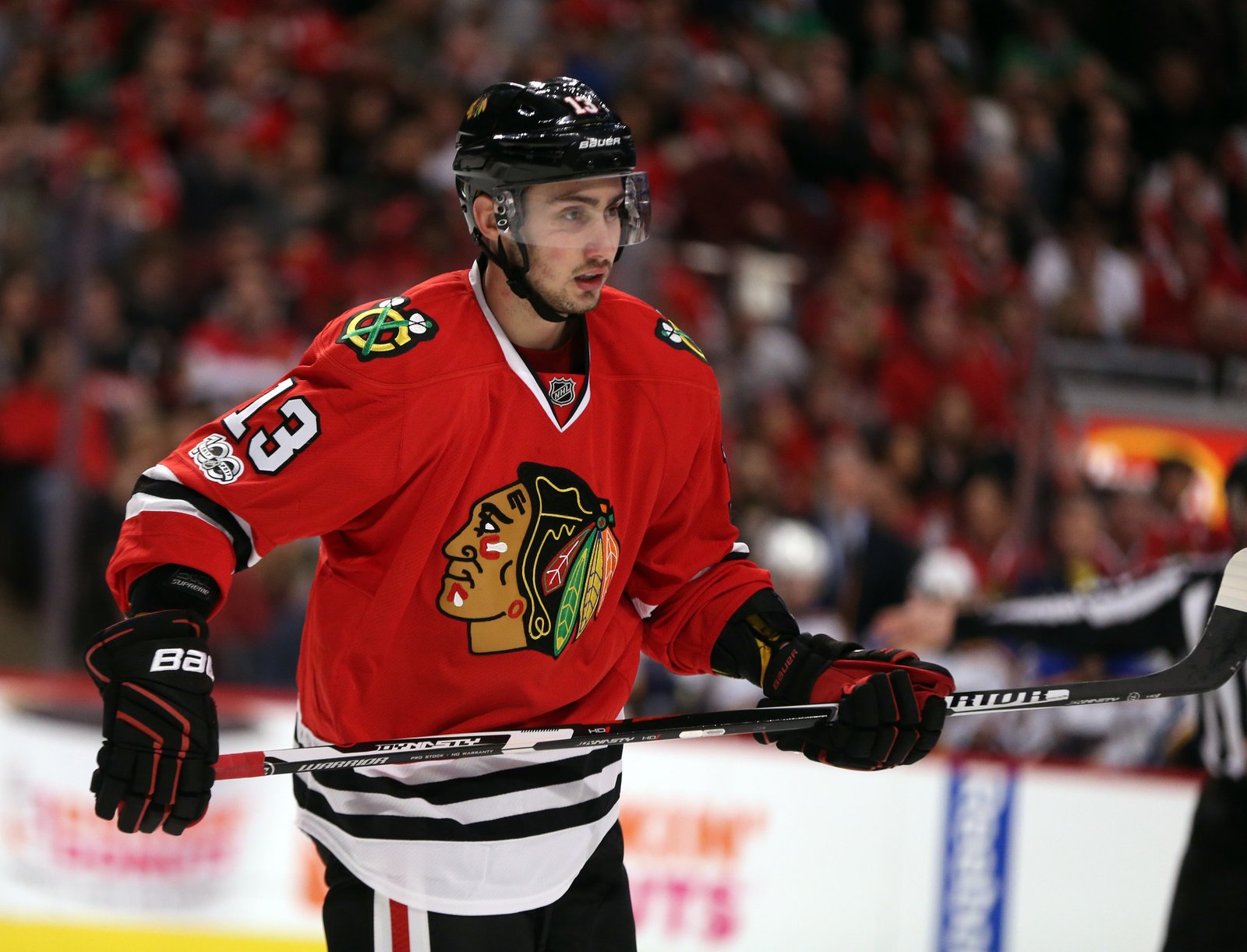
It sounds strange, as bad as the Hawks were at times. The thing was, they were rarely boring. And almost all of that came down to their young forwards who burst onto the scene. And perhaps leading that charge was Nick Schmaltz, who was finally left alone to play center (at least most of the season) and proved that’s where he should have been all along. That doesn’t mean there wasn’t incessant bitching about his habit of not shooting enough, but clearly the Hawks have a definite #2 NHL center on their hands, perhaps their best one since before Patrick Sharp decided he was too good or too handsome or too both to play there anymore.

Nick Schmaltz

78 games, 21 goals, 31 assists, 52 points, +1, 18 PIM

50.3 CF%, -2.54 CF% rel, 48.8 xGF%, -1.23 xGF% rel, 64.2 ZSR (zone-start ratio)

Certainly, the entertainment factor with Schmaltz is high. And it’s easy to overestimate his contributions by a touch because he’s so easy to notice. The Hawks might not have had a player faster with the puck consistently than Schmaltz, and his vision opened up a lot of things for his wingers. Stalberg may have been faster but wasn’t nearly as shifty, and neither was Sharp in his heyday. Whether you’re in the arena or just watching at home you know when Schmaltz is on the puck, and it’s easy to think he’s dominating games that way, or at least more is happening than actually is.

Again, you have to look at Schmaltz’s numbers closely because mostly they were accumulated with Patrick Kane, which helps. It also skews how you view his possession numbers. Schmaltz, or at least the Hawks when Schmaltz was out there, outscored what his possession and chance-numbers suggested they should. The thing is this tends to happen with Kane on the ice for years, as he’s never been a great possession player but is so lethal that he’ll usually cash in or set up teammates to do so more than the percentages suggest. Whether Schmaltz can carry this out away from Kane, should this come up at some point next season, remains a question.

There were obviously flaws to Schmaltz’s game. He’s not very big, which led to him getting beaten down low in his own zone a lot and thus getting pinned in there or shifts at a time. This was clearly Q’s main concern, either starting him in the offensive zone as much as possible or discarding him to wing at times as well. As we know, Q doesn’t really like d-men or centers that don’t do everything, and Schmaltz struggles with the own-zone portion of the game. But in an ideal world, the Hawks would have a #1 and #3 centers who could take most of that responsibility, leaving Schmaltz to start a majority of times in the offensive zone. It’s certainly a model other teams have used. So Schmaltz’s future hinges a bit on any Toews revival and/or future acquisitions and whether or not EggShell is anything.

A lot was made of Schmaltz’s pass-happy ways, though he still managed 21 goals which you’d take from a #2 center pretty much every season. The number that jumps out at you is that he shot 17.8% to get there. Given the amount of chances he was getting for himself (0.51 ixGF/60) and what he ended up scoring (0.91 iGF/60) he is going to have to get more chances to get to 20+ goals again because it’s not likely he’s gong to maintain a near 18% shooting-percentage. His rookie year saw one of half that, so let’s split the difference and say he can settle in to a 12-13% shooter.

Outlook: It would be peachy keen if Schmaltz could ascend to a true #1 center and give Toews something of a break. And the list of centers the past decade or so who put up 50+ point seasons at 21 is encouraging (here’s a look if you need). Still, it’s hard to look at Schmaltz’s size and skillset and think he won’t always need to be at least a little sheltered in terms of shifts and opposition. But being Robin to someone else’s Batman is hardly a bad role to be, and one a team needs to be successful. Yes, it counts on getting anything more from Toews, though that’s hardly an impossibility. Schmaltz will be in a contract year next season, so if he’s going to pop for ace numbers, now would be the time. But he can definitely count himself a piece.

Everything Else

The Rockford IceHogs, AHL affiliate of the Chicago Blackhawks, are playing a waiting game until later this evening. Monday night, Rockford’s Central Division Final opponent will be decided when Manitoba or Grand Rapids wrap up their Game 5 tilt.

The IceHogs have been to the second round of the Calder Cup Playoffs on two previous occasions since the Hawks affiliate arrived in the Forest City. They have never advanced past this round.

Back in 2008, Rockford’s inaugural campaign, the Hogs were eliminated by the Chicago Wolves. The piglets swept Chicago last week to advance to their current position.

In 2014-15, the IceHogs finished a single point behind Grand Rapids for the top spot in the Midwest Division with a franchise-high 46-23-0-5 mark. They swept Texas to meet the Griffins in round two. Grand Rapids then dispensed the Hogs in five games.

Will the third appearance in the second round be the charm for Rockford? The ingredients for a successful postseason run have been stewing over the course of the past six weeks.


How’s That, You Say? Here’s Why The Arrow Is Pointing North:

The IceHogs are playing their best hockey of the season.

Rockford finished the regular season 14-5-1-1 before winning three straight against the division champions in the opening round of postseason action.

They’re getting loads of veteran leadership at both ends of the ice.

Veteran players like Chris DiDomenico (arguably the Hogs best forward the past few weeks), Lance Bouma and Andreas Martinsen have added a layer of ruggedness that has served Rockford well as the physical nature of playoff hockey becomes more of a factor. Cody Franson and Adam Clendening deepened the back end dramatically.

Their special teams, particularly the power play, has kicked it up a couple of notches.

Heading into the Wolves series, I pointed out that just looking at Rockford’s pathetic man-advantage numbers would be misleading. I’m guessing Chicago knew that going in. I’m darn sure the Wolves knew that when they skated off the Allstate Arena ice following their 4-3 loss to Rockford.

The IceHogs converted their power-play chances at a rate of 39 percent (7-18) against Chicago. ‘Nuff said.

The goal-tending has been very good.

Rookie Collin Delia has earned the right to anchor the Hogs in net regardless of the opposition in the division final. He was by far the hottest goalie in town heading into the postseason, going 10-1-2 in his final 13 starts of the regular season.

In three playoff games (nearly four, with the extra sessions Thursday night), Delia posted three wins with a 1.62 GAA and a .927 save percentage.

Since the IceHogs punched their ticket to the second round, speculation on who Rockford would be better off facing has run rampant. Personally, I’d rather face the team that lost their best-of-five series. That’s not the way it works, though.

I figured that the Griffins would make quick work of a slumping Manitoba club, but the Moose have played well. Grand Rapids had to win Thursday to force a Game 5. Either of these teams are going to be a formidable opponent.

Eric Tangradi, the Griffins leading goal-scorer and a veteran of AHL playoff battles, is out for Game 5 via suspension. Both teams have won in the other’s barn this series, with Game 5 being in Grand Rapids. It could go either way, to be honest.

Later this week, when the IceHogs have an opponent, I will return with a in-depth look at what could be a historic playoff series for the folks here in Winnebago County.


Everything Else

If Erik Gustafsson becomes a solid top four defenseman for a playoff-bound Hawks next year, I expect to be put on the payroll. Because it was I who told you he sucks to high heaven when the Hawks signed him a contract extension for two years we never saw coming. And then after that he was simply everywhere, mostly good and some bad, and then he might actually be something you want to use next year.

Erik Gustafsson

35 games, 5 goals, 11 assists, 16 points, 6 PIM, +1

55.0 CF%, +6.3 CF% Rel, 52.7 xGF%, +8.4 xGF% rel

I suppose the first thing to look at with Gustafsson is his end-of-the-year pairing with Connor Murphy (UNITY!). They simply put a fist in everyone’s skull for 10-20 games, which isn’t enough to conclude it’s a permanent thing but is enough to investigate next year. They had a 57.3 CF% together, and a 58.0 scoring-chance percentage. They were a little wonky defensively, as was the whole team, in that they gave up more good chances versus the amount of chances, but the puck moved the right way when they were on the ice. And they didn’t need the boost of a lot of good zone starts, as the took less than half in the offensive zone.

And really, Gustafsson’s numbers aren’t worse with Brent Seabrook, though you remember they were a complete disaster in their own end. It didn’t really matter how often they got to the offensive zone if they were guaranteed to give up a goal anytime they were pinned in their own. And it sure felt like that.

Still, after his contract signing, Gustafsson was at least a really fun, third-pairing cowboy. And you might just need a third-pairing cowboy, at least one you can try and shape into something more. The signature was springing himself on a breakaway in that game against the Jets, because only cowboys would ever attempt it. You ever remember Duncan Keith on a breakaway?

Gustafsson didn’t show power play quarterbacking skills though, which the Hawks need. Maybe it’s in there, it’s not like he got a ton of chances, but the Hawks need to find out if he can run a second unit so they don’t have Keith running either and saving his legs. Still, of all the Hawks d-men he showed at least some skill in getting a shot through, and it’s something the Hawks should work on tirelessly in training camp and even the first month or two of next season.

Outlook: It’s going to depend on what the Hawks do via trade and free agency. If you have Gustafsson on the third pairing, that’s a really good place to be. Sadly, the Hawks probably aren’t going to be able to acquire two top-four d-men to get him there, which is what it would take. Which means you might go into next season with Murphy-Gustafsson as your second-pairing and your most obvious puck-moving one. If Gustafsson takes a half-step forward, it could work. He’s got the aggressiveness, the skating ability, and the vision to do it. And Murphy can mostly cover for him in the defensive zone, especially if Crawford is back and healthy. 5-11-16 over 35 games would average out to 11 goals and 37 points over a full season. If Gustafsson can bump that to 45 points, and he could with power play points, you’d take that on your second pairing in a heartbeat.

I’ll be waiting for my check.

Everything Else

Our next stop on the hindsight circuit brings us to Chicago’s two young Swedish defensemen, Gustav Forsling and Carl Dahlstrom. Let’s do these bad boys one at a time.

Gustav Forsling

41 Games, 3 Goals, 10 Assists, 13 Points, -2, 8 PIM

48.9 CF%, -6.8 CF% rel, 44.54 xGF%, -8.9 xGF% rel, 51.67 Zone Start Ratio

With what appeared to be a mostly patchwork blue line group heading into the 2017-18 Blackhawks season, it seemed to make sense that Gustav Forsling would get a really fair shake at proving his worth in the NHL. Some might make the case that he did get that shake, but those some would be wrong. Yes, Forsling spent a good amount of time at the NHL level last year – playing in half the games definitely strikes one as a fair shake. But the big number that sticks out there is the 51.67 Zone Start Ratio. For a player of Forsling’s skillset, that is entirely too low, even as a defenseman. Barely having more than half of his shifts start in the offensive zone screams misuse.

Add in the fact that he was saddled for much of the season with Jan Rutta, which we covered yesterday, and you have another example of the miscasting. The root of that misuse is that Joel Quenneville seems unable to see Forsling as anything other than what he isn’t, which is to say that Q sees his lack of pure defensive d-zone instincts, physicality, and overall boring defensive play and has thus far tried to coax him into developing that side of his game rather than really accentuating what he does well. Which is really strange, because it seems to me that what Forsling does well is almost exactly what the Hawks blue line really needs.

Forsling has the most beautiful skating stride on the team, sees the ice with enviable vision and anticipation, can drop a puck on his teammates tape nearly as good as anyone else on the team, and he can combine all of that moving full speed up the ice with the puck on his tape. We’ve been clamoring for Keith to have a mobile partner who might be able to cover up for his freewheeling and loss of mobility, and it seems like Forsling might be the right fit. Even if his defensive instincts are not exactly high level, he can get himself back in coverage well enough to break up or delay any rush enough to let the other four guys get back. No, it’s not the ideal scenario because it’s not Erik Karlsson or Oliver Ekman-Larsson, but he’s got the shell basics outline of the game those two play with still plenty of potential to be tapped into.

In a perfect world, Joel Quenneville realizes that he already has defensemen with skill sets more geared toward what he’s tried to get Forsling to do these past two years, and finally starts letting my special boy (yes, I am still giving him that title) off the leash a bit to play a style that fits him best. That might be with Keith, maybe with Murphy, it could even be with Seabrook if the Hawks and Seabs can get on the same page with a role like Sam outlined the other day. That’s the best and maybe only way you’re really gonna see what you have in the Fors.

But this isn’t a perfect world, so Quenneville will do the same shit for the third year and hope it works this time – something something definition of insanity – before Forsling gets sent back to A in January again. Hooray.

Carl Dahlstrom

11 Games, 0 goals, 3 assists, 3 points, -2, 0 PIM

52.29 CF%, -5.29 CF% rel, 46.7 xGF%, -6.55 xGF% rel, 46 Zone Start Ratio

There isn’t too much you can glean from just 11 NHL games for a young defenseman, especially one who was in just his second year in North America. Dahlstrom has his good and bad moments, which is really shitty analysis, but again, it was just eleven games. What more do you want from me?

Digging into the pairings a bit, Dahlstrom spent more time with our ginger darling Connor Murphy than other blue-liner while he was in Chicago, with those two racking up 50:31 of ice time together at 5v5, or about three-to-five games worth of being a pairing. Dahlstrom only played about 120 5v5 minutes total away from Murphy. They posted a 52.53 CF% together, which was better than either of their marks away from each other, though Murphy had significantly more time without Dahlstrom than vice versa, and I don’t read anything into it for #5. But what it does show for Dahlstrom is that he has the goods to play at an acceptable level in the NHL if paired with a good partner.

Overall, I don’t really know what kind of future Dahlstrom has in Chicago. You have the obvious three of Keith, Nacho, and Murphy that will be hear for the long run, plus Rutta and Oesterle who if here will probably get minutes from this coach. Then you have Forsling, Jokiharju, and Ian Mitchell that the organization appear to be very high on. On top of all that, consider that you’re probably adding at least one or two high-level guys – one NHL d-man via trade or free agency, and ideally a top d-man prospect with the lottery pick – and you have a whole hell of a lot of guys in front of Dahlstrom. But besides that, how was the play Mrs. Lincoln?

In all seriousness, the bottom pairing and depth d-man spots should be wide open for competition in camp next year, and Dahlstrom will likely be given the same shot as anyone to earn one of those spots. It’ll be up to him to do so.