Everything Else

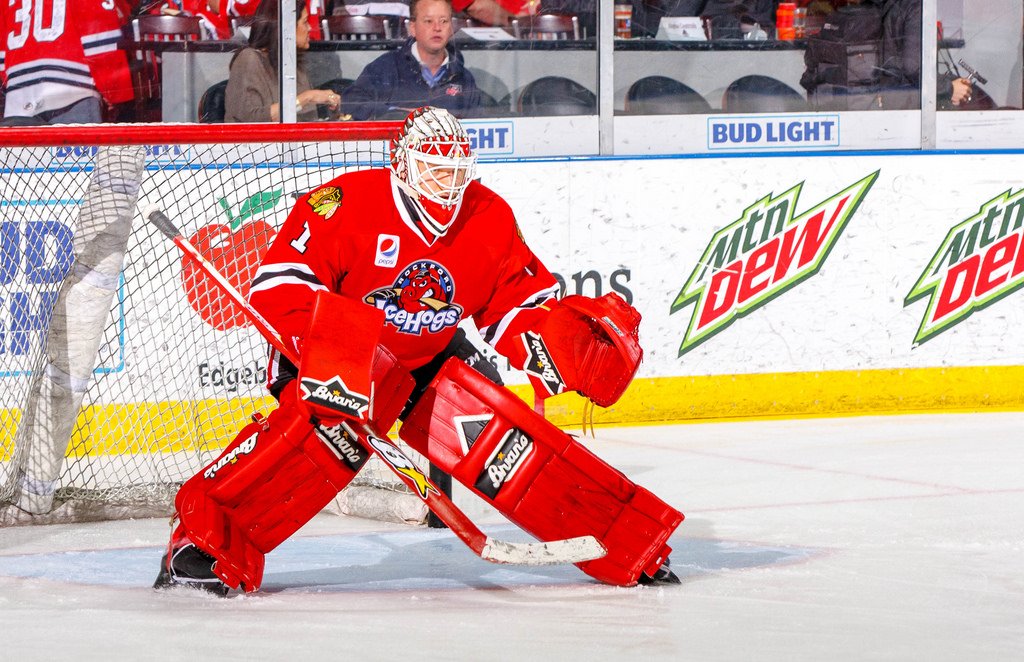
The Rockford IceHogs had a bit of a revolving door when it came to the crease this past season. Injuries to some key personnel made for some vertical movement for several of the goalies in the organization.

As the first installment of some “in-depth” looks at the Hawks AHL affiliate, let’s cast our gaze squarely between the pipes and the four players that patrolled that area for Rockford in 2017-18.


Collin Delia-28 Games (17-7-4), 2.72 GAA, .900 Save Percentage

Timing is everything in the development of a prospect. Case in point…the rookie campaign of Collin Delia.

Delia earned himself an entry contract with some strong showings in the Hawks past two prospect camps. He began the season as quite the rambling man, working out with the Hogs staff and trekking to the Indy Fuel of the ECHL for game action.

It was not a successful formula for Delia.

Yes, the same 23-year old who stood so tall in the first two rounds of Rockford’s playoff run was flat-out terrible in Indy. In ten starts, he was giving up over four goals a game and sported an .887 save percentage. In a spot start for the Hogs in Iowa on November 9, he gave up four goals on 16 shots and looked completely overwhelmed.

When he was pressed into action against the Wild on December 28, Delia had not played a game in Indy or Rockford in over a month. At that point, he was only playing because the cupboard was bare. J.F. Berube was injured and Jeff Glass was in Chicago. The IceHogs had to go with Delia and Matt Tomkins in net and try like hell to limit quality shot attempts.

Again, with a veteran at Jeremy Colliton’s disposal, I doubt Delia would have had many starts in the two months that Berube missed. Opportunity was rapping at Delia’s door…and you know what? The kid responded big-time and began getting his act together.

It took several games (with the Hogs D playing a big part in limiting high percentage shots), but Delia began to look a bit more comfortable in the crease. He put up a 5-0-1 stretch from January 6 to the 26th, then took his game up a notch from there.

In his last 15 starts, Delia was 11-3-3 and limited opponents to three goals or less in 12 of those contests. His eight starts against Chicago and Manitoba in the Calder Cup Playoffs proved to be the high-water mark. Delia took over in the first two rounds, led the Hogs to the conference final and completed an astounding turnaround to his first professional season.

Delia’s style has him winding up on his backside quite a bit. It’s something I think he needs to address in Rockford this fall. However, I believe that Delia has shown the potential the organization saw when they offered him an NHL contract.


Jean-Francios Berube-15 Games (7-8), 2.37 GAA, .920 Save Percentage

The former Islanders farmhand helped get Rockford off to a strong opening, winning his first five starts. Berube then dropped five straight decisions, though he was playing solid in the net when he was called up for a week of backup service in Chicago.

Returning to the IceHogs December 8, Berube stopped 18 shots in the first half of the next night’s start against Grand Rapids when he suffered a knee injury that kept him out of action for the next two months. He came back in February, lost two starts despite playing well, then was moved up to back up Anton Forsberg the rest of the season.

That December injury was pivotal for several reasons. A healthy Berube would likely have gone up to Chicago when Corey Crawford went down later that month. Rockford would then have ridden Jeff Glass for the majority of the last four months of the regular season. Glass and his feel-good run with the Hawks may not have come to fruition.

Flip Berube and Glass if it pleases you, though Berube was by far the better candidate for a recall prior to his injury. Either way, there is no way that Delia would have been able to work his way into the role he enjoyed (and certainly deserved) in the latter stages of the season.


Jeff Glass-28 Games (15-9-2), 2.82 GAA, .904 Save Percentage

Glass had his own success story in reaching the NHL this season. In Rockford, he served as half of a pretty successful veteran tandem in net until Berube got hurt.

Starting in the second period of the game Berube was injured to when he was recalled to the Blackhawks, Glass had a 2.39 GAA and a .935 save percentage in six games, during which Delia was planted firmly to the bench.

Glass surrendered eight goals against Manitoba when the Moose were an offensive juggernaut in November and ten more in his first two games back with Rockford in February. Aside from that, he was a steady presence in goal. Glass held opponents to three goals or less in 23 of his 28 appearances and to two goals or less in 14 games.

Glass was also a much-needed veteran voice in the locker room who came into the Western Conference Final after sitting for a month and was tremendous in his four starts. I’m not sure how much interest he’ll draw as a potential NHL backup heading into this summer, but he is a solid addition to an AHL roster.


Matt Tomkins-Eight Games (1-4-2), 4.04 GAA, .871 Save Percentage

Chicago’s seventh-round selection in the 2012 NHL Draft was on an AHL deal after completing his college career at Ohio State. Tomkins was injured for six weeks early in the season while in Indy but was playing well for the Fuel when he was recalled to Rockford to form a rookie goalie platoon with Delia in late December.

The Chicago Wolves put up six goals in to spoil his debut December 30. His best start came against Cleveland January 19, when he stopped 32 of 35 shots and helped the Hogs rally from a 2-0 deficit to beat the Monsters 4-3.

Tomkins dropped his last two starts for Rockford before Berube’s return sent him back to the ECHL February 8. He did see action late in the season, losing a 4-3 decision to Texas April 7 as the Stars rallied for three goals in the final period.

Tomkins’ Indy stat line (11-9-2, 3.47 GAA, .912 save percentage) was about par for a Fuel squad that gave up 3.41 goals a game this season. He didn’t show enough to merit an entry contract from the Hawks, in my opinion, but who’s to rule out another one-year AHL deal?


So…How Does The Goalie Situation Look Like For 2018-19?

The two goalies behind Corey Crawford, as was the case last year, are Forsberg and Berube…at least for the moment. Both are under contract for next season, as is Delia and recently signed Finnish goalie Kevin Lankinen.

Unless one of these players are moved in a trade, it’s difficult to see Glass remaining in the organization. I’m guessing that the Blackhawks have seen what his ceiling is. As I mentioned before, Glass is a solid veteran at the AHL level but a Delia-Lankinen pairing in Rockford would be best for developing potential NHL talent.

The Ivan Nailimov situation could be an x-factor in the goalie picture. It has been reported that Nailimov, a 2014 sixth-rounder, wishes to be traded. Even from Russia, the 23-year-old can see a crowded crease behind Crawford in terms of securing an NHL job in Chicago.

Could Delia, one of the Hogs postseason heroes, find himself with the Fuel again this fall? In the present configuration, someone is destined for Indy. It’s hard to see Chicago signing Lankinen to throw him to the ECHL. Delia has proved he’s capable of handling substantial AHL minutes, but I don’t believe he’s vaulted over Forsberg or Berube on the depth chart.

To assume that Chicago maintains their goal-tending collection with no changes may be a bit foolhardy. The Hawks appear to want an upgrade at the spot behind Crawford (Carter Hutton, anyone?), which could further muddy the waters. Expect a deal involving Forsberg, Berube or Delia sometime this summer, or possibly after the three get a hard look in training camp.

Depending on how much baseball I find myself watching in the next few days, I’ll take a gander at the defensive landscape Monday morning and the forwards sometime after that. Meanwhile, follow me @JonFromi on twitter for any thoughts I can belch out over the summer.


Everything Else

Let’s pause from the offseason merry-go-round for a bit and talk about Dan Carcillo’s cause/drive/plea, whatever term is best. If you haven’t seen it, he posted a video to Twitter this week that’s worth the time:

At the top, it is clear that Carcillo is sincere, he is angry, he is still grieving, and he is concerned. He wants to see change and is willing to do the work and convincing to see it through. Overall, it should be highly commended.

Still, there’s a couple aspects where I feel Car Bomb is just a little off the path.

One, I’m not sure he’s attacking the right thing here. Clearly, the NHL and NHLPA have a lot of work to do. The NHL already has a lawsuit to deal with that almost assuredly will not go well for them, and the union could obviously do more to open the NHL up with information and actual, concerted plan for how to deal with head injuries. This half-in, half-out, quiet room if it’s a third-liner and it’s not the playoffs garbage clearly isn’t working.

And yet, the NHLPA works for the players, at least in theory. And it brings into question what the endgame for Carcillo and others is. Essentially, much like the NFL, it feels that the result should be that all players coming into the league, as well as parents and children just starting the game, know what the risks down the road are. You can’t remove head injuries from hockey. The game moves too fast and especially at the higher levels they guys are too big. There are obviously things the NHL, and NCAA and juniors and all the way down can do, and we’ll get to that. But you’re never going to remove risk from the game, just as you can’t in football.

Parents can make informed decisions, so can players as they get older. And the thing is, if given all the information and warned of what can be waiting when the playing career is over (and no matter how concussed you are, you can still be a GM of course), if a player has a chance at the NHL, I think we know what their choice is going to be. I think you’d find the same with football as well. Most, and maybe an overwhelming most, are going to still play and take the glory, money, fame, whatever else. And while that might not be the choice for us, it’s certainly one we can understand. Players want to keep playing, and while we may say they have to be protected from themselves, how many honestly would agree to that?

Really, it seems to be a debate of what we, the viewing public, can live with instead of what the players want, and yet it’s never framed that way. At this point, players in both the NHL and the NFL would have to have their head in the sand to not know what they’re risking, at least in some ways. Clearly there could be more done, but it no longer is a secret. And they’re still out there. More and more I hear people saying they can’t watch football because of what they now know it’s doing to the players. That could easily come to hockey, too. And that’s our choice. Pretty soon, everyone on the ice and in the stands is going to know exactly what’s going on, what’s at stake, and it’s up to them whether they want it in their lives or not.

Secondly, Carcillo only makes a passing mention of how he played the game, though finally acknowledging at long last that he did cause injuries to others. He fails to mention all the injuries he tried to cause, but baby steps to the elevator. We’ll get there.

And that doesn’t mean that Carcillo’s career and/or style should disqualify him from speaking out or leading this charge. In fact, he might be the right voice to do so. But only if he fully recognizes what he did on the ice, and is then speaking to those who are doing the same now (hi there, Tom Wilson, Brad Marchand, Ryan Reaves, I could go on…). I think we’ll all accept the occasional hit that goes bad or collisions. What the game has to rid itself of is deliberate attempts to injure, and more ex-players who did that speaking out would be a huge step in that. A sort of, “I was once like you and now look at what I have…” kind of thing.

Yes, the NHL needs a better head trauma protocol. But it also needs its players to want it. Players don’t want to leave the ice. They don’t want to get checked out. They jake their baseline tests to appear less hurt than they are when they have to take them again. And while Carcillo wants to lay all of the blame at the feet of the union and league, the “Warrior Mentality” is just as at fault. That players and fans either label those who want any attempt at a headshot out of the game weak or those that do are afraid of speaking up. Players don’t want teammates suspended for 20 games or more, which is what it will take and what Wilson or others should have already banked. Coaches and GMs need to stop employing and deploying players who do nothing else, forcing others to respond in kind.

The problems are there, and it’s a very good thing that Carcillo wants them addressed and now. But they’re more widespread than he either realizes or wants to admit.

Everything Else

It feels like Stan Bowman is going to have another “June 23rd” in the coming week. That was the day last year when he went more aggressive than we’d seen before, some might say he went “a little funny in the head,” and shipped out Artemi Panarin and Niklas Hjalmarsson (hilariously not telling his coach) for Brandon Saad and Connor Murphy. We’ve already been down the road on whether these were good trades or not, so we don’t have to do that again right now.

What’s clear is that Stan knows the temperature under his office chair is getting turned up, and Rocky Wirtz going “Kiss Of Death” after his flavorless Manhattan of a season in Crain’s made that abundantly clear, as well as John McDonough stomping around the Hawks offices like Dracula and Miranda Priestly’s lovechild.

So earlier in the week we talked about Justin Faulk, as that’s been the big rumor. Yesterday, the Sun-Times’s Mark Lazerus (closer than you know…love each other so…Mark Lazerus) put forth a rumor that Faulk might cost the Hawks one Brandon Saad. When reading that for all of us here, we cringe a bit, mostly because we love Saad and mostly because we feel that trading him after this season would A) be selling low and B) evidence that the Hawks don’t really have any sort of plan.

And yet, when you begin to think about it, this might make more sense. While Faulk didn’t have his best year last year, that kind of return for Saad certainly wouldn’t be selling low, per se. As previously stated, the Hawks don’t have a lot of pieces. While we dream about centering a deal around Artem Anisimov, fooling some GM with his goal totals and size for the far too many GMs who are still concerned about that sort of thing, it’s unlikely. The Hawks simply can’t lose Schmaltz, because they don’t have much depth down the middle. DeBrincat is almost certainly untouchable, given that he could very well be a 35-goal scorer if deployed properly. To give you some idea how valuable that is, there were only seven 35-goal scorers in the league this year. Dylan Sikura wouldn’t have much value, one would think. Below the main roster, it’s hard to see what else the Hawks can throw at a team. There’s no surefire prospect, though we’ll get to Jokiharju in a second.

Still, the loss of Saad makes the Hawks look awfully short at forward. You have….this?

– Toews – Hinostroza?

DeBrincat – Schmaltz – Kane

Sikura – Anisimov/Ejdsell – Duclair?

Jurco – Anisimov/Ejdsell – DUHHHHHH?

No offense, but I’m not going to make plans for that team in May. I guess this is the balance. Toss in David Kampf and an almost certainly returning Tommy Wingels (it’s a name, not a condition) and you’re still not inspired to write poetry about it. If the Hawks had another kid you were confident could step in to a top six role, you’d be more comfortable losing Saad, but he doesn’t exist yet.

You could argue the Hawks should just load the top line and let the rest fall where it may and have Top Cat, Toews, and Kane up there and just pray they jump into hyperspace, and maybe that’s the plan. I guess I can live with a second line of Sikura-Schmaltz-Hinostroza… I just won’t live comfortably. Or happily. Or healthily.

Which brings us around to Henri Jokiharju, who signed his entry-level deal yesterday. Now, normally, I would bet pretty good money the Hawks bring him to camp, throw him out in a couple preseason games, and then punt him back to Portland for his last year in the WHL. But this is not a normal time, and both Q and Stan might have to get outside their comfort zone here.

Yes, Jokiharju is only 19. But his numbers compare favorably with Mikhail Sergachev, who played a role on the best regular season team in the league. And Jokiharju did it in the WHL, which is a much tougher scoring environment than the OHL where Sergachev was. He also squares with Ivan Provorov, who has been the Flyers best d-man the past two years (and don’t give me any Ghost Bear bullshit).

Basically, what I’m saying is the Hawks are desperate, and it may come to toss Jokiharju in the deep end and leave with it. That doesn’t mean pairing him with Keith, but a heavily sheltered role with Murphy on his off-side or Dahlstrom or something I haven’t thought of and see where you are after 40 games. If he plays his way up the lineup, even better. But even at his tender age, he almost certainly can give you something in the same usage that Sergachev provided, assuming that Quenneville wouldn’t turn psychedelic purple at the thought of using a d-man who isn’t 20 yet. He did it before with Leddy…though we all know how that went at first.

While Stan might say something about “development,” he isn’t going to be here for the end of Jokiharju’s apprenticeship at lower levels if the Hawks don’t turn it around.

It would take quite the set of tires to pin that much on Jokiharju before he’s ever played professionally, but if the Hawks sold out on him in their minds they might consider cheaper additions on the blue line, like de Haan or Hickey from the Islanders or whatever they could fashion out of Anisimov (which is clearly Nurse from Edmonton because Peter Chiarelli would totally do that) and keep Saad around.

It’s not going to be boring.

Everything Else

Alex Ovechkin had barely gotten the Chalice over his head before we got some pretty tasty rumors about the Westside Club de Hockey. And they certainly bring some excitement and questions, and there’s nothing we love than the two of those together.

So let’s start with Scott Powers, who hasn’t been alone in reporting that the Hawks have called the Carolina Hurricanes about Justin Faulk and Scott Darling. Elliote Friedman was also in on rumors that Darling could beat a hasty retreat to his beloved land of beef and deep dish. There’s some smoke here, so let’s talk about the fire (YOU’LL JUST HAVE TO IMAGINE THE FIRE…). Faulk is easy enough so let’s do that second.

The possibility of bringing Scott Darling home would simply have to mean that at best, the Hawks have no idea when Corey Crawford is going to be ready to play again, or if. The worst case is they know he won’t anytime soon…or again. If the Hawks are looking not just for a quality backup, but one that can step in and take the starting role and do a passable impression, then you know something is up with Crow. And if it’s Darling they’re talking about, that’s $4.1 million worth of goaltender you’d be bringing in and you wouldn’t be bringing in that kind of number to merely be a backstop.

Now, if you’re sitting there wondering to yourself, “Darling didn’t kind of blow his chance at being a starter?” well, I won’t necessarily tell you you’re wrong. What I will say is the Carolina doesn’t do any of its goaltenders any favors with the way they played, and Darling was never the type you’d want to perform miracles night after night. That said, unless they completely overhaul the defense, including mailing Brent Seabrook to Zanzibar with Jordan Oesterle or something, it’s highly unlikely the Hawks are going to be all that defensively sound either. And given how the forwards shake out, the Hawks might have to play an even more up-tempo style to match what the Penguins or Knights or Preds do. Which means you need more circus acts from your goalie, which is what got the Canes in this hole in the first place. Duncan Keith isn’t going to rediscover Norris form next year, though he can still be good. Erik Gustafsson is still not going to be able to spell “defense.” Whatever Forsling improves, it’s still going to be a learning curve.

The other nugget here is that Friedman suggests Darling could be had for Marian Hossa’s contract. Which…I mean I guess? The appeal for the Canes is that though they would gain about a million and a half in cap hit, in actual dollars they’d spend three million less given that Hossa’s salary is only $1 million. And I mean…sure? If they’re that desperate to lose Darling, but we’re still talking about a goalie who’s only had one bad season and I don’t know that there are many alternatives out there for them.

One would be Phillip Grubauer, but he could be a cheaper alternative for the Hawks as well, at least in terms of dollars. But the Caps would want actual assets in return for a promising goaltender who had a wonderful regular season and is just 26. He’s also RFA, so he that might lessen the assets needed to get him and also makes his salary cheaper. But Grubauer is going to want to at least have a chance to compete to start, and if Crow is ever going to play again (and this is how we should really start framing the discussion) he’s still going to slide right back into being the #1. But, as said, Grubauer is restricted so you can sign him for two years or whatever and tell him to just wait it out. And given when those two years are up Crow would be 35, perhaps he’s ready to take over then. But again, it’s a thin goalie market, and there will be plenty of teams calling about Grubs, which will only drive the price up.

As for Faulk, well, we’ve only been screaming for the Hawks to get him for like five years now. He might not solve everything but he solves a ton. He’s a right-handed puck mover you could play with Keith, or Murphy on his off-side, or Dahlstrom, or some other combos. He’s a real live power play QB and not one play-acting at it like Keith. He’s sound defensively as well. You could already see pairing him with Keith, leaving Murphy and Gustafsson to be ya-ha time on the second pairing and leaving Seabrook on a third pairing where he actually can still be useful given the right partner.

Of course, you can’t just HAVE Justin Faulk. The Canes are looking to cash in on this, and distressingly Powers says in his article the Hawks won’t move the #8 pick. WELL WHY THE FUCK NOT?! By the time whoever they take at #8 (it’s so going to be Tkachuk’s asshole son, the second one) is actually ready to contribute at the NHL level, everyone very well might be out of a job. While planning for the long term is nice in your life and maybe even mine (never tried it), this team doesn’t have a long-term. Two seasons from now when everyone is in their mid-30s or worse they’re going to suck and suck hard, and no amount of clever drafting is going to prevent that unless they really get some somewhere-over-the-rainbow luck happening. The #8 pick alone isn’t going to get you Faulk, but it might take the place of a body you don’t want to give up. I’m sure the names on Carolina’s list start with “Schmaltz, DeBrincat, and maybe even Sikura.” Anisimov isn’t going to get it done either, though man that would be wonderful.

I suppose if I squint you could justify losing Schmaltz if you thought Ejdsell was ready for primetime now, and if you thought Quenneville could disabuse himself from the notion that Anisimov is a #2 center in the Western Conference. Those seem like big, motherfuckin’ ifs.

But hey, at least the kettle is percolating over on Madison. We’ll see what the construction workers yelling at McDonough want.

Everything Else

So is this reverse Groundhog’s Day, when Rocky Wirtz comes out of his office to say something publicly? And are there construction workers outside his office yelling at him about Andrew Shaw? Inquiring minds want to know.

Anyway, if you didn’t see it, Rocky had an interview in Crain’s today. And really, the only newsworthy bit about it is that Rocky spoke publicly at all, which he’s not really prone to do. But what people will focus on is that Rocky hints that there will be changes, where exactly he doesn’t say, if the Hawks don’t come strong out of the gates next season.

And really, this isn’t a surprise. The Hawks haven’t been a factor in the playoffs in three seasons, which puts them basically on par with a lot of shitty teams. Here are a list of teams that haven’t even spasmed a playoff series win in the past three seasons: Florida, Carolina, Flyers, New Jersey, Columbus, Toronto, Montreal, Buffalo, Detroit, Minnesota, Arizona, Vancouver, LA. This is definitely not a group you want to be among. And on this list, you could easily say that Philly, New Jersey, and Toronto have much brighter futures than the Hawks do at the moment.

So clearly, the Hawks need to change their fortunes, and I don’t think it’s suggesting much to say that Q might want to get his troops roaring out of the gates or he might want to get a resume ready. Sure, maybe you could axe Stan instead or at the same time, but firing a GM in the middle of a season hardly makes any sense because there’s not much a GM can do if he takes the job in November unless you’re looking to really wheel and deal at the deadline. And almost always that’s a tear-down, and this Hawks team can’t be torn down even if that’s something they would ever consider (and it isn’t). The Hawks’ wheeling and dealing will come this summer, or it had better, and Stan will deserve one season to see how that turns out. A new coach can at least take the same toys and deploy them differently–so maybe this time next year Hawks fans aren’t watching a d-man who their coach only paid attention to long enough to urinate on star on the top four of the team leading 2-1 in the Final, for example.

This is the NHL. You don’t get four seasons of not mattering unless you’re the Sabres or in some forgotten outpost like Sunrise or Glendale. Especially when you’re doling out some of the contracts the Hawks are at the moment.

Of course, it wouldn’t be a Rocky interview–especially in Crain’s–if he didn’t get to cry poor a bit and lo and behold, there’s the “only 85%” renewal factoid. Of course, that 15% (something about that number in this town. IT’S A FUCKIN’ PLAYGROUND!) was immediately gobbled up by the waiting list but at least Rocky noticed. It was somewhat shocking that Rocky didn’t go back to the “we still lose money” shelter he’s been using since he took over, even with ticket prices tripling or more in the 11 years he’s had the team.

What’s clear, and I’ll give Rocky this, is that the Hawks sure can use playoff revenue. Whether I think they’re actually in the red or not (I don’t), I wouldn’t presume to think they’re so much in the black that five or six home dates in the playoffs don’t make a difference. Seeing as how the Hawks have had five playoff home dates in three seasons, you can bet it’s made a difference on the big black ledger. Yes, I’m absolutely sure the Hawks still do their numbers by hand because why not?

So it’s only natural for the owner, the one signing the checks after all, is going to balk at losing out on that. We know that McDonough has made basically everyone’s life hell over there this season with the Hawks’ failings, so everyone is on high-alert.

I’m sure I could read into it more about Rocky’s comments on the contracts the Hawks have handed out, but there’s no point. Rocky isn’t going to sell Bowman or McDonough out like that by saying, “Well Seabrook’s contract is a goddamn iceberg and he’s not even that mobile so fuck!”

And in general, though not always, Rocky has been pretty hands-off and certainly hasn’t attacked the spotlight like other owners would or could have with the success he’s had. Sure, he stepped in it a bit with his comments about Patrick Kane, but he’s hardly alone and I honestly don’t know what else he would have done. Other than that and his occasional poor-crying, Rocky has been happy staying in the background and I’d rather have that than a hockey Mark Cuban, or wannabe G.I. Joe in Florida, or whatever this new nutjob in Carolina is going to do.

Unlike his president, Rocky is certainly smart enough to tell you what he doesn’t know. I guess we should worry about who will be making the decisions should massive changes come, whenever that day is. But then Rocky is the guy who knows that he needs to find the guys who know to make those. He’s not his father, after all.

Everything Else

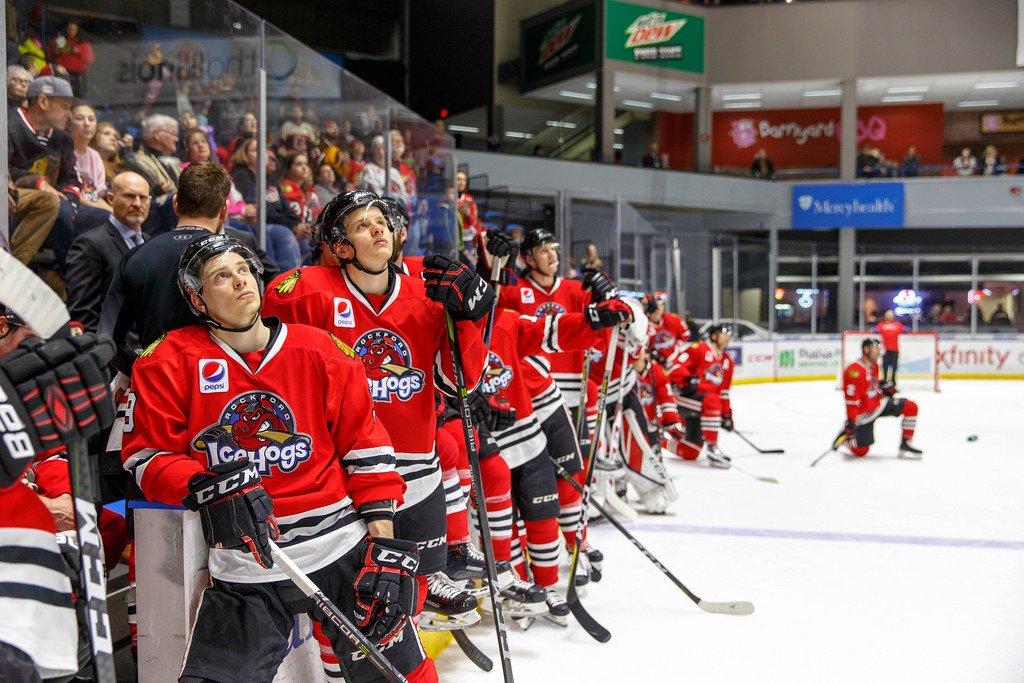
The Rockford IceHogs had themselves one heck of a playoff run to cap the 2017-18 season. They came up a bit short of hoisting a Calder Cup, but still wound up as one of the last four teams standing in the AHL’s postseason tournament.

(tap…tap…tap…)

The piglets were eliminated by Texas in six games in the Western Conference Final, but showed the high level of compete that marked this year’s club. Three of Rockford’s four losses, including Game Six May 28, came via overtime. The Hogs did themselves proud by taking the franchise into previously unexplored territory.

(tap…tap…tap)

After a dismal showing last season, Rockford cleaned house, installing a new coach and overhauling the roster. The result was a team that finished fifteen games better than the 2016-17 edition of the IceHogs, then ripped through the first two rounds of the Calder Cup Playoffs.

(tap…tap…tap)

Stick taps for a successful season, perhaps? You could make that assumption. However, that’s not what I’m driving at. What I’m doing here is tapping on the brakes.

Don’t get me wrong; this was a special season and was a huge breath of fresh air after the calamity of a season ago. There’s truly a lot to be excited about. Several young prospects had promising results in 2017-18. That said, the Hawks organization seemed to learn a lesson regarding the construction of the minor-league roster.

Or, maybe the organization’s hand was guided by Chicago missing out on the playoffs. Either way, the fans in Rockford saw things go down differently than it did in 2016-17.

Remember in The Lion King where Mufasa claws his way up the canyon wall, only to be nudged to his death by Scar in one of the classic jerk moves of the animated medium? That will do nicely…but imagine this…

What if, instead of Mufasa, Simba manages to approach the crest of the canyon wall. What if Scar not only offers his help in securing safe ground for his nephew, but buys him a caribou popsicle and generally provides valuable support to the growing cub?

Well, Hawks GM Stan Bowman is Scar in the above scenarios. Change out Simba for the ‘Bago Flying Piglets of 2017-18. Last season’s Hogs were no Mufasa; a better analogy would be if one of the crazy hyenas had scratched its way up the ridge.

Bowman scuttled the ship (one that was undermanned to begin with, but I digress) in late February of 2017, trading away the team’s top scorers. This past season, he bolstered the roster with some veteran additions. Did it make a difference? Yup.

Here’s how the final 20 games of the season went for those two clubs:

2016-17: 4-15-1

2017-18:14-5-1

Those veteran additions spearheaded Rockford’s late-season surge and the remarkable playoff run that followed. Credit goes to first-year Hogs coach Jeremy Colliton, rookie goalie Collin Delia’s stunning development over the course of the campaign and prospects like Matthew Highmore and Anthony Louis. That said, without Cody Franson, Adam Clendening and Chris DiDomenico (and to a lesser extent, Lance Bouma), Rockford probably doesn’t sniff the postseason this spring.

Colliton impressed me with his handling of a baby-faced roster throughout the season. However, if he had been dealt last year’s hand, could he have guided that group to a playoff berth?

Bowman set Colliton up with a bevy of first and second-year players out of training camp. Colliton stressed a fast-paced attack and saw his team go through its ups and downs, all the while showing a knack for playing hard to the final buzzer. He did a fine job with a very young club.

What was sorely needed, as I pointed out when the team began play this season, was experience. From this year’s season preview:

What the team seems to be lacking is that contingent of veteran leaders. Players who have logged some mileage in the NHL and can help season a young team. Usually, the Blackhawks sign a player of that type in the summer to a two-way deal knowing full well he’ll spend the season in Rockford.

Could a player like Lance Bouma, Tommy Wingles or Jordan Tootoo find his way through waivers and onto the Hogs roster? Maybe Chicago brings a veteran piece aboard this week. For now, this is a team very short on elder statesmen.

Andreas Martinsen, who came to town via a trade with Montreal, was the guy who filled that role for most of the season, though it was evident that a few more skaters of his experience would really help the IceHogs.

Tootoo was eventually waived but never appeared in a game. Bouma, while not showing up much on the scoreboard in the playoffs, was a key contributor once he was waived and assigned to the AHL.

Rockford was 26-23-3-3 following a 6-3 loss to Wilkes-Barre/Scranton on February 23. Injecting a veteran presence into the Hogs roster was the converse of Bowman’s deadline plan the year before, with dramatic results.

Here’s a question I posed in that season preview back in October:

Do the Blackhawks nab a veteran stick on this side of the puck who could provide some steady offensive push, a la Spencer Abbott last season? All signs point to no, but that may need to change if goals were as hard to come by as they were in 2016-17.

It took until late February, but Bowman added not one, but three players to boost the offensive punch. Franson (reassigned from Chicago) and Clendening (obtained for Laurent Dauphin) completely changed the power play, which struggled mightily up to that point in the season.

The addition of DiDominico turned out to be the biggest move of them all. When Ville Pokka was traded to Ottawa for the veteran forward, it didn’t seem to be the kind of move that transformed a season. I wasn’t sure what DiDomenico would be able to bring to Rockford.

What he brought was a healthy dose of red-ass that had been lacking on the roster. He also went on a scoring binge I never saw coming; 23 points (8 G, 15 A) in 22 games in the regular season, then 18 more (7 G, 11 A) in 13 postseason games. I can’t overstate how the additions of DiDomenico, Franson and Clendening changed the Hogs for the better.

There are really two teams to analyze here; the band of youngsters that went through the first five months of the season and the veteran-led squad that finished the last three months in dominating fashion. Colliton proved to have the savvy to effectively helm both incarnations (though he never got around to naming an official captain).

There is much to like about the former; Highmore’s outstanding rookie season and Delia taking advantage of injuries in the system and completely turning his season around. Louis paced the team in points during the regular season.

Rockford’s AHL signees made an impact not previously seen. Tyler Sikura was the team’s MVP and William Pelletier’s non-stop motor was tailor-made for Colliton’s style of play. Darren Raddysh stayed in the lineup for the bulk of 2017-18. Like Sikura, Raddysh earned an NHL entry deal for the effort (Pelletier’s AHL contract was extended through the 2018-19 season as well).

Upon the arrival of the aforementioned veterans, NHL players like John Hayden and David Kampf along with Swedish prospect Victor Ejdsell, the depth chart deepened significantly. Top-six skaters earlier in the schedule were filling out the third and fourth lines by the end of the season.

As a franchise, the IceHogs front office has to be doing cartwheels. After a drop of almost 1,200 fans a night over two seasons, fans made the pilgrimage to the BMO Harris Bank Center to support the Hogs during the playoffs. You would have to think that this exciting season of action is going to boost ticket sales in 2018-19.

So far as prospects, I’d say that the season was promising, though the real proof of prospect development will come this fall when most of the catalysts of the postseason run will be elsewhere. A lot of folks who caught Hogs fever the last couple of months may be salivating at what could be next season, but the team we saw down the stretch is not the team we will see come October.

Players like Luke Johnson and Viktor Svedverg made great strides in their games and were key contributors throughout the campaign. There are a lot of sophomore seasons (Alexandre Fortin, Luke Snuggerud, Graham Knott, Matheson Iacopelli) that will weigh heavily in terms of Rockford’s fortunes in 2018-19.

I will start plowing though the 89 games that comprise the piglets journey this week. I’ll be back with the tale of the tape in several installments, starting with the goalie situation as it is currently comprised.


Everything Else

It’s something of a spring tradition, at least it is when your team doesn’t go anywhere or misses the dance altogether. There’s always a player or two or six who make it to the Final and some of those even win it (funny how that works). And you sit there and curse the brainpower of your local/favorite organization, and are convinced if only they saw the world they way you saw it, there’d be a never-ending parade. Often, this involves a player you didn’t even like when they sported the colors you prefer, and what you often do is lament that your coaching staff doesn’t know how to get the best or even good out of said player.

The case of Michal Kempny is a little more tasty than that.

Most players don’t get a 180 from one Edward Olczyk. And yet that’s what we had last night, as Eddie lauded Kempny’s performance in Game 7 and throughout the playoffs, and remarked he was more comfortable in Washington because he knew “one mistake wouldn’t mean getting benched.” That certainly wasn’t the theme in the booth when Kempny was here, and Eddie wasn’t alone as pretty much everyone covering the Hawks leapt to point out his foibles when the coach was basically throwing him under the bus. And the mistakes weren’t always there.

There is more to unpack here than the untrained eye might guess. And we’ll get to all of it. But let’s not bury the lede.

Michal Kempny’s resurgence, or I guess simply “surgence,” with the Capitals would raise the curtain or lid on what was and might still be a dysfunctional system between the Hawks front office and behind their bench. While we try and guess or claim we know what goes on, it’s probably safe to conclude the Hawks always try and reach a consensus. They have many voices in there, Bowman and Quenneville are the two biggest, but MacIassac and Maciver get heard as well (Irish much?), as well as Kelley, the elder Bowman (even if he’s what they’re moving Sue over at the Field to display), Stewart, Hallin, et al.

Still, Kempny was a player that Bowman clearly wanted, given that he signed him twice, and their European scouting recommended. As as we’ve said in previous posts, the Hawks’ European scouting is probably the strongest of the three areas (pro and amateur the others). They had clear plans for Kempny.

And yet he could never win any affection, or barely attention, from Quenneville. We rarely saw him in anything more than a third-pairing role, even though this was a blue line that’s been screaming for mobility for two seasons. He even played with a snarl in his own end that Q supposedly loves. Kempny only played more than 18 minutes with the Hawks five times this season, and he exceeded that six times with the Caps in just a quarter of the season, basically. In these playoffs he’s exceeded 20 minutes five times, with only one of those being an overtime game. It is clear that Barry Trotz is not a moron, so what does he see that Q couldn’t.. or more to the point, wouldn’t?

We had written at many points last year how Kempny’s pairing with Seabrook, despite all logic, actually worked. The dude carried a 58% share with Michal Rozsvial for fuck’s sake! He clearly had use.

And yet he was another player that the front office, whoever were his fans and whoever weren’t, had to toss overboard because they knew simply the coach would never give him a chance. And because of that, they had to know he wouldn’t re-sign here and had to cash in whatever they could. Most players the Hawks have lost over the years were due to cap considerations, but their coach’s use and view of them always played a part. And for the most part, the Hawks have gotten it right. Kempny now, Teuvo this season are generally the exception of who’s gone on to be successful. And we’ve written this article before.

It’s the sideswipe from Olczyk that makes this more interesting, however. It’s not something we’ve ever heard, and there’s been no bigger water-carrier for the organization and how it sees its players than those in the booth. From protecting Marcus Kruger in his rookie year to the over-the-top criticisms of Teuvo to the shielding of Seabrook this year, to his one-man band that basically handed Duncan Keith his second Norris with the Leddy-bashing thrown in, this list could go on. Where Eddie was getting his info is up for endless debate, but clearly this one didn’t come from the coach. Does Eddie perceive a less secure Q, one that he doesn’t have to cozy up to quite as much now? Does he just disagree with his methods more than he did?

If I can put my tin foil hat on–the sun is out after all–I’m curious what Eddie is getting at. Sometimes I wonder if Eddie hasn’t looked at Q’s job with envy, and wouldn’t mind positioning himself in line should it finally become open. But that seems far-fetched, though he’s stated his desire to try coaching again. Perhaps he just became frustrated, like a lot of us, at the handling of the lineup on a nightly basis and couldn’t take it anymore. Maybe he’s just like a lot of fans who want to criticize after a season gone wrong, even if it involves players he himself criticized when they were hear and now the winds have shifted. I don’t really know.

What we can do is be wary of how things are going to go from here. Because the Hawks aren’t going to get older, and they’ve said as much, as far as how they want to develop the team under the aging core. Sure, they may make a splash or two in free agency this summer, but the fortunes of this team are still greatly dependent on Schmaltz, Top Cat, Sikura, Ejdsell, Duclair, Hinostroza, Saad, Murphy, or at least whoever among them sticks, to go along with other kids through the system and signed out of Europe (Ian Mitchell and Jokiharju would be the two names at the top of that list). And at the very least, Eddie is pointing at a disconnect in how the front office and scouting wants players developed, and how they’re actually getting used and developed.

Everything Else

It was kind of a weird season for Patrick Kane. And not all of it was self-inflicted. But perhaps no player symbolizes what went wrong for the Hawks, and their reaction to it, better than him. Let’s deep dive.

Patrick Kane

27 goals, 49 assists, 76 points, -20, 32 PIM

51.6 CF%, -1.1 CF% Rel, 48.0 xGF%, -2.36 xGF% rel

There are a couple thing to know about Kane before you get into how this season fit. While his previous two MVP-level seasons are the ones that get the most attention, Kane had actually been a point-per-game player for five straight seasons before this one. One was the season-in-a-can of 2013, and the next two were ended prematurely due to injury where he only played 69 and 61 games. So he could have had eye-popping numbers in five seasons instead of the two he did simply due to different fates. So to complain he’d fallen off that a bit this seasons would seem the most petty of tactics, but it’s the standard he set.

Second, it’s important to note that Kane is one of those players that the metrics don’t mean a ton to. He’s never been a great possession player, and has always lagged behind the team rates for the past six years. In fact, his relative marks above are the best he’s had in the past four seasons. Some of that is playing with exclusively offensive players like Panarin or basically glorified obelisks like Artem Anisimov or players needed heavy sheltering like Brad Richards or Michal Handzus (the horror…the horror…) or Andrew Shaw. The roster wonkiness has always seemed to affect Kane most or thereabouts, but it doesn’t matter because he’s going to score anyway.

So why the dip in points this year? Quite simply, luck and linemates. Kane’s personal SH% dropped to 9.5% this year from 11.6% last year and 16% the year before that. Even if 16% is the outlier leading to a 46-goals season we’re probably not going to see again, 9% is low enough below his career 12% mark that you know it’s crap luck. Even that career mark would have seen him score 34 goals this year instead of 27. The team’s overall shooting-percentage when Kane was on the ice dipped from 9.5 to 7.7. That might not sound like a lot but it’s a difference of 12 goals over the season at evens just for Kane’s time on the ice.

And we can boil it down to luck, mostly, because he was getting the same chances as he had the previous seasons. Kane actually had more attempts at evens per 60 minutes this year than he had in five seasons. Some of that could be a product of playing with the pass-happy Schmaltz. Kane got more shots on net than he had in five seasons as well. His individual expected goals was higher than it was the previous two seasons, though not as high as ’15 or ’14. Again, this is where we can’t measure if he somehow lost something off his shot or accuracy, but it’s a good sign he was getting the chances we’re accustomed to seeing.

It would be easy to point to the power play as a points-dipper (phrasing?), but Kane actually only had one less point on the power play than he did last year, though obviously nowhere near the 37 power play points he piled up in his Hart year. But this is where the discussion turns. Because most will tell you the Hawks power play struggles due to it standing around and waiting for Kane to do something. Our argument this  year is Kane is just as much of a problem. The puck dies when it gets to him. It’s isolation basketball, and there’s little temptation for anyone to do anything when that consistently happens. It’s not near the full explanation for why the power play in a constant state of self-fuckery, but it’s one. Going forward, whoever is running it has to get Kane to make decisions quicker and to move around more. The stick-handling at the circle for 10-15 seconds isn’t getting anyone anywhere except closer to the embrace of the reaper.

And this is where we get beyond the stats. There wasn’t anything Kane could do to save this season. A 110-point tour-de-force still lands this team well outside the playoff spots. And there were some nights, or at least periods, where it did seem Kane was trying to salvage everything himself, and drag this team to relevance.

But there were other nights, or shifts, where it was clear Kane couldn’t locate a fuck to give. On some level, you understand. As well-informed about hockey matters as he is, Kane almost assuredly knew this season was toast in January. And in his 12th year, you could understand if a game against Minnesota in February just doesn’t have the same ring as it did when the Hawks were good. Still, that’s not what he’s asked to do. There were lazy passes or changes, a lack of desire to backcheck, or trying shit simply to entertain himself. Cynically looking for his 500th assist when the Hawks were getting clubbed in Arizona was a particular highlight.

He’s not alone. Toews had his nights. So did Keith. When you’ve spent as long at the top as these guys have, finding the same charge when at the bottom is near impossible. They shouldn’t be given a pass but they also shouldn’t just be accepted either.

If the Hawks are going to be good again, they’ll need Kane back at his PPG+ form. And he probably will be with simple luck rebounding. But it would also help if he were there every night, and that can’t be dependent on if he thinks the rest of his team is at his level. Sure, accepting the problems and putting Top Cat on his wing for the 35 goals he could assuredly score with Kane wouldn’t be a bad idea either.

But also, whatever fatigue there is with Joel Quenneville has to be cleared by the team’s veterans. Our suspicions before have been that Kane and Toews have sort of tired of the coach’s voice, but with the Hartman trade it appeared that it was the kids who weren’t really responding. And yet…and yet…

Get to the 5:07 mark of this video, and while dabbling in body language and speech analysis is probably a really dumb thing to do, does this strike you as someone believing in the direction of everything? Something tells me there are interesting times ahead, and that doesn’t necessarily mean smooth.

Everything Else

Ever since the Hawks pipeline started churning out actual players regularly a decade ago, call-ups have followed a pretty familiar pattern. Unless they were really touted prospects with pedigree (Saad, Teuvo, DeBrincat), for the most part they would come up, get a fair amount of games, and a lot of them would merit more affection that they should simply because we were all kinds of bored of all the guys who had been here for years. Some were actually useful like Andrew Shaw or…well, Andrew Shaw. Most fade into the background. David Kampf is one of the weird ones who kind of fits in the middle. He didn’t gain huge fanfare, and it feels like he’s in the background, but he might actually be useful.

David Kampf

46 games, 4 goals, 7 assists, 11 points, 12 PIM, -9

51.9 CF%, -0.09 CF% rel, 47.5 xGF%, -1.83 xGF% rel

There’s not too much point in getting too attached to fourth line centers. There’s only one Marcus Kruger in the world, and we saw how even that went last year. They’re middle relievers, or fourth wide receivers. If you don’t think you have one you can probably find one somewhere pretty easily.

That doesn’t mean Kampf was completely disposable. Defensively, he was actually pretty good when on the ice. He had the second-lowest corsi-against per 60 on the team among forwards (trailing only DeBrincat WHY THE FUCK WAS HE ON THE THIRD LINE MOST OF THE YE….sorry, sorry, tiger got out of the cage there). His xGA/60 only trailed Vinnie Smalls and Jurco among the forwards. And when talking about a fourth line player, the first thing you ask is that they keep it out of your net. Considering the goaltending the Hawks were getting, there wasn’t much Kampf could do about that but he did what he could.

The problem for Kampf might lie on the penalty kill. He was only one of six forwards to be used for more than 50 minutes while shorthanded, but he had the worst metrics of those in terms of attempts and chances against. We’ve never subscribed to the theory that penalty killing should only be done by third and fourth liners, but if you have ones that can’t they tend to be shuffled out for those who can. After all, you can probably find a tomato can who can give you 12 minutes at evens per night and nothing else anywhere. If Kampf is going to stick, that’s going to have to get better.

Outlook: When you look at him, you can’t help but think, “He’s fine, and if he’s the fourth line center at the start of the season I won’t die, but it’s also a spot you can probably improve upon.” If the Hawks are actually a real-ass team next year, Kampf feels like the type who would be doing the Rockford shuffle all year, getting you out of a stretch when injuries and fatigue pile up and providing a spark. It would help if he was lighting it up with the Hogs in their playoff run right now, but he doesn’t have a point in seven games. He’s young, he’s cheap, he’s fast, and those are all things not to be discounted. If Anisimov is traded he probably gets a center spot by default.

But you can’t help but think this is something the Hawks can probably do better in when the time comes. If that “better” is a step forward from Kampf himself, then that’s fine. But for an idea what good teams have at center on their bottom unit, the Jets have Lowry, the Preds have Jarnkrok (when their coach isn’t turning into Dr. Weird), at the moment even the Wild have Jordan Greenway. Do you think Kampf is in that class?

Everything Else

The Rockford IceHogs are in rarefied air this spring. The Flying Piglets of Winnebago County are riding a hot group of veterans, freshman goalie Collin Delia and a lethal power play into the Western Conference Final with the Texas Stars.

The Hogs are the winners of seven straight games in the postseason, sweeping both the Chicago Wolves and Manitoba Moose to reach the third round. This is the farthest a Rockford AHL squad has advanced in the Calder Cup Playoffs. Fans have flocked to the BMO Harris Bank Center to watch this exciting mix of youngsters and veterans who have put it together at the most opportune of times.

Rockford will begin the series in Cedar Park for Games 1 and 2 on Friday, May 18 and Sunday, May 20. The action returns to the BMO next Tuesday, Thursday and, if necessary, Friday.

Will that Game 5 be required, or will the IceHogs be able to dispense of their opponent as they did their Central Division adversaries? I’m holding off on the sweep talk, because the Stars present a formidable challenge.

The IceHogs are 3-1 in head-to-head action with Texas (who join the Central Division starting next season) in 2017-18. However, it’s best to look at the two April contests in Cedar Park that were split between the two teams.

Rockford took the April 6 contest in a shootout, winning 3-2 on the strength of two power-play goals and a fifth-round shootout winner from Viktor Svedberg. Two days later, the Stars put up a trio of goals in the third period, rallying from a 3-1 deficit to beat the Hogs 4-3.

Finishing second in the Pacific Division, Texas eliminated Ontario in four games before knocking off Tuscon in five. The Stars beat the Roadrunners in overtime Saturday night to win their division final.

Texas is a veteran-laden team that likes to push the pace of the game and has a red-hot goalie in net. In other words, the Stars are a lot like Rockford in make up heading into the Western Conference Final.

Since the play in net could well dictate which team moves on to the Calder Cup Final, we’ll start with a look in the respective cages to begin this look at the two teams.

Anchoring the Texas run and playing out of his mind of late is 35-year-old Mike McKenna. The Stars brought him in to be the starter this season after helping take Syracuse to the Calder Cup Final the previous spring. McKenna lost that job to Landon Bow with some spotty play in the regular season but has been stellar for Texas in the playoffs.

McKenna has a pair of shutouts in the postseason. He also relieved Bow in the second period of Game 3 of the Stars first-round series with Ontario and held the Reign scoreless for 68:19 as Texas prevailed 5-4 in double overtime.

The veteran of 13 AHL seasons (and 24 NHL games in that span) is sporting a 1.65 GAA and a .952 save percentage on nearly 35 shots per contest.

For Rockford, Delia has been equally impressive, with a 1.64 GAA and a .948 save percentage. He’s faced a couple of fewer shots per game (just under 32 shots), but he has been first star in four of the IceHogs seven playoff wins.

This Western Conference Final could very well wind up a case of which goalie is better on a given night. Delia has been as cool as a Rancho Cucamonga cucumber for the Hogs. The edge in experience obviously goes to McKenna, who has 54 AHL playoff games under his belt. What matters now is the games that loom ahead of these two net-minders.


Skaters

Experience is all over the Texas lineup. The Stars top line, Travis Morin (10 G, 51 A), Justin Dowling (13 G, 28 A) and Curtis McKenzie (25 G, 23 A) are all holdovers from the 2014 Calder Cup Champs. Defensemen Dillon Heatherington (Lake Erie in 2016) and Andrew Bodnerchuk (Manchester in 2015) have also hoisted Calder Cups in their long AHL careers.

Nine-year vet Brent Regner, who Hogs fans may remember from his time with the Wolves and the Peoria Rivermen, had himself a career year with 10 goals and 21 assists in the regular season. Another veteran, Mark Mangene (7 G, 19 A) has spent time as a forward and a defensemen in the playoffs.

Former Sabres and Canadiens forward Brian Flynn spent 2017-18 with Texas and was quite productive (18 G, 29 A). He leads the Stars with six playoff goals.

Add in solid rookies like Roope Hintz (20 G, 15 A) and Sheldon Dries (19 G, 11 A) to a potent offensive group. First-year defenseman Gavin Bayreuther (7 G, 25 A) is picking up his game in the playoffs.

On the IceHogs side of the ledger, the move that brought Chris DiDomenico to Rockford keeps looking better and better. The veteran forward brings an edge to the Hogs that is evident in the playoffs. With four goals and seven helpers in the postseason, DiDomenico leads the team in scoring and is a catalyst on the power play along with Cody Franson (4 G, 4 A) and Adam Clendening (1 G, 8 A).

A real x-factor in the playoffs for Rockford has been Victor Ejdsell, who brings extra offensive skill to the table. Ejdsell had four points against Manitoba in the Central Division Final and leads the IceHogs with five goals.

Carl Dahlstrom and Viktor Svedberg have paired with Clendening and Franson, respectively, to form two tough defensive pairings. Gustav Forsling, who skated in 41 games for the Blackhawks this season, is on the third pairing with Darren Raddysh. This should give you an idea of the depth the Hogs boast on the blueline.

What has served as Rockford’s fourth forward line has also been led by a player with NHL experience. Tanner Kero has lent his defensive prowess with fast-skating William Pelletier and Anthony Louis. Again, to have players like Kero and Louis, who led the IceHogs in points in the regular season, skating in a fourth-line role speaks volumes about Rockford’s playoff depth.

Andreas Martinsen (2 G, 2 A in the playoffs), John Hayden and Lance Bouma have provided muscle for Rockford. The latter two have not made a big impact on the scoreboard in the postseason. Like players such as Kero and Luke Johnson, however, Hayden and Bouma could be players that step up against the Stars in the box score.


Special Teams

Rockford’s power play has been nothing short of awesome in the postseason, converting on 37.5 percent of its chances. The first unit of Franson, Clendening, DiDomenico, Johnson and Tyler Sikura have scored 10 of the Hogs 15 goals with opponents in the box.

The three veterans move the puck around the offensive zone until Franson gets open at the left dot for the one-timer. If the shot doesn’t find twine, Johnson and Sikura are there to clean up. If that look doesn’t pan out, it’s Clendening from the point or DiDomenico skating into the slot. That formula has been hard to stop.

Texas, however, held a pretty good Tuscon man advantage to just two goals in 17 opportunities in their Pacific Division Final. The penalty kill unit, which was less than average in the regular season, has stiffened up a bit. The Stars figure to be a more disciplined team than the Moose were; keeping the Hogs top power play unit off the ice will be a prime directive for Texas.

The IceHogs have been shorthanded 28 times in the playoffs and have surrendered just two goals. Neither of those were by Manitoba. Special teams have been a huge difference-maker. At some point, the Hogs may have to pick up the scoring at even strength. It will be fun to see how long this bunch can keep up the power play dominance, though.

For Rockford, the key will be the opening weekend of action and taking advantage of the 2-3-2 AHL playoff format. Getting one game in Cedar Park will give the IceHogs the chance to close out the series at home.

To say the Hogs are rolling at this point of the Calder Cup Playoffs would be an understatement. This group has the kind of chemistry that wins championships. Rockford is deep on both ends of the ice. They have dictated the style of play against two solid division opponents. It is safe to say that they have worn the opposition down with superior depth.

Texas is a veteran team that, on paper, has the horses to keep pace with the IceHogs. Like Rockford, the Stars seem to be hitting their peak right now. It should result in an exciting series.

Follow me on twitter @JonFromi for thoughts and updates on the IceHogs all through the playoffs.