Everything Else

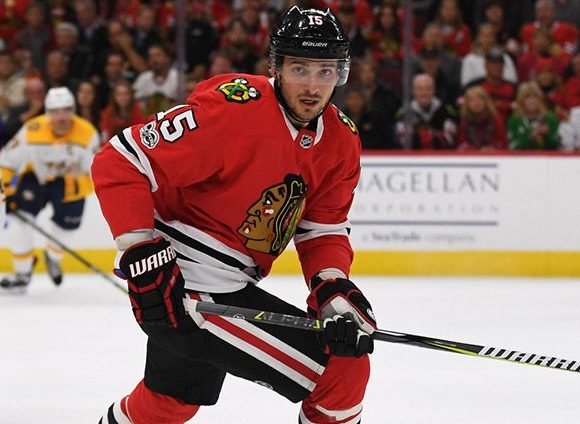
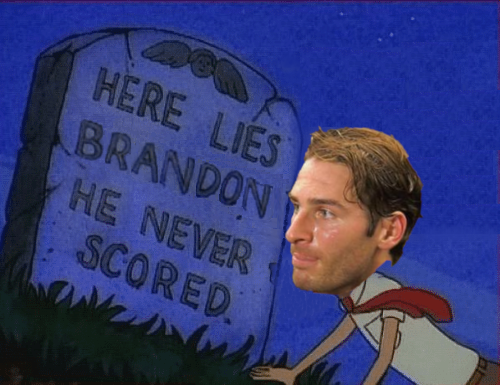
No one, and I mean no one, was happier to hear about the Brandon Saad for Artemi Panarin trade last year than me. In fact, I distinctly remember writing something to the effect of “Is there really anyone out there who would rather watch Panarin than Saad on the ice?” in the early stages of the season. Call it a proto-Fels Motherfuck, because the answer to that question was a resounding “Yes, we all would.” And yet, this is the hill I will die a bloody death on, because Brandon Saad, regardless of performance last year, fucks. And this year, he will fuck again.

2017–18 Stats

82 GP – 18 G, 17 A

56.7 CF%, 60.2 oZS%

Avg. TOI 17:30

A Brief History: By pretty much all measures, the Panarin–Tyler Motte (lol) for Saad–Anton Forsberg trade was a loss for the Hawks in 2017–18. Whereas Saad went on to post his lowest point total since his rookie year during the season-in-a-can, Pantera built off his first two outstanding seasons, with 82 points (27 goals) last year away from Patrick Kane.

We went over Saad’s struggles multiple times last year. I wrote a fucking doctoral thesis on how last year was one of Saad’s best years of his career by all metrics other than points. His even-strength CF% and CF% Rel were both second highest of his career. Only Jonathan Toews had a better CF%, and no one had a better CF% Rel than Saad. Other than Tommy Wingels, no Blackhawk had a larger discrepancy between xGF% (51.62) and GF% (45.1) than Saad. Saad also logged his lowest PDO of his career BY FAR, with a withering 97.5 versus a career average of 100.4. Combined with his far-below-average shooting percentage (7.6% vs. a career 11.8% prior to last year) and the fact that no one he played with regularly scored, there were plenty of people ready to declare Brandon Saad dead.

Fuck that.

Brandon Saad isn’t far from being the Hossa Lite we all expect and need him to be. It really is as simple as him having a bit more luck on his shooting. It never looked like Saad had lost a step or was dogging it out there. Outside of maybe lowered confidence from shooting a full 4% lower than his career average, Saad looked just as good as he always did, and all the numbers—besides points—show that. If Saad had shot at just his career average, he’d have had 28 goals on the season, which would have been second most of his career.

But no one wants to listen to the notes he’s not playing. Fortunately, we won’t have to this year.

It Was the Best of Times: This is easy. Saad is going to be just 26 this year, and I don’t think we’ve even seen his final form yet. Playing on a line with Schmaltz and Kane, Saad takes every “trade Saad” proclamation ever uttered personally and tosses a 15% shooting percentage on 240 shots, good for 36 goals. He also contributes 55 assists, turning himself into the 90-point monster some people thought he might have been last year. He continues to be a possession behemoth, which makes Schmaltz and Kane even more dangerous than they were last year. He single-handedly keeps that line well above water on the possession ledger and even contributes on the second PP unit.

It Was the BLURST of Times: The worst thing that can happen to Saad is an extended injury, something that keeps him out for weeks like our woebegone Irish Son Connor Murphy. Unless he’s hurt, last year is probably as bad as it gets for Saad. It’s still possible, yet highly unlikely, that he’s now an 8% shooter, but there’s absolutely nothing to suggest that last year’s piss fest was anything other than an outlier. It’s also unlikely that he’ll be traded—which was one of our fears this summer—and after StanBo told Tom “Team Grit” Dundon that a Faulk-for-Saad trade was a non-starter, I don’t think there’ll be much worry about losing our Syrian Savior to trade anytime soon.

Prediction: I’m going all in on Saad this year. 30 goals, 40 assists, leads the team in CF% Rel. Helps Kane get to 95 points, helps Schmaltz break 50 for the first time. Is a complete nightmare for opponents on the PK. Chips in a few goals in the second PP unit (which, if you’re scoring at home, will be comprised of Gustafsson, Ejdsell, and Saad by my count. Throw in Schmaltz and Wide Dick, and there’s what I think the second-unit PP should be).

Everything else might go wrong for the Hawks this year. But Brandon Saad will not be one of them. Like a phoenix rising from Arizona, Brandon Saad will show us all why trading Panarin for him wasn’t for naught.

Previous Player Previews

Corey Crawford

Cam Ward

Duncan Keith

Connor Murphy

Brent Seabrook

Brandon Manning

Jan Rutta

Erik Gustafsson

Henri Jokiharju

Nick Schmaltz

Alex DeBrincat

Chris Kunitz

Artem Anisimov

Marcus Kruger

Victor Ejdsell

Jonathan Toews

Everything Else

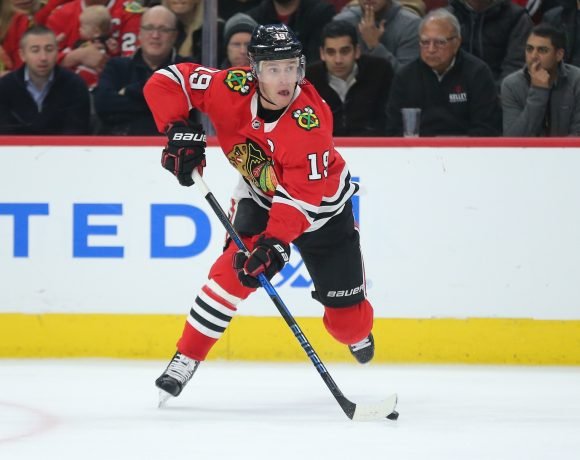
Oh, Jonathan Toews, what are we to believe? Is it all downhill from here? Is the slow, sad decline inevitable? Should we abandon all hope and just accept that the glory days are over and become accustomed to the wilderness stretched interminably before us? Alright, alright, that’s a bit dramatic—and particularly because it’s not actually that bad. Toews is not that bad. And with the right amount of weird hockey luck, he may be due for a renaissance. Let’s take a look:

2017-18 Stats

74 GP – 20 G – 32 A

56.8 CF% – 57.3 oZS% – 42.7 dZS%

19:41 Avg. TOI

A Brief History. We pored over Toews’ performance a few times last year, and the Cliffs Notes version is he had shitty luck, and a linemate with even shittier luck. All this led to a lower point total than usual, which wouldn’t be concerning in and of itself, except that it was the continuation of a trend of decline that started in 2016. Also you just expect your top-line center to be closer to 60+ points, not barely breaking 50, and we’ve (rightly) come to expect the most elite level of play from Toews.

But as we pointed out, Toews’ underlying numbers were good: for example, his xGF% was 52.1 at evens, his possession numbers were solid (56.8 CF% at evens, 58.4 all situations), and his CF% Rel at 4.4 was fourth best on the team. And two of the three guys in front of him on that list were linemates Brandon Saad and Weiner Anxiety (no skypoint). So he clearly had the puck and had a better chance of keeping the puck than not, but his shots weren’t converting to as many goals. Saad’s off year also meant Toews had fewer assists than he normally would. So it seems that much of his struggles last year were due to things like rolling pucks, weird bounces, a goalie standing on his head…I mean, if you’re doing the right things and not scoring, there has to be some fluky shit at play that you can’t control. The problem is, how long can that fluky shit go on, and when does it stop being fluky?

It Was the Best of Times. We all know what the best-case scenario is: Toews pulls an Anze Kopitar and has a bounce-back year, scoring around 70 points, bringing Top Cat into the ranks of elite top-liners with him, and leading a not-pitiful power play (which alone would increase his point total over last year). I keep harping on having Brandon Saad on the top line with Toews and DeBrincat, but after watching him, Schmaltz, and Kane in admittedly brief preseason action, I think we need to find a worthwhile winger (i.e., not Chris Kunitz) to skate with Toews and Top Cat. Who that could be is anyone’s guess—Eggshell? Kahun? Sikura? Who the hell knows, particularly with Q shaking up the lines in camp recently. Like Pullega explained yesterday, there is a decent case to be made for Ejdsell on right wing, with his big shot and playmaker potential. However it shakes out, in this fantasy world we have an aging experienced, resurgent Jonathan Toews flanked by gifted youngsters and the result is a dominating top line.

It Was the BLURST of Times. We also know what the worst-case scenario is: Toews doesn’t rebound but rather gets slower, continues struggling to score, and has at best one winger to pass to. Stuck with useless-clod Kunitz, who couldn’t corral a pass to save his life in the preseason game the other night, Toews’ point total declines and, with fewer quality chances, that shooting percentage continues to tank. The power play remains total clown shoes, and even though he’s not really playing like a 1C, there isn’t a way to gracefully ease him to another line.

Prediction. I’m cautiously optimistic about this one—I think Toews has a better year, if not an amazing year. There will be linemate shenanigans as Q pulls his usual bullshit, but at some point they’ll settle on someone who doesn’t make you cringe, and when that combination does get worked out he’ll rack up just over 60 points on the season. The power play will be not as wretched as last year and that will help the increased point total as well. Please note I didn’t say the power play would be good, only that it will be less horrific. Toews’ possession numbers will stay strong, but his speed won’t markedly improve (maybe it’ll improve a little; he’s certainly a health nut and can probably gain a step back but it won’t be earth-shattering). And if Quenneville loses his job, Toews will be leaned upon and lionized even more by the media for his LEADERSHIP and all that jazz. The Hawks made him the face of the organization…we’re going to keep looking at it.

Previous Player Previews

Corey Crawford

Cam Ward

Duncan Keith

Connor Murphy

Brent Seabrook

Brandon Manning

Jan Rutta

Erik Gustafsson

Henri Jokiharju

Nick Schmaltz

Alex DeBrincat

Chris Kunitz

Artem Anisimov

Marcus Kruger

Victor Ejdsell

Everything Else

With only the second line having any kind of predictability, there looks to be a lot of open space for the younger crop of players in the bottom six. One of the more intriguing options is the massive Victor Ejdsell, who came over in the Hartman trade last year. Though he’s not likely to serve as a savior for anyone, he’s young, large, and has a big shot, so at least he’s something to look forward to.

2017–18 Stats

6 GP – 0 G, 1 A

43.3 CF%, 60.0 oZS%

Avg. TOI 13:19

A Brief History: Ejdsell is a curious combination of size and skill rarely seen around these parts. When Nashville shipped him over, his 6’5”, 214 lb. frame screamed, “Annette Frontpresence!” But Ejdsell, for all his largeness, has never been a plop-in-front-of-the-net guy. He came up at the end of the year for a cup of coffee, and outside of a surprisingly strong first game, which found him centering Brandon Saad and Patrick Kane, he looked lost and timid playing primarily between Alex DeBrincat and Dylan Sikura in his final five games with the big club.

Last year’s AHL playoffs is where Ejdsell shined, though. In 13 games, he scored 12 points (seven goals, five assists), including two series-clinching goals against the Chicago Wolves and Manitoba Moose. The biggest question mark on Ejdsell’s ledger was whether he could skate in stride, both based on his size and adjustment from the larger European ice. According to Jon Fromi, he never looked lost on the ice in terms of skating while with the IceHogs. Coupled with his booming shot and strong on-ice vision, Ejdsell has potential to come into his own this year.

The question will be where can Ejdsell play? He came over as a center, but there’s a bit of a logjam for the Hawks at center, and that’s not necessarily because of depth. With Jonathan Toews, Nick Schmaltz, Artem Anisimov, and Marcus Kruger all pretty much chiseled in as your centers, there’s not much Ejdsell can provide there (read: he won’t have an opportunity to provide there).

Fortunately, between the AHL playoffs, training camp, and preseason, Ejdsell has found himself on the wing more often, which likely will suit a man of his significant carriage more fittingly. Whereas the scouting report has often said that Ejdsell projects as a playmaker, given the heat on his wrist shot, he might find additional success pounding shots off of passes rather than making passes himself. Moving Ejdsell to the wing can also cover a bit for any holes in his skating and defense, which he projects to have based solely on his size and inexperience.

It Was the Best of Times: Best-case scenario sees Ejdsell blossom not as simply a winger but as a winger on his off-wing. A workable combination of DeBrincat–Toews–Ejdsell brings a ton of scoring potential to the de facto top line. For this to happen is to expect probably too much from Ejdsell. Because he’s not a crash-the-net type, Ejdsell would be responsible for making plays while Toews went to get the puck below the goal line. You’d also need to expect Ejdsell to improve on his backchecking skills, which might also be asking too much based on the fact that he’s probably never going to be anything more than an average skater.

But if everything went perfectly, a combination of Ejdsell’s instinctive playmaking abilities, big shot, and talented linemates could make Ejdsell a dangerous wild card on the top line. It would also solve the “Toews needs to score more” problem, since that onus would fall mostly on DeBrincat as a sniper and Ejdsell as a playmaker/shot pounder, leaving Toews to take the Marian Hossa two-way player responsibilities.

Finally, Ejdsell steps up as a key contributor on the power play. He found time on the PP in the AHL and did decently, and he parlays that potential into success on the second unit with Erik Gustafsson.

It Was the BLURST of Times: Ejdsell doesn’t make the team at all because his skating simply isn’t up to snuff. This would mean he would have to be a worse skater than Anisimov, which is almost inconceivable. He toils in the AHL all year and can never put it together. This opens the door for a third line of Kunitz–Anisimov–Andreas Martinsen, which is not a line that teams that make the playoffs have.

Prediction: Ejdsell breaks camp as a third-line winger next to Anisimov and Sikura. When Quenneville finally comes to terms with the fact that Chris Kunitz is not a first liner, Ejdsell gets a shot next to Toews and DeBrincat. He becomes a 15-goal scorer, three of which come on the power play with Gustafsson and Kane, and works well as a setup man for DeBrincat, racking up 40–45 points on the year. His defense is never outstanding, but it gradually improves as he learns his angles and how to use his length as a weapon when he feet aren’t up to the task.

I’m bullish on Ejdsell’s ability to take the leap forward this year. But I think that unlocking Ejdsell’s potential is tied to playing him on the RW with DeBrincat on LW, because as teams realize that they have to focus on DeBrincat’s ability to snipe, it will leave Ejdsell with more space to capitalize on his hard shot, especially his wrister. Playing Ejdsell on the right side will open up those shot opportunities nicely.

Previous Player Previews

Corey Crawford

Cam Ward

Duncan Keith

Connor Murphy

Brent Seabrook

Brandon Manning

Jan Rutta

Erik Gustafsson

Henri Jokiharju

Nick Schmaltz

Alex DeBrincat

Chris Kunitz

Artem Anisimov

Marcus Kruger

Everything Else

If you believe that time is a flat circle, then there are two signings that make perfect sense. One is Brandon Manning, whose performance Q recently described in an after-camp interview as pleasing in the same breath as saying that Jokiharju will need to work on his decision-making if he wants to make the team. The other is Chris Kunitz. He came into the league when the Hawks were really bad and, barring a lot of ifs becoming yeses, will likely go out of the league when the Hawks are really bad.

2017–18 Stats

82 GP – 13 G, 16 A

50.2 CF%, 46.8 oZS%

Avg. TOI 11:57

A Brief History: Kunitz has been playing professional hockey since 2004. And believe it or not, he’s played mostly good hockey by the numbers over 14 years. Kunitz is a rare combination of GRITHEARTFAAAAAAAAART and actual talent, and unlike many other plugs teams sign simply because DEY WERE ON DA TEAM DAT WON DA CUP SO DEY KNOW HOWDA WIN, Kunitz usually contributed to his team’s success in ways that didn’t get the blood pumping to Mike Milbury’s gnarled shillelagh. Over all four Cup runs, he posted a healthy 51.5 CF% and contributed 29 points (five goals, 24 assists). His career 55 CF% is nice, and reflects both the talent he’s played with (Crosby, Malkin et al.) and the 55.4 oZS% he’s accrued over his career.

So what the silly shit is he doing in Chicago?

Last year saw Kunitz in a full-fledged fourth-line grinder role. For only the third time in his career, he started more often in the defensive zone than the offensive zone. Despite spending just 46.8% of his time on the offensive side of the ice, Kunitz still posted a 50.2 CF% with the infinitely talented Ning. He also scored 29 points, which would have made him #8 in the Hawks’s scoring totals last year, just two points off Artem Anisimov.

Given his contract this year (one year, $1 million) and usage last year, Kunitz would have been a no-doubt improvement for the Hawks on the fourth line. He’s a bit long in the tooth, but he can still be a gigantic boil on his opponents’ asses in terms of agitation and offensive production.

The problem, of course, is that Joel Quenneville has no intention (and perhaps no option) to use him as he should be used. Early in camp, he’s on the top line with Jonathan Toews. With all the what-have-you about how Toews needs to up his scoring if the Hawks want to stand a chance, it’s hard to understand how having Kunitz on his left side helps him do that. Kunitz is slower and less handsy than he was in his heyday. Maybe, if you really, REALLY squint, you can justify having him on the right side next to Alex DeBrincat and Toews, but if it’s come to that, then this year is already a burning clown car with a stuck horn.

And of course, in the organ-I-zation’s constant attempt to tie their own hands behind their backs while pissing into a headwind, Kunitz has a No Movement Clause. So, if he manages to have a decent year and turns into trade bait, he will have all the leverage in picking which team the Hawks can even potentially trade him to. That’s fine from a high-level players’ rights lens, but I don’t see any reason why the Hawks had to give him an NMC in the first place, and I’ve given up on trying to figure it out.

It Was the Best of Times: There might still be some gas in Kunitz’s tank. In a best-case scenario, he hunkers down the fourth line with Marcus Kruger and I guess John Hayden, and they serve as a strong shutdown line with a bit of scoring flair in Kunitz and Hayden. In small doses, Kunitz plays on the right side of the first line with Toews and DeBrincat, playing the role of Annette Frontpresence and taking the Wide Dick route of having Toews and DeBrincat fire shots at him instead of the net. He scores 15–20 points by the trade deadline and agrees to a trade to Toronto for a second- or third-round pick in 2019.

It Was the BLURST of Times: Kunitz spends most of his time on Toews’s left side, which is where DeBrincat should be if Q is dead-set against throwing Top Cat–Schmaltz by the Bowlful–Garbage Dick out there regularly (and of course he is). This means that either DeBrincat has to play on the right side (recall that even though Top Cat is righthanded, he’s goofy-footed in that he’s more comfortable on the left wing) or, god forbid, on the third line again. When approached by upper management about a trade, Kunitz declines.

Prediction: With this team looking more and more like the West Lake Landfill—which, I shit you not, is a smoldering landfill fire approaching a radioactive waste dump outside of St. Louis, a more apt metaphor for that dogshit city I cannot think of—I suspect Kunitz will play more time than anyone wants on the top line. But with Dominik Kahun promising to fuck off back to Germany if he’s not on the team this year, maybe Q does DeBrincat–Toews–Kahun (which is a problem itself) and lets Kunitz troll around the bottom six, which is where he belongs at this point in his career.

The nice thing about Kunitz is that he’s fine. He’ll be OK if in the bottom six, frustrating on the top line. Much like how this season looks to bode, his presence is an overall shoulder shrug, a constant reminder that nothing gold can stay.

Previous Player Previews

Corey Crawford

Cam Ward

Duncan Keith

Connor Murphy

Brent Seabrook

Brandon Manning

Jan Rutta

Erik Gustafsson

Henri Jokiharju

Nick Schmaltz

Alex DeBrincat

Everything Else

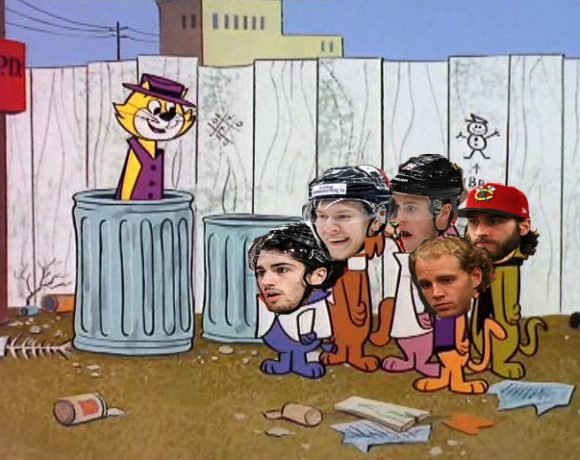
Following on yesterday’s hopeful theme, one of the other bright spots from last year was obviously Alex DeBrincat, affectionately known as Top Cat around these parts. Despite his coach’s best efforts to keep him off the team, and then thwart his development once there, Top Cat blossomed into the latest version of our Special Boy. So what does sophomore year hold?

2017-18 Stats

82 GP – 28 G – 24 A

54.3 CF% – 58.9 oZS% – 41.1 dZS%

A Brief History. Along with Nick Schmaltz, DeBrincat was the breakout star of the season. And Top Cat may actually take top honors in that category because he was the leading goal-scorer. And he did it without playing on a line with Patrick Kane. DeBrincat led the team in hat tricks, with three (how meta); had the second-highest shooting percentage at a muscular 15.5 (behind only Schmaltz’s aberration); and his line’s possession numbers were the strongest on the team, although DeBrincat’s zone starts were incredibly sheltered, it must be added. However, if you control for guys who played less than 41 games (i.e., didn’t play at least half the season so getting discarded in my very scientific opinion), Top Cat’s 54.3 CF% at evens is fourth best, and guess who was ahead of him? Linemates Jonathan Toews and Brandon Saad (and Vinnie Hinostroza, sky point).

And let’s not forget—let’s NOT forget Dude—that Top Cat was shuffled around with subpar linemates while Quenneville tried his damndest to find a reason to be off with his head. DeBrincat was moved to the opposite side and got stuck with the likes of Lance Bouma as well as Patrick Sharp and Ryan Hartman. No, I’m not comparing even about-to-retire Sharp with Lance fucking Bouma, but none of these were appropriate linemates for Top Cat’s speed and passing. Despite Saad’s rough year and Toews’ ongoing decline, their line was definitely not painful to watch, notching 8 goals and an impressive 67.4 CF%.

It Was the Best of Times. In an ideal world, everything comes together and Top Cat remains effective on the right side because if he’s going to play on the top line, it’ll be in that capacity, that much is clear. And he should be on the top line—he’s one of the most gifted scorers on the team and I’m kinda being generous to some of the other players by saying it that way. In the best-case scenario, he has a 70-point season, helping to spark a Saad renaissance and extending Toews’ usefulness. He can make the jump from promising youngster to legitimate elite top-6 scorer.

It Was the BLURST of Times. There are a couple worst-case scenarios to ponder, unfortunately. So far, Chris fucking Kunitz has been seen on the top line with Toews and DeBrincat, which is so utterly stupid and utterly Quenneville-ian that it defies the capacity for logic. Yes, let’s put a useless, aging, bottom-6’er on the top line with an already-slowing center, entirely wasting DeBrincat’s abilities. Another potential situation is that he falls victim to Q’s machinations and gets marooned on the third line with Anisimov and whatever other oaf ends up there—could be Kampf, could by Hayden, really a race to the bottom in terms of options for DeBrincat, while Kunitz is this year’s Tommy Wingels, i.e., no-talent asshat on the top line because REASONS. In this scenario, physically unable to skate as slowly as these fools, Top Cat unsurprisingly struggles to score, which becomes a wretched feedback loop of Q claiming he doesn’t deserve to be on the top line, and so he doesn’t score, and it goes around and around. This sophomore slump entirely of the coach’s making makes him eager to get the fuck out of here and play for a team that recognizes his talent, while at the same time the front office obliges so that they can bring in yet another useless, aging veteran because they decide that GRITHEARTFART was what their forward corps was lacking.

Yet another nightmare scenario is that Top Cat doesn’t keep his head up and some Neanderthal decides to CHANGE THE MOMENTUM in a random game and demolishes him, since even if he can put on some bulk he will not conceivably be able to put on any more inches, and he ends up concussed or with a liquefied knee. (If Niklas Kronwall so much as blinks at him I’m going to hunt that fucker down, I’ll tell you that right now.) Either way, whether by misuse or abuse, should one of these situations come to pass this city would see yet another talented youngster provide flashes of brilliance before having it all ripped away.

Prediction: I can only hope to be wrong about the injury thing. I’m going to tell myself calm, soothing words and just say that won’t be the case. As for Top Cat’s place in the lineup, I think he’ll earn his spot on the top line and he’ll click with a resurgent Brandon Saad.  It’ll take a few weeks of dumbfuckery as Q tries to make the Kunitz experiment work, or Saad-Schmaltz-Kane works out for a while so they genuinely have to play someone else on the top line. DeBrincat will lead the team again in goals, this time over 30, yet probably have some wobbly patches throughout the season when Q wants/tries to demote him, and Top Cat has to play his way out of trouble every time. And he will. Because he’s our Special Boy.

Previous Player Previews

Corey Crawford

Cam Ward

Duncan Keith

Connor Murphy

Brent Seabrook

Brandon Manning

Jan Rutta

Erik Gustafsson

Henri Jokiharju

Nick Schmaltz

Everything Else

Friend of the program Jay Zawaski had some thoughts on Tuesday. This is a subject we discussed a lot last year, what was the Hawks real intent on the season versus what they told everyone it was and why there was a difference. Jay’s not wrong about anything he says here, and it is a nice thought he wishes for where the Hawks were completely transparent about what their plans are going forward.

But the more I think about it, what do they have to gain?

Quite simply, the Hawks are not going to sell more tickets if they tell everyone that they’re in the process of turning over the team to their younger players. I don’t know that they’d sell less, but their position in the Chicago sports landscape isn’t so secure that they would feel they can risk it. While telling us exactly what “The Plan” is would make us all feel better, our mental state isn’t of real importance to them. The Hawks quite simply can’t take the risk of telling their only casual fans that this season might not matter. And that’s assuming there is “a plan.”

Secondly, the Hawks can’t really send that message to Keith, to Seabrook, to Kane, to Toews, and maybe even especially to Crawford. While the organization might be looking at the days already where they’re no longer the main contributors, considering they’re the guys who pulled this organization out of the seventh level of hell they’re owed a certain amount of promises from the front office. You can’t really tell these guys that they’re going to spend the next season or two or three playing games that aren’t going to matter. Maybe they know it already, maybe they don’t, but you certainly can’t give them that message in public. And considering whatever Crawford is working his way back from (and right now “working” is just a claim), it would be truly unfair to have him bust his ass to come back to backstop a team his bosses just told everyone isn’t really relevant.

These guys are made, and I think the only way the Hawks could even consider it would be to meet with them privately and say this is where we want to go, and you have the option of being a part of it or not. These guys all have full NMCs and I doubt any of them are interested in moving, but they also might not want to have another playoff-less season or two.

At the same time, the Hawks simply can’t move them, because of the aforementioned fragility of their place in the market. Toews, Kane, Keith, Seabrook, and Crawford are still the players most fans can identify only and buy the tickets to see. You and I might go to see Top Cat’s or Schmaltz’s (or hopefully Jokiharju’s) development (because we’re sick and our lives our empty), but the guy or girl you work with doesn’t. Even if we passed through some undiscovered wormhole into a world where the Hawks could and would do a full tear-down, McDonough and Rocky are not going to stomach a season or two of a half-empty building. Not after all the back-slapping they’ve done with each other by taking the Hawks out of that by simply standing there while the roster that was already in place took shape.

However, the Hawks “rebuild” plan is flawed. You “rebuild, ” whether fully or on the fly, if you have players to build the future around. The Hawks don’t. Nick Schmaltz maxes out as a great #2 center. Maybe DeBrincat is a genuine top line scorer, and maybe he’s something of a tweener from a #1 or #2 LW. He could be any iteration of Phil Kessel, really. There’s no top-pairing d-man anywhere near ready. If you’re building a team around #2 centers and maybe 1st-line wingers, congratulations you’re the St. Louis Blues or the Minnesota Wild. And you know where that road goes and it’s nowhere pretty.

Which brings me to Erik Karlsson. If you’re a team that’s called about Justin Faulk, then you’d obviously call about Erik Karlsson because Erik Karlsson is the absolute idealized version of Justin Faulk. Sure, the Hawks would have to clear out Hossa’s contract to fit him in for this season, and then need more salary cap rises to accommodate him for the next contract he’s going to sign. But based on what’s been rumored to be the return from the Stars or Lightning, the Hawks could probably match it.

So if they’re not rebuilding, and they say they aren’t, and they’re after Justin Faulk, why aren’t they calling? Why aren’t they at least saying they’re calling? Karlsson is the quickest route to maximizing whatever you have left in “the core.” If you’re stated aim of competing every season is your actual aim, and we don’t know that it is, you’d be in on this. You would have been in on Tavares too, but the Hawks didn’t even get in the room.

McClure has a theory that the Hawks would never take on any player that would have to be paid more than Toews and Kane (which is funny in itself, because Keith has been the most important player throughout this run but that’s another discussion). Karlsson doesn’t make that yet but obviously will. I wonder if that’s the case and whether that really matters to either if they’re staring at finishing out their careers playing on middling teams.

Given what’s already on the roster, the Hawks simply can’t be bad enough to draft high enough to get a true difference maker without a shit-ton of luck either in the lottery or by getting a player of that quality in the spots they don’t generally come from. So why are those picks so important? And if everyone’s job is on the line like they claim, wouldn’t you be after the one player that basically assures everyone keeps their job? Karlsson takes this dreck and at worst it’s a playoff team with a healthy Crawford (and maybe even not). That would at least see Quenneville finish the season and Stan get to see out whatever his plan is.

But again, there’s no impetus for them to tell us. The sweaty hand-clappers and their ugly fucking kids will still be at the Convention happily sopping up whatever tripe they’re fed. There won’t be much scrutiny from a press corps that has the Cubs and Bears training camp a mere two weeks away. Quite simply, the Hawks won’t tell us what they’re doing because they don’t have to.

Everything Else

One of the stranger themes that is constantly present with the Hawks year in and year out is the Trade Guy. It seems like each offseason – or at least every other year – there has been at least one player whose combination of play, contract, and being surpassed by other players just proving to be better, leads to him being an extremely obvious trade candidate both from the sensibility standpoint and the fan outrage standpoint.

First it was Nick Leddy, then it was Patrick Sharp, followed by Bryan Bickell, and now it’s Artem Anisimov. Wide Dick proved to be the prize of the first Brandon Saad trade, and he really has been perfectly fine for the Hawks in the three years he’s been here. He’s netted at 20 goals in each of his three seasons in Chicago, a feat he had only achieved once prior to landing here. A good chunk of those are probably a direct result of playing with Patrick Kane for three years (and Artemi Panarin for two of those), but it’s still a decent selling point if your trying to build value on the trade market, which we are.

The analytically minded are not going to be as bullish on Anismov, and for good reason – he has only broken 50% shot share at 5v5 once in three years in Chicago, but he’s also never dipped below 49% so it’s not like he’s getting skulled out there. It’s basically a back and forth when he’s out there, which isn’t exactly ideal but is still adequate enough to not be maddening. Again folks, we’re going full on used car sales pitch here.

Anisimov does have some obvious shortcomings that are definitely less than ideal for a center, like the fact that is really slow and also terrible on the dot. He’s a perfectly fine player and one that might truly be able to contribute to a good team if used properly, or eat top six minutes for a middling or bad team and do a pretty good job. Basically, if Stan Bowman is worth his salt (and I think he is), he should be able to build a market for Anisimov. The question, though, is how good that market would be.

Back at the trade deadline, the Hawks were rumored to be considering trading him, but the best offer they got was a third round pick from Columbus. But the trade deadline doesn’t always bring out the full market because it seems like teams are always hesitant to players that aren’t the “biggest” names on the market at that time. The NHL Draft and free agency season has become the big event for major moves as teams try to restructure themselves for the new seasons by plugging holes or adding new elements, so Anismov’s market is probably going to have at least a few takers. But the market isn’t your only obstacle.

Anisimov has a full NMC that runs until July 1, so that throws a major wrench in any plans that Stan may have had to try and move him at Friday’s draft. And this is where it gets murky, because if you’re Anisimov you might be smarter to waive that NMC this week and give yourself a bit more control over where you play next year rather than handing in a 10-team list on June 30 only to have a 1-in-1o shot at your preferred location come July. Not that Stan would ask Wide Dick where he wants to go and then only try to make it work there, but if Stan gets a deal put together on Friday and calls up Anisimov’s agent, maybe it makes more sense to just say “yes” then and know you’re wanted where you’re headed rather than go into the new league year with only an inkling of an idea of where you’ll be come October.

I think the Hawks might be able to sell a team like Carolina on taking Anisimov as part of a package for Justin Faulk, and I genuinely think Carolina would be a nice landing spot for Wide Dick while also striking me as a nice place to play. Is that more attractive than trying to sort through which third of this league is desirable enough to play in to include them on an “okay” list?

Given that the Hawks are pretty much set at their top two center spots at this point with Toews and Schmaltz, while also being rumored to have interest in John Tavares, it’s starting to feel more like “when” Anisimov gets traded rather than “if” he gets traded. It doesn’t feel particularly likely that it happens this week, but stranger things have happened, and it’s all going to come down to what level of control Wide Dick wants on his future. It’s at least something to keep an eye on come Friday.

Everything Else

There’s a bit of a fuzziness to it, but John Hayden ended up playing more than half of the games on the schedule for the Blackhawks. He was here until January, got sent down to Rockford, then came back up in March. Do you remember much about what he did? Because I sure don’t.

John Hayden

47 GP, 4 Goals, 9 Assists, 13 Points, -4, 54 PIM

47.6 CF% (Evens), -6.4 CF% Rel (Evens), 48.97 SCF% (5v5), 45.06 xGF% (5v5), -5.5 xGF% Rel (5v5)

 44.8% oZ Start (Evens)

What We Said: He probably won’t be more than an answer to a trivia question in a few years (Who was the 20th Yale Bulldog to crack an NHL roster?).  He’s the Atlas Shrugged of hockey players: not nearly as great as his proponents say, an overhyped tome of theoretical muck whose pedigree rests mostly on his size and standing out among the mediocre.

What We Got: Going into the season, we asked, “Who is John Hayden?” Well, he’s not quite a scorer, and he’s not quite a fighter, but man. . . . So to answer the question, I don’t know.

The best answer I can come up with is probably no more than a bottom-six puck absorber. And really, that’s all Hayden will ever have to be on the Hawks. In the time he was up, he spent most of his time with other Blackhawks castoffs, Lance Bouma and Tommy Wingels. You’ll certainly take the 13 points he provided skating primarily with and against the dreck of the league.

The most surprising thing about his year was his zone-start ratio. When we previewed Hayden at the beginning of the season, I wondered whether Hayden was a “start in the offensive zone” kind of guy, and this year showed he wasn’t. He tended to fall more into what would have been a Marcus Kruger–line role. And all of his advanced stats reflect that: His Corsi and expected goals for percentages all reek of a guy who spends most of his time in the ass-end of the ice.

Hayden also played the role of tenured fighter, leading the team with four fights. I had always held out hope that with his improved skating, Hayden could be a sneaky scorer on the bottom half, but it looks like the Blackhawks expect him to be the guy who initiates fights for HOCKEY REASONS. Much like every Yale graduate ever, the idea of John Hayden being more than an exhausting waste of time and money always flatters to deceive.

Where We Go From Here: Assuming Hayden doesn’t get traded to a team looking for some dick-swinging grit (looking at you, Tom Dundon), he’ll likely do the same thing he did last year. He’ll putter around on the fourth line, have a few fights, then play a few shifts with Toews because he’s DA BIG BODY WIT A BIG HEART DEY NEED IN FRUNNA DA NET. We’ll see a few flashes of skill from him before he bares his red, overeducated ass, because the myth of the rough-edged hockey fighter scraping out a living despite the odds gives no quarter.

Ideally, we’ll see Hayden on the fourth line with guys like Kampf, Wingels, and Highmore. He’s a useful guy if you’re looking to build a line that acts as a big meat slab, which looks like the direction the Hawks are going to go with him, judging by his fancy stats and zone starts. He might even be able to find a home next to guys like Ejdsell and Sikura, and that might work out too. He’s got just enough skill to run with guys like them, and doing it on the bottom lines might open the Hawks up to some much needed depth scoring.

At the end of the day, John Hayden is like the Kevin Orie or Jorge Fabregas of the Blackhawks: Just good enough to stick around, but never much more than a hazy memory.

Everything Else

Brandon Saad’s year was an extended cut of Lisa explaining why the electric violinist was better than she seemed. You had to look at the stats Saad WASN’T underwhelming at to appreciate his year. But when the whole point of bringing the guy back was to give Toews more support and even shoot for a 30-goal season, it makes the My Chemical Romance-ian angst over losing Panarin for him more understandable (even though it’s misplaced).

Brandon Saad

82 GP, 18 Goals, 17 Assists, 35 Points, -10, 14 PIM

56.7 CF% (Evens), 5.7 CF% Rel (Evens), 54.93 SCF% (5v5), 52.15 xGF% (5v5), 3.63 xGF% Rel (5v5)

 60.2% oZ Start (Evens)

What We Said: While I can see a 30-30-60 year from him, expecting 70–80 points might be asking a bit much . . . Having him out with Toews could bring about a renaissance for The Captain . . . His all-around game is a welcome aspect for a team that lost one of the greatest back-checkers of all time, and should help re-establish the Hawks as a strong possession team.

What We Got: Saad had a year of unexpected firsts. It was the first time that he finished with a negative goal differential. It was the first time he finished with a shooting percentage under 10%. It was the first time he finished the year with fewer points than the last. By their powers combined, these aspects turned what was supposed to be the rekindling of our love affair with Hossa Jr. into a season of grumbling and disappointment. And as painful as it is to admit, by the metrics that matter most—namely, goals and points—this was a massively disappointing year for Saad.

We can go on about how Saad had his best possession year since 2013–14 (in which he had a 58.5 CF% in 78 games). We can talk about how Saad’s CF% Rel this year was his best ever in a Hawks sweater (trailing only last year’s 6.4 in Columbus). And you know I want to tell you how all of his problems were anomalous, the result of a precipitous and unforeseen drop in his shooting percentage. (If he had shot at his 11.8 S% average he had prior to this year, he would have had 28 goals this year.)

But with Saad coming off three consecutive 50+ point seasons, that all looks like a bunch of excuses for a poor performance or a stubborn justification for trading Panarin, even though it isn’t. All those numbers bolster the “Saad is still a great player” argument, but they don’t explain why his shooting percentage was down so much.

If you go back and watch some of Saad’s scoring opportunities, you’ll notice that there seems to be about a half-second delay between when you’d expect him to shoot and when he actually took his shot. I don’t know whether this hesitation is a matter of confidence, timing, or simply losing a little bit off his fastball, but it was more noticeable this year than ever before. Rather than puckering your sphincter for what you’d assume would be a scorching one-timer, most times Saad had a good scoring chance, you’d find your shoulders slouchier than usual and your gut hanging over your jeans just a little bit more woefully, knowing that if he didn’t launch the puck straight into the goaltender’s chest, it was going to go a little too high or a little too wide.

Not knowing why is the hardest thing to process. As unfulfilling as it is to read what amounts to a shoulder shrug and a “what can you do,” it looks more like a season-long malaise than some underlying problem, given Saad’s body of work over the last five years. Everything else looked as good or better than expected, except, ironically, for his play with Toews.

While the Saad–Toews tandem was by no means bad, bringing Saad back didn’t have the effect we had hoped. In the 750 minutes they played together at 5v5, they were a possession monster, with a 57+ CF% and a 52+ High-Danger Chances For Percentage (HDCF%).

But they also got pummeled in High-Danger Goals For Percentage (HDGF%), to the tune of 42+. Away from Saad, Toews sported a throbbing 61+ HDGF%. Away from Toews, Saad had a flaccid 38.89 HDGF%.

Additionally, both Saad and Toews had better—albeit below their average—on-ice shooting percentages away from each other: Together, they had a 6.41%; Saad without Toews had a 7.39% (7.6% individual on the year); and Toews without Saad had an 8.62% (9.5% individual on the year).

All of this is to say what we’ve been saying all year: The chances were there for Saad, and they just didn’t go in. Unless you buy the idea that Saad peaked at 24 (and if you do, go back to work, Peter Chiarelli), there’s no explanation for it other than sometimes the bear just eats you.

Where We Go From Here: Saad was an offensive disappointment, but he did everything else as good or better than before. And if Crawford stays healthy, maybe we’re sitting here talking about how Saad overcame his scoring demons in the playoffs and laughing about how stupid hockey can be. Instead, after an underwhelming year from both the team and the man, we’re subject to asinine chatter about trading Brandon Saad (for what, who knows?). Anyone who tries to sell you that tripe is probably a good candidate for the ol’ Moe Szyslak fork in the eye, given Saad’s career trajectory to this point.

Saad will be 26 next year, right in his prime. He’s still a possession dynamo with outrageous transition speed for a skater his size. And if he produced at just his career rates, he would have had the best offensive season of his career this year. Saad is still young, still important, and still capable of being everything we hoped he would. He just seemed a little hesitant this year. It could just be that Saad–Toews needs a finisher—whether that’s Kane, DeBrincat, or potentially Vinnie—to complete that line. And I can hear the “DAT SOUNDS LIKE ARTEMI PANARIN IF YOU ASK ME” snark a mile away, but when it comes down to it, I’ll take a younger, more well-rounded Saad at $6 million than an $8–10 million sniper like Panarin, if I have to choose one.

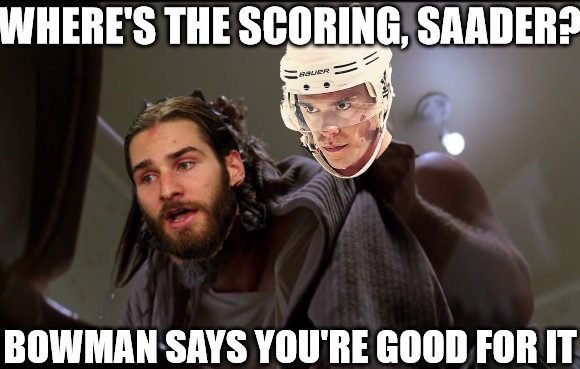
Still, Saad will need to prove, for the first time in his career, that this year was a blip for his offensive output. Bowman said he was good for it, and it’s down there somewhere. Let’s let him take another look.

Everything Else

For the second straight season, it felt like we watched Jonathan Toews go through a year in which he played very well, had solid underlying numbers, and yet due to voodoo or bad luck or the lack of lean meat in his diet he couldn’t find the score sheet. The hilarious part is he still put up 20 goals and 52 points in 74 games, which is still pretty damn good. But his paycheck and role demand more, and his play deserved it. Shall we?

Jonathan Toews

74 games, 20 goals, 32 assists, 52 points, -1, 47 PIM

56.14 CF%, 4.79 CF% rel, 53.09 xGF%, 4.19 xGF% rel, 55.15 Zone Start Ratio

I think there’s a lot of value in bookending the preview/review process with players as a writer, which is why I wanted to do this review for Toews after doing the preview earlier this year. Honestly, before looking into any of his numbers, I went back and read said player preview. That presented me with a problem – I, uh, think I might end up repeating myself from that post a lot.

That’s because, like I said to open this one, Toews had another year comparable to his 2016-17 campaign. He had elite shot metrics with that 56.14 CF, the expected goals was nicely in his favor as well at 53.09, and yet a career low shooting percentage drives the production numbers down. Compare those expected goals to his actual GF% of 50.57 and it gives you an even better scope of just how bad his luck was. Spending damn near the entire year with Brandon Saad, who was going through the same damn thing (TEASER: review coming tomorrow from Mr. Pullega), didn’t really help matters.

Let’s play a projection game. After shooting 9.5% this year, his first time below 10% in his career, Jonathan Toews’ career shooting percentage has now dropped to 14.1 percent. If he simply shot that rate this year, he’d have scored 10 more goals. 62 point year in 74 games. That’s good.

Before these last two years, Toews was shooting 15.1% on his career – and while a one percent drop probably doesn’t strike you as huge, to drop a goal per 100 shots after just two seasons is kind of insane. If Toews had shot at 15.1% this year, he has 32 goals. Again, good.

And again Brandon Saad’s career low shooting year definitely impacted Toews as well, likely on the assist side of the ledger. I won’t dig too much into the numbers so as not to steal Pullega’s thunder for tomorrow, but if Saad shot his career rate this year, I bet Toews added anywhere from 2-8 assists to his ledger as well.

So the ultra-optimistic side of this projection game puts Toews at 32 goals and 40 assists, and if you play slightly more conservative you have him at 30 and 32. Either way, you’re looking at somewhere in the 65-70 point range in 74 games played. That is damn near elite production in today’s NHL. “But Twitter told me the sky is falling on Jonathan Toews,” you say! Twitter is wrong. It is always wrong.

A while back I compared Toews to Anze Kopitar, and that comparison is still apt. Kopitar had a much worse 2016-17 than Toews in the luck department, but things swung his way in 2017-18 and he ended up with career highs in shooting percentage, goals, and points, and all of that earned him a Hart trophy nomination and he just might win the damn thing even though it should go to Nathan MacKinnon. But here’s the most encouraging part of Kopitar’s huge year as far as it applies to Toews – his combined shooting percentage from last year with a career low shooting percentage, and this year with the career high, sit right in line with his career numbers and his typical fluctuation of his career.

Obviously there are flaws to some of this numerology I’m doing, but the over-arching point is that things aren’t all bad for Toews unless there is more to this whole thing than shooting percentage. The overall numbers don’t indicate that there is, though, meaning that unless there is some lingering injury that is somehow leading to the decline in shot conversion, everything we know about numbers and regression indicates that Captain Vegan is due for a correction.

And if all else fails, maybe he should start eating steak again. How the fuck could anyone give up steak?