Baseball

Game 1 Box Score: Reds 6, Cubs 3

Game 2 Box Score: Cubs 4, Reds 3 (1o)

Game 3 Box Score: Cubs 5, Reds 2

Seems pretty simple, when you get quality starts you’ll get wins. The Cubs have gotten six of them in a row. They’ve won five. Arguably should have won all six, but it would be truly petty and desperate to complain too much about a 5-1 homestand so far. This isn’t rocket science. Throw in a Kris Bryant binge, and suddenly things are starting to look as they should. Though with a couple glitches, so it’s your parents’ perfect night out. The food is great, and the service just good enough to allow them to complain.

Let’s run it through.

The Two Obs

-Hard to decide on the headline, but let’s go with Yu Darvish, who has yet to give up a run in two post All-Star starts and has only walked one in 12 innings. Today, Darvish was fastball heavy. It says he only threw 30 four-seam and 16 two-seam, but considering the latter was averaging nearly 95 MPH, I think they’re all just four-seamers. He also piled in 26 cutters, so it was a power outing. His last pitch was 98, which on a hot day is something. Combine them all and he threw 61% of them for strikes today, which goes along with his quotes after his last start about finally feeling like he has command of his fastball and doesn’t just have to rely on his cutter to get strikes. You’re seeing a variance in Darvish’s approach now, as he was slider heavy against the Pirates. But when he has command of it all, he can do that in any way he wants. Hopefully this is the start of something big, and as his next start will come against the decidedly punchless Giants (though more so now)…well, let’s just hope.

-Cishek has a 2.83 ERA, and I’m convinced this is a government lie. Every time I look up it feels like he’s giving up a run, even if it isn’t always his. He’s giving up homers on fly balls 50% more than last year, though everyone seems to be doing that now. I still worry about the amount of appearances this year and last, and this pen never lets you rest, does it?

Of course, backing him up with Rosario and Brach was never going to work out, was it? I can’t believe I’m asking for Edwards to hurry.

-At this point, we have to guess there’s something physical with Rizzo. He hasn’t homered in over a month, and he has 10 doubles over the last six weeks or so. He just doesn’t seem to have the pop. To be fair to him, his hard contact and line drives are much higher in July than they were in June, so maybe whatever it was has passed and he’s just trying to find the swing again. The Cubs are a Rizzo binge alongside the Bryant binge from like a 12-game winning streak.

-I don’t need Albert Almora Jr. to hit. He’s good enough in the field and the Cubs should have enough other hitters to just take his defense and run. I do need him to keep his head in the game. It didn’t end up mattering last night, but once again him not running after a drop third is a sign of a player not locked in, and this is what the Cubs were trying to address in the offseason. It has to stop.

-Looks like I motherfucked Alec Mills into a quality start, which is probably my biggest accomplishment of the season.

-Heyward seems to have a new knack for big hits, huh?

Onwards…

Hockey

It should come as no surprise that today, as Dom Luszczyszyn at The Athletic broke down the most financially efficient teams and the most very much not, the Hawks are at the bottom of the list. They’re only ahead of known basketcases Los Angeles and Detroit, so there’s something to feel good about.

Ruining most of the Hawks’ chances is the Seabrook contract, and we’ve run enough miles on that one for now. What’s really galling about it is that the Hawks couldn’t wait to tell you about all the cap space they had this summer, and how finally they could do some things to improve. And what that got you was Olli Maatta, Calvin de Haan, and Andrew Shaw. A terrible defenseman, a decent one who really is at most a middle pairing guy, and a utility winger who will probably be played over his head simply because of name recognition. In the interest of fairness, it also got you what is probably a pretty good goalie at worst, a really good one at best, though you already had one of those.

The problem for the Hawks is that they keep playing in the part of the market that hamstrings a team, and that’s the middle. In a cap era, you pay for the top talent, you scout veraciously at the bottom to keep things cheap there, and that’s how you fill out the roster. Forking over $8.5M combined for Maatta and de Haan, guys who are no more than #4 or #6 d-men, is how you end up in trouble again. The galling thing about Maatta is he was acquired for a player who gave you more value to what you were paying him in Dominik Kahun. Perhaps you’ve replaced Kahun with Kubalik, but having both probably would have negated the desire or need for Andrew Shaw, if such a thing actually existed. Shaw is, at least right now, probably better than both of those players but $3M better?

Once again, the Hawks seemed to have failed to learn the lessons of why they were good way back when. Then they paid Toews, Kane, Hossa, Sharp, Keith, Seabrook, Hjalmarsson, and Crawford (to a lesser extent Oduya). Behind that were Saad, Shaw, Leddy, Kruger who were essentially on nothing or entry-level deals. The Hawks got themselves in that mess partially when they handed a support player a “middle” contract, Bryan Bickell. They watched Seabrook become that.

Up front, they’ve gotten middling production from Saad for what is barely top of the line money. That’s after they had top of the line production from Panarin for value, considering he didn’t get paid until this summer. Once again, name recognition and the need for it did the Hawks in, even if Saad has been ok.

And it’s a problem going on down the road. The only cap space the Hawks have in ’20-’21 is thanks to both goalies being unrestricted free agents, except someone is going to have to play goal. And now that you’ve erased any of Collin Delia’s NHL time, you have no idea if it could have been him. The $19M the Hawks have in space for next year, which might only raise to $20M or $21M, is almost certainly all swallowed up by DeBrincat, Strome if he comes along, and whichever of the two goalies you choose to keep.

Which means Erik Gustafsson is gone, which means he probably shouldn’t be here now, but there’s another topic we’ve gone 15 rounds on. So there’s Adam Boqvist’s spot opened up, assuming he doesn’t force his way in this year. But how do you get Ian Mitchell in? Moving Maatta and de Haan along again? You might not get so lucky into getting them while not having to take bad contracts back. Connor Murphy? Unless his back goes out again moving Murphy out and Mitchell in is probably a lateral move to start, though obviously makes you cheaper. And you’re still pretty thin.

The Hawks have also missed with some bottom, cheap talent that they need to provide more value than their paycheck says. Brendan Perlini failed to live up to that, Drake Caggiula was hit and miss and hurt (though another one who could do most of what Shaw does at a far cheaper rate).

As we mentioned on the podcast, the reckoning with Seabrook can’t be put off too much longer. They seemed to think they had to avoid it this year by moving Jokiharju along and figuring Boqvist is a longshot to make the team. That won’t last, as Boqvist will have to be ready in 2020 and after three years at college, Mitchell shouldn’t need much seasoning if any at all.

The Hawks seem to get it in that they want to pay DeBrincat and Strome, who are top of the roster. But how does that arc the Hawks up in the coming years? They’ll barely have enough room to cram in forwards on entry-level deals to level this out like Dach, Kurashev, or Nylander (and that’s even if they don’t sign Perlini).

The Hawks told you they did all their digging. All it was was a rest, because they’ll have to keep doing more next summer, too.


Hockey

Looking at the Hawks’ offseason moves thus far, which have ranged from the curious to the mildly dissatisfying to the outright stupid, the signing of Robin Lehner is probably the least offensive or, put another way, has the best chance of not blowing up in their face. To review, Lehner was third in Vezina voting last year, with a .930 SV% and 2.13 GAA, although he basically split starts with Thomas Greiss.

Now, before I go any further, let me just say that Lehner’s political stance sucks, and I highly doubt any of our readers would be surprised to hear me say that. But, I can’t change what he thinks, I assume there are many other players whose political opinions would also disgust me, and this is just a fact to be filed away in the “shitty things I can’t do anything about” category.

Setting all that aside, the question then becomes what does this goaltending situation actually look like next season? As I just mentioned, Lehner had a great year splitting starts, and the Islanders just seemingly fucked up by getting bored or distracted, and Lamoriello went all “is a moron” in the GM category as is his way, and Lehner pretty much fell into Stan Bowman’s lap and was willing to take a one-year deal. He’s still a bit of an unknown quantity because his Vezina- quality year could have been a fluke, or he could be hitting the best years of his career and last season was just a harbinger of what’s to come. He had some success in Buffalo with a .920 SV% in 59 games, before hitting a rough patch and then heading to the Islanders, and his career could flourish now that he’s overcome some serious shit. It could really go either way.

And as we know, Corey Crawford’s immediate future is just as uncertain. He’s worked hard to come back from the concussions, and we seen flashes of brilliance mixed with some, well, less-than-brilliant stretches. He picked things up in mid-March after coming back from concussion #857 and put up a very respectable .916 SV% through March (starting at 3/9, full disclosure), which was crucial to the farcical playoff run they pretended to make right at the end. And still, the injury history is there and we all know it. So essentially there are a lot of questions surrounding the goaltending situation and there are a few ways this could play out. So let’s explore, shall we?

Crawford is good, Lehner is bad

If this is how it pans out, then the signing will look like a relatively low-risk gamble that just didn’t work out in the Hawks’ favor. If Crawford is at his historical average around .915, and the PK gets less wretched because de Haan, Maata, and/or Carpenter somehow make a difference, then Lehner could be relegated to a true backup role, and he could choose to try his fortunes elsewhere at the end of the season, with 5 mildo out the door but no lasting harm done. Or, he could even be moved mid-season if Delia or Lankinen are making noise in the AHL and some desperate team is willing to take a chance. And this is a real possibility—the Islanders gave up 30.9 shots, putting them solidly in the middle of the league, whereas the Hawks were dismal second-worst, giving up 34.8. It’s entirely possible Lehner can’t withstand the shit defense that, as we’ve covered, hasn’t really gotten much better from last year.

Should Crawford be holding his own and Lehner struggling, the Hawks will still find themselves in a pickle when Crawford’s contract is up at the end of the season because no matter what he’ll be past his prime, even if this season is a renaissance or bounce-back or any other tired trope you want to use. They’ll have to come to a decision—the Hawks and Crawford—about whether re-signing him for a year or two is worth it, would they really expect him to be the starter, would he rather move on somewhere, what type of payday could really be in the offering (probably not a big one), etc., etc. Lehner not being a reliable alternative answers none of these questions, but if he can’t repeat last season’s performance, then signing him was a relative shrug and “meh we tried” for the organization.

Lehner is good, Crawford is bad

This would be a tough spot but would show that this dumb luck signing was the right thing to do. Let’s say Crawford has a slow start, i.e., barely cracking a .900 SV% by the time Thanksgiving rolls around. Even if it’s not totally his fault and he’s facing between 35-45 shots a night, we still need lights-out goaltending because the defense is still slow and bad. If Crow can’t manage a .910 continuously, and if the PK remains dead-ass last in the league, that’s a serious problem.

And, let’s say Lehner is throwing out a .925 in the handful of starts he gets in October through early November. The Hawks would have to seriously consider making Lehner the No. 1 but could you imagine Crawford as the backup? The organ-I-zation has disrespected him enough times that I wouldn’t rule it out, but it would be both weird and sad. It would also be interesting to see if Coach Cool Youth Pastor actually did it, but he doesn’t have a long history with either goalie so theoretically he shouldn’t be shackled to any sense of loyalty.

It would be uncomfortable, especially for those of us who love Crawford, but December is going to be intense and if he can’t withstand the shitty defense, something has to be done. The Hawks could survive as a bubble team if Lehner can hold it together, and the front office would have a clearer direction of what to do when Crawford’s contract ends. Lehner could get another deal for a few more years, and Delia and Lankinen can fight it out for the backup spot.

They’re both good

What a problem to have, right? In this scenario it’s a 1/1A setup and starts are split nearly evenly, similar to what Lehner and Greiss did last year, with both guys throwing about a .920 SV%. Such a situation could possibly even overcome the terrible defense or at least the team could win despite the shit at the blue line. However, while this may sound like the best-case scenario, I for one do not trust the goalie-by-platoon method. I know, it’s worked in a couple situations but it makes me nervous. What if one guy is on a hot streak but you sit him? Can both maintain momentum when not playing as often? Can Lehner replicate it a second year? Maybe he can, and maybe it’s a good thing for Crawford too as the wear and tear doesn’t get to him plus there’s fewer chances for him to smash his head into a metal post or the ice again.

Any of those are possible, but I’m just saying that I don’t trust the committee strategy long-term. Making  a run in the playoff—as this team CLAIMS is the goal—when you don’t know who should start in goal is nerve-wracking, to say the least. Now of course, it’s important to have two good goalies, one of whom is a solid backup. Let’s remember how crappy Cam Ward was at times last year, and please know that I’m not saying we should have some schlub just so that the depth chart is clear.

But, if this team really does scam their way into the playoffs, platooning isn’t the strategy that’s going to give me a lot of confidence as they’re facing truly good teams. Is there also a component for the goalies themselves—resentment or frustration when the time actually comes? Maybe not, but again, that’s a lot of questions just posed about the goaltending situation, which is generally not where you want to be if you’re aiming for a deep playoff run.

They’re both bad

Well then we’re fucked.

So, you’re saying there’s a chance?

The short answer to all this is: we have no fucking clue. Yet. There are so many variables right now it’s impossible to predict, but it will begin to make itself known. And then we’ll have to see what CCYP and StanBo are willing to do—they’re terrified of Seabrook as we know, will they also be too scared of Crow to take the necessary steps, should they become necessary? I think they won’t be. Personally I think they’d tell him to hit the road with no sense of irony or shame. If Lehner is going to suck that will also make itself known, and then we’ll be stuck with what we’ve got and will wonder how to move forward after the season.

In comparison to the shit at the blue line, this goaltending situation shouldn’t leave us hiding behind our couches as we watch, at least for now. But no matter how it turns out, someone’s going to get hurt. Even if only in the emotional or metaphorical sense.
 

Baseball

I know where this will go. I’m just a bitter Cubs fan tying to rationalize to himself the trade of Eloy Jimenez. And I’ll cling to anything and everything like Linus’s blanket that will make it ok in my mind while Eloy spends the next decade raining projectiles onto the Dan Ryan. Feel free to think this.

It can be universally agreed, I think, that Eloy Jimenez has had something of a choppy rookie season so far. There have been flashes of brilliance, mutant power, and intelligent approach while at the same time a heavy slapdash of whiffs, curious decisions, and at times bad luck. All of it has led so far to a tick above average 107 wRC+, and a pretty on the nose of average .330 wOBA.

There’s little doubt that Eloy is going to be a very good player one day, perhaps even great. There’s probably a little more discipline at the plate to be harvested, which should lead to better pitches, which should lead to more balls landing the in the shrubbery. Another spin or two around the league couldn’t hurt either.

But looking up Eloy’s numbers this year, I was struck by something weird for a player with such obvious power. Eloy doesn’t hit the ball very hard, at least not consistently. Yet ≥

Jimenez currently has a 35% hard-contact rate, which isn’t terrible but isn’t anywhere near what you would expect a genuine slugger to have. For reference’s sake, your leader in hard-contact rate is Christian Yelich at 54.6%, though no one would expect Eloy to already be performing at an MVP-level. Eloy’s 35.5% mark would rank 123rd in the Majors if he qualified, right in between Andrew Benintendi and Kevin Pillar. Fine players to be sure, but not exactly where you picture Eloy.

Eloy’s line-drive rate of 14.5% would also be borderline abysmal, though you wouldn’t fret much about it if he were hitting a lot of flies hard. Which he’s not.

Statcast-wise, it’s not a prettier picture. Eloy’s average exit-velocity of 90.3 MPH is good for 108th in the league. His barrel-percentage of 9.9% ranks 98th. Again, you wouldn’t expect Eloy to already be among the giants of the game, but given the power he has flashed at times you would think he would be making more loud noises more consistently, even if they didn’t always produce runs. Which leads one to believe his .271 BABIP isn’t really all that much bad luck

It’s a little tricky to see why this might be, but let’s try. For one, with over half of Jimenez’s contact on the ground, you might conclude that he’s had a roll-over problem (much like old Jeeps). And that seems to be the case. When Eloy puts it on the ground, 63% of the time he’s pulled it. Conversely, he gets the most amount of fly balls when going the other way, or just about half the time. It’s not that Eloy doesn’t have power the other way, he should just have more of it.

Right now, when going to right field, Eloy only has a 24.5% hard-contact rate, though a better than normal 19.5% line-drive rate. Strangely, the numbers are even worse when he pulls the ball. The hard contact is just about the same, but the line-drive rate is a measly 11.1%. How can a guy like this not be producing line-drives when pulling the ball?

If you’re about to suggest that Eloy should have a more Goldilocks approach, I’ll stop you and say you’re right. When he stays up the middle, his hard-contact rate is 54.2%. Now we’re talking.

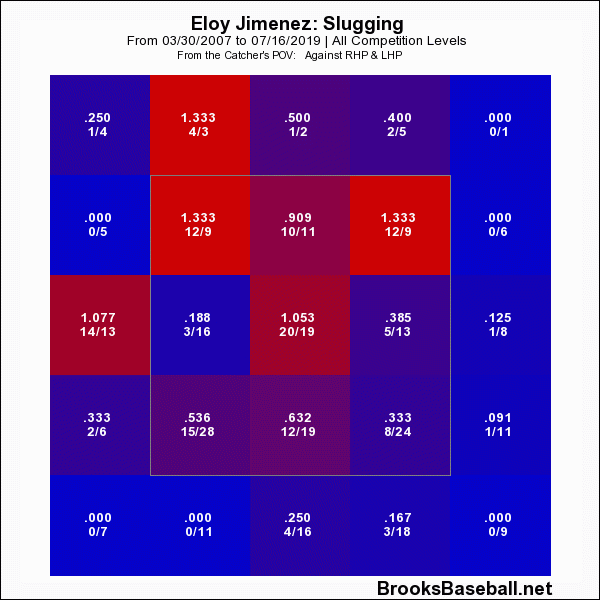
Of course, it’s not that simple. You can’t just hit anything up the middle, it depends on how you’re being pitched. And based on where Eloy’s power has been, it’s a tougher riddle. Eloy is something of an iconoclast this year when it comes to hitting. Most hitters these days have found ways to lift low pitches for power and are vulnerable at the top of the zone. Not so much with Eloy:

But, MLB pitchers being what they are, Eloy doesn’t see a ton up there. This is where Eloy sees fastballs:

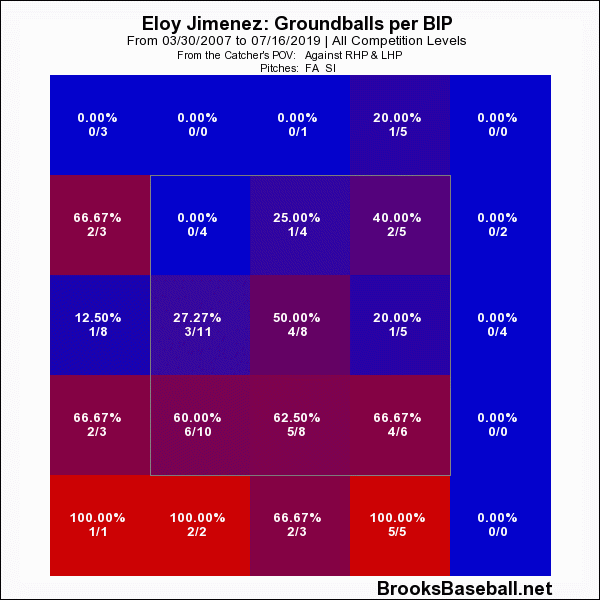
Mostly not up. And weirdly, he’s turning a ton of them into grounders:

As you might have already guessed, Eloy sees almost all of his breaking pitches low and away, and his only power off of them has been on mistakes that hang in the middle or high in the zone. That’s going to be true his whole career.

Eloy needs to stay up the middle for a while, and figure out how to lift low fastballs. Which I have no doubts he will one day. Because someone like this should have better contact numbers, even in this nascent stage of his career.

Hockey

It probably should have happened a year ago, if ever at all, and you knew it was coming for sure as soon as the Hawks drafted Kirby Dach. The Hawks needed cap space, they needed a space for another center either this year or next, so off Artem Anisimov had to go. And today he did to Ottawa, for Zack Smith. The headline of the deal is that the Hawks will save $1.3M in space over the next two years. I’ll forgive you if you don’t vomit with joy.

On the surface to the uninitiated, it will look a little strange. After all, Anisimov managed 20 goals in three of his four seasons here, and was in between Kane and Panarin when they were setting off all sort of fireworks together for two seasons. To the dedicated observer though, Anismov’s numbers were something of a mirage. He was a plug-plus at best who could barely move and had decent hands around the net. His goals and points were accumulated through the Nuno Gomes method, which is where you let far more talented players ping pucks/balls off of you into the net and you get to take the credit. In a league that’s only getting faster, Anismov’s place became more and more precarious, and he was hardly cut out to be a bottom-six winger as he was at times last season.

Anisimov’s extension will be another cudgel to beat Stan Bowman whenever he is fired or leaves, though those in the know will tell you orders came down from on high on that one to appease the angry masses about the first Brandon Saad trade. Whatever, it’s over now.

Of course, this being the new Hawks ethos, they got a plug in return. They’ve been chasing Zack Smith for years, with rumors of them calling the Senators about him stretching back to at least 2013. He’s got that precious size, except he doesn’t do much with it anymore and he isn’t very quick either. Smith has only managed 20 goals in the league once, where he shot 20%. The past two years he’s pretty much been between a third- and fourth-line contributor, and while listed as a center I have to believe at his age they see him as a wing now. Otherwise you’ve basically made a lateral move for a fraction of cap space now and next year.

Metrically, Smith hasn’t been of any use in a couple years, though he was getting dungeon-shifted by the Sens last year and you might imagine that’s the plan here whether he ends up skating with Kampf or Carpenter or both. Or maybe the Hawks are planning to move him along as well to open up even more cap space. We’ll see.

Smith can certainly act as more of a checking center than Arty ever could, though that would give you 2.5-3 checking centers in Kampf, Smith, and Carpenter. So you’re depth chart looks something like:

Saad-Toews-Shaw

DeBrincat-Strome-Kane

Kubalik-Smith/Dach/Kampf-Sikura

Caggiula-Kampf/Carpenter-Carpenter/Smith/Perlini/Wedin

Let’s just say there are options on the bottom-six, and that’s even without the longshot of Dach making the team. Again, it’s not that likely that Smith is at center these days, so the most likely solution is Kampf and Carpenter taking the last two center spots, with an outside shot of Caggiula taking some fourth center time (they wanted to try it last year, or so they said).

So there you go, the Anisimov Experience is over. The first Brandon Saad trade now has netted you…well, nothing.  A couple of 20-goal seasons that stood for bupkus. Great work all around.


Baseball

I remember Joe Sheehan (who had an interesting and misguided angle on last night’s trade) writing about this the night after THE NIGHT in Cubs history. It was about how random it was for Mike Montgomery to be on the mound to get the last out. How he had been traded three times, never really flourished, seemed a surplus-acquisition at the time, ended up being pretty useful in a couple of roles, and here he was throwing the biggest pitch in Cubs history. Baseball can be strange that way.

And it can also be strange in that not even three years later, you’re now surplus to requirements and headed to the basement, standings-wise, in Kansas City. Baseball can be fickle, too.

So it proved with Montgomery, who kind of pitched himself out of a role this season. It’s rare that a pitcher can hang onto the “tweener” role for a lot of years. If you’re not good enough to start and pretty much not good enough to take a prominent relief role, eventually you’re just plain not going to be good enough. Something happened to Monty’s fastball/sinker this year and he’d been straight gasoline. The future wasn’t bright either, as if even two spots were to open in the rotation next year (one is more likely if any), then Adbert Alzolay is going to take it.

Montgomery made it clear he wanted to start, and that’s his prerogative. His stuff does lean toward starter, I just don’t think his stuff is good enough to negotiate a lineup two or three times. Not our problem now. He requested out, he got his request, and we thank him for his services. He wasn’t going to be the long man here with Chatwood around (though Joe Maddon doesn’t want to seem to use him in that role either), he’s never been a LOOGY and definitely should be aiming for higher than that, and doesn’t have the stuff to be a shutdown guy. No use trying to jam it into the puzzle here.

So to Martin Maldonado, who was available for just money in the winter. The Cubs demurred, preferring to let Victor Caratini assume the backup role, which he’s done with aplomb. It seems really odd that the Cubs would trade an actual something for a catcher merely to fill in one or two days while Willson Contreras is hurt. So what’s really going on here? And what changed between the winter and now?

The obvious answer, and one nearest the conspiracy theorist’s heart, is that Caratini is about to be part of a package to bring another reliever or bat to the Northside. You’d have to think there’s some market for a young, switch-hitting catcher who can hit and has decent enough framing numbers. He also walks. There is some puff to Caratini’s numbers, but his contact numbers suggest it isn’t much puff. Considering the rest he’s been able to provide Contreras over the past few weeks, you could see where the Cubs would be comfortable riding Willy hard (phrasing?) in the season’s last two months. That is if he were healthy, which he’s not, and while the Cubs are saying it won’t be more than the 10 days for his arch problem, the fact that it could have been made worse playing on it doesn’t exactly instill you with confidence about the rest of the season.

Maldonado definitely can’t hit, but he can catch and frame and all that, and is pretty much the definition of a backup catcher for hire these days. If he’s just third on the depth-chart, it would seem weird that the Cubs want to carry three catchers. Maddon hated doing it in the past when Contreras came up in 2016, but there was little choice given David Ross‘s and Miguel Montero‘s statuses.

If Caratini is traded, it would first obviously depend on the return, and second would put the Cubs in the exact same situation next winter that Caratini bailed them out of this time around. No backup for Contreras, signing some plug and perhaps overworking Willson. I guess that’s a minor problem in the grand scheme of things, though.

Some of the more mischievous around would opine that it actually means more of Contreras in right field, letting Caratini catch to boost the offense. Given how highly the Cubs rate defense (it’s why Russell and Almora still get starts, people), and that would give the Cubs possibly the worst defensive outfield in baseball (Heyward isn’t that good in center despite what you might think), I find that hard to believe. It would be creative, I’m just not sure if it wouldn’t be creatively destructive. Especially as so far this year, only Cole Hamels has kept things on the ground at more than an average or below-average rate.

For right now, the Cubs lost a nothing to gain really a nothing, and that’s all it may be if Maldonado is moved to Iowa when Contreras is healthy and is basically here to save us from the Taylor Davis Experience ever again. It’s what comes next that’s interesting.

Hockey

Man, I really enjoyed that week where I didn’t write about the Hawks. But as that obnoxious bar on the Southside wrote on November 3rd, 2016, “All good things must come to an end.”

There seems to be two schools of thought on the Henri Jokiharju trade, probably the last big move of the summer aside from all the “Boy this kid looked good in drills at Prospects Camp!” articles. One is it’s a sign of the true incompetence of the Hawks, giving up on a player before his second professional season merely because he was confident and thought he belonged in the lineup over Brent Seabrook, which he did, and getting essentially nothing in return. The other is that Jokiharju only impressed in the Hawks defense last season because it was that bad, really never flashed a plus-skill, and seemed very much a floor-guy instead of a ceiling guy.

I happen to think both of these things are true, but I’m going to use it to frame a larger picture.

The prevailing theory around here has been that the Hawks pro scouting sucks ass (and it does), while their European and amateur scouting has been pretty good. The former still remains true, though that will hinge on what Kubalik and Wedin provide this season. It’s the latter that we really have to start to question.

Over the last seven drafts, here are the players taken to make any impact for the Hawks: Teravainen, Hinostroza, Hartman, Schmaltz, DeBrincat. You can add a couple names that have played but really didn’t do much: Dahlstrom, Hayden, Sikura, Jokiharju. On that list, only Dahlstrom is even on the roster.

Just looking around, that’s not a terrible number. For example, the Lightning have taken six players (arguably) over the last seven years to make a serious impact for them: Joseph, Cirelli, Vasilevskiy, Pacquette, Point, Drouin (who got them Sergachev, and we’ll come back to this). The Predators have only had five: Arvidsson, Fiala, Seth Jones, Saros, and Sissons, though Kamenev and Girard did land them Kyle Turris (whatever that means for you). The Bruins, a team that’s been competitive for as long if not longer than the Hawks, have seven: Grzelcyk, Heinen, Pastrnak, Carlo, DeBrusk, McAvoy, and arguably Donato who helped get them Coyle.

The Penguins have only taken five players to make an impact in the league in the past seven years: Guentzel, Murray, Simon, Kapanen, and Maatta, with Kapanen used to get Phil Kessel in part.

So I guess the Hawks are something like average or so. What’s galling is that because none of the players who actually had an impact are on the team anymore, the only thing the Hawks have to show for all of them is Dylan Strome, with the jury very much out on (at least in my mind, the Hawks seem desperate to hand him $7M after the season. Though they were for Schmaltz, too). Teravainen and Hinostroza were lost simply to get rid of bad contracts. Hartman for a pick and EggShell, who will now never play another game for the Hawks. You’ve got the one prime player in Top Cat, and maybe a useful piece in Sikura (very questionable) and whatever Strome turns out to be.

Which makes it feel like when the Hawks move a player they’ve taken, they’re always selling low. Having a logjam of defensive prospects isn’t a bad thing. Even if you were down on Jokiharju, this is still a player who is 20, who was the top pairing d-man on a World Junior championship team, and a former first round pick. Would it have been a crime to let him tear up the AHL for another half-season or so to entice someone into actually giving you something for him? It’s not like there was a clock on this.

Or perhaps the whole league had seen Jokiharju for what he might be, but that doesn’t exactly give you confidence in the Hawks’ scouting and development either. This smacked of getting rid of to get rid of, which isn’t exactly how you build a consistent winner. And this is the NHL, there’s a sucker in a GM chair tons of places. Just throw a rock and you’ll hit one.

We could do a whole other full post, and probably will, about how Jokiharju was moved really in service of their terror of Seabrook turning on them, which is yet another discouraging sign of how the Hawks operate. But for now, it’s kind of alarming how many picks just turn into nothing for the Hawks. The record over seven classes is one star, and one traded for what might be a lateral move in Strome.

Curiouser and curiouser…

Baseball

VS 

RECORDS: White Sox 42-47   Royals 32-62

GAMETIMES: Mon/Tue/Wed 7:15, Thurs 12:15

TV: WGN Mon, Tue/Wed/Thurs NBCSN

ALL YOUR BBQ ARE BELONG TO US: Royals Review

PITCHING MATCHUPS

Game 1: Lucas Giolito vs Jake Junis

Game 2: Dylan Cease vs Glen Sparkman

Game 3: Chevy Nova vs Danny Duffy

Game 4: TBD vs TBD


PROBABLE WHITE SOX LINEUP

Leury Garcia – SS

Yoan Moncada – 3B

Jose Abreu – 1B

James McCann – C

Eloy Jimenez – LF

Jon Jay – RF

AJ Reed – DH

Yolmer Sanchez – 2B

Ryan Cordell – CF


PROBABLE ROYALS LINEUP

Whit Merrifield – RF

Alex Gordon – LF

Adalberto Mondesi – SS

Jorge Soler – DH

Chelsor Cuthbert– 1B

Hunter Dozier – 3B

Bubba Starling – CF

Nicky Lopez – 2B

Martin Maldonado – C


Another week, another series against the Royals for the Sox.  Yet these teams couldn’t have started their post All Star break more differently.  The Royals handily took their opening series against the moribund Detroit Tigers, while the Sox got their lunch fed to them by the A’s.  Apparently having 3 days off in a row turned the Sox into a bunch of slap hitting singles monsters, as in the first 2 games they managed a whopping ZERO extra base hits.  The Royals, meanwhile, banged out a boatload of them, and also ran wild on the basepaths.

Yet nothing seems to be the cure for what ails the Sox like this KC Royals team, as so far they’re 7-3 against them with two of the losses coming in the opening series of the season.  This Royals lineup looks mostly the same since the last time these two teams faced off, with one exception.  KC called up their “Feel Good Hit Of The Summer Local Boy” in Bubba Starling right before the All Star break.  Starling, the Royals 1st round pick in the loaded 2011 draft (taken 5th over all), had the distinction of being one of three players taken in the top 30 of that draft who had yet to reach the majors.  Some of the notable names from that draft taken after Starling include Javy Baez, Anthony Rendon and Francisco Lindor, making Starling the 2011 MLB version of Sam Bowie.  He also hails from Gardner, Kansas which is about 60 miles SW of KC.  Starling seems to have pushed light hitting speedster Billy Hamilton out of the starting lineup, which will probably preclude his trade to a contender who has a need for speed in the postseason.

The Sox will toss out their best 3 starters to kick off the series with Giolito, Cease and (sigh) Nova to take the bump in that order.  Giolito will attempt to right the ship after taking losses in his last 3 starts.  He did manage a scoreless inning in his All Star game debut.  Dylan Cease will make his second career major league start on Tuesday against moon-faced yahoo Glenn Sparkman.  If Cease can command his fastball at the top of the zone, and dot the bottom with his breaking pitches the Royals shouldn’t have an answer for him.  Nova will look to continue his “streak” of giving up less than 5 runs, which I guess is considered progress for the Sox starting rotation these days.  Game 4 looks to be a bullpen one for both teams, as the Sox have no days off this week.  After his disastrous start against the A’s on Saturday, Dylan Covey might not be the guy to turn to, and instead we will see some more of Hoss Detwiler.

With no Tim Anderson to throw at this series, Ned Yost will have to find something else to get pissy about if he’s gonna show his young team HOW TO PLAY THE GAME THE RIGHT WAY.  The Sox get a chance to redeem themselves after the Oakland series, and Sox fans get this year’s version of “Free Eloy” as Luis Robert moves up to AAA and his first taste of the juiced balls at that level.  Judging by the 2 dingers and 7 RBIs he had in his first appearance, you’re gonna hear Rick Hahn talking a lot about the holes in his defensive game before too long.

Let’s Go Sox.


Baseball

As we head into the 2nd half of the season, the league is increasingly divided into two sections: sellers and buyers.  As has been the case since their 2015 World Series victory, the Royals find themselves solidly in the former category.  This year, however, they don’t really have a whole lot to offer playoff contenders except for Whit Merrifield, who would probably bring quite the ransom back to a team that is desperate to bring some excitement back to BBQ City.  Merrifield is having another great year for the Royals, getting his first ever All Star team selection last week.  He’s currently slashing .309/.360/.497 with 11 HR and 44 RBI, and has added 14 stolen bases to his line.  He plays primarily at 2B, but can be slotted anywhere on the field with plus defense at the majority of positions.  Were he to continue on this pace, he’d be worth 5.4 WAR at the end of the season.  On top of that, he’s signed to a team friendly contract with 3 more years of control to any team that could acquire his talents.

Yet therein lies the rub for any team looking in on his availability, as Royals GM Dayton Moore has already come out and said that he’s not planning on moving Merrifield as he means too much to the team and no one could possibly entice them to move him.  While this might just be a GM attempting to set the market impossibly high to sell his player, it seems more likely that Moore plans on building around Merrifield and other younger players.  The Royals already have the uber-exciting Adalberto Mondesi and Hunter Dozier having success up at the major league level in addition to Merrifield.

If this is truly the case, Dayton Moore either thinks that his rebuild will be far enough along in the next three years for the team to compete, or that Merrifield puts enough butts in the seats that it’s better for the Royals to keep him around and potentially see him walk in 3 years as opposed to flipping him at the deadline for a king’s ransom of young talent that could supercharge his team’s rebuild.

So which is it?  Looking a little closer at the numbers, it seems it’s neither.  As it stands right now, the Royals farm system ranks somewhere around 19th in the league after this years entry draft last month.  They have 3 top-100 prospects in addition to the dearth of youth currently playing at the major league level.  Were the Royals to move Merrifield they’d easily jump into the top 10, much like the Sox did with the Sale/Quintana/Eaton trades.  As far as league attendance goes, the Royals pulled in about 1.7 million last season, about 400,000 below the AL average.  This is a precipitous drop from 2016 (Merrifield’s first season in the majors) where the Royals drew 2.6 million.  This season has them at 850,000 thus far, which puts them in line with last year’s numbers.  So the idea that Merrifield puts asses in seats doesn’t really pan out either.

So looking at those numbers, the smart play for the Royals would be to move Merrifield to a team desperate for leadoff infield help.  Based on a quick glance at the contenders, he would be an instant upgrade for the Dodgers at second base solidifying an already terrifying lineup.  The Dodgers also have a top 10 farm system loaded with the kind of talent that could push the Royals rebuild up a few years.  The A’s farm system is also pretty well stocked, and could use an infield upgrade on the left side.  There should be no end of suitors for Merrifield’s services, but unless Dayton Moore has a huge change of heart (or some type of brain transplant) it looks as though he’s staying put in KC.  Which in the long run is best for the White Sox as a whole, since it pushes back their competitive window even further behind the one Rick Hahn is looking at.