Baseball

Now we come to another key member of The Future™ who had himself a breakout year, Yoan Moncada. Not only did he bust out at the plate (ending up the 4th best hitter in the AL behind Timmy, DJ LeMahieu and Michael Brantley) but also in the field, transitioning pretty seamlessly from the cornerstone position to the hot corner. Let’s dig in, shall we?


2019 Stats

.315/.367/.548

Vs LHP .299 Vs RHP .322

7.2 BB% 27.5 K%

25 HR 79 RBI 81 R

.379 wOBA 141 wRC+ 5.7 WAR

Defensive Runs Saved -6 UZR +4.3


Tell Me A Story: Questions, questions, questions. Coming into the 2019 season, all Moncada had around him were questions.  In 2018 he slashed .235/.315/.714 and lead the AL in strikeouts which lead to question after question about whether or not Moncada should abandon switch hitting, about his aggressiveness at the plate and whether or not he took too many called 3rd strikes, all the way to his preparation level for his defensive play. There were even a few members of Sox Twitter (depression level: Joker) who had doubts about his hustle level during the season.

Moncada apparently heard all of these questions himself, as in the off-season he headed to Arizona to work with hitting coach Todd Steverson for the Long Dark of winter. During those months, he spent a considerable amount of time on his swing mechanics and working on being more aggressive at the plate. In addition to that, in the middle of his off-season workouts he found out from Ricks Hahn and Renteria that the Sox were going to move him back to 3rd base, which was his original position when he was drafted out of Cuba by the Red Sox. That’s a lot to deal with for someone who was admittedly struggling under the pressure of being ranked the best prospect in baseball and being the cornerstone of a trade involving a potential hall of fame pitcher.

The work he put in during the winter was immediately shown off during Cactus League play in March where he posted a 1.110 OPS and clocked a few dingers. Most importantly he looked far more comfortable hitting from the right side of the plate, where quite a few times he looked lost in 2018. The hot spring training carried right over to the regular season where he hit .301 in April and knocked out 6 of his eventual 25 home runs.

His effectiveness from both sides of the plate was worth noting, as he was able to up his average hitting right handed from .209 in 2018 all the way to .299 this year. The strikeouts dropped precipitously as well, going from a league high 217 last year down to a far more respectable 153 this season. His walk rate dropped, but that’s something you would expect from a player actively working on being more aggressive at the plate. Really the only thing missing in Yoan’s offensive game is power from the right side of the plate, which you can see below in his slugging heat charts.


Defensively, Moncada improved as well moving from 2B to 3rd pretty easily. His DRS score may not show it with an ugly -6 but looking at his Ultimate Zone Rating for his play at 3rd base and it’s positive for the first time ever in his career. Fangraphs also had him as the 4th best overall 3B in the whole league, based on qualifying time. So while DRS is a solid stat, sometimes it does not tell the entire story defensively for a player. His errors also dropped from 29 last season down to 15 for this year. Not too shabby for one off-season of hard work, which should hopefully put to rest the talk of his lack of preparation and hustle.

Moncada did miss some time at the beginning of August with a hamstring strain, and a few games after getting drilled on the knee with a Chris Sale slider the same game where the Sox lost Tim Anderson to the shitty field conditions at Fenway. Overall however, he was able to stay on the field pretty consistently which is what you would hope for your hot corner.

Contract: Under team control through 2020 making $550,000, Arbitration begins in 2021, free agency in 2024. I would expect the Sox to try and buy him out of those arbitration years in a deal similar (but more expensive) to what Tim Anderson and Eloy Jimenez got.

Welcome Back Or Boot In The Ass: Once again, just like Timmy there’s no question that Moncada comes back as perhaps the most important member of The Future™ club. Questions going into next season are all predicated on what Rick Hahn has planned for free agency. While I don’t expect Moncada to be moved in the field again as he’s settled in nicely at 3rd, I wouldn’t completely rule it out should the team make a surprise run at Anthony Rendon should he not re-sign in DC. Other than that, it’s a question of where he hits in the lineup and who is on base for him to drive in. Sky is the limit for Yoan here on out, and it’s gonna be awesome to watch him become the superstar he was advertised to be back when the Sale trade was made. The Red Sox may have won the battle, but I think the White Sox win the war.


Baseball

Here he is, ladies and gentlemen: Your 2019 American League Batting Champion and Gold Medal Winning Bat Flipper……

TIM ANDERSON

/PYRO GOES OFF

/CROWD GOES BALLISTIC

/NED YOST SPONTANEOUSLY COMBUSTS


2019 Stats

.335/.357/.508

2.9 BB% 21.0 K%

18 HR 56 RBI 86 R

.363 wOBA 130 wRC+ 3.5 WAR

Defensive Runs Saved -9


Tell Me A Story: In a season where Rick Hahn really needed some pieces of The Future™ to break out and give the rebuild a nice new glossy shine, Tim Anderson stepped up and not only gave Hahn a success story (along with Yoan and a few others), but the White Sox organization a face and an attitude they can market the living shit out of if they do it right. This season can be classified as nothing but a giant plus for Tim Anderson and the team, and while there are a few questions going forward, it’s nice to finally have something to energize the fan base and get people excited about the product on the field again.

Looking at Anderson’s stats this season there are a few things that immediately leap out at you, the first of which is obviously his AL leading batting average and his .508 slugging percentage. The .357 OBP tells you the thing that we’ve known all along as Sox fans, mainly that Tim Anderson is not up there looking to take a walk. His 21% K rate is league average however, which means that he’s able more often than not to put the ball in play. So the big question is how was Tim able to boost his batting average by almost .095 this season? His .399 BABIP suggests a good chunk of those gains were of the batted ball luck variety. Looking at his contact rates shows everything pretty close to his career averages especially in terms of his hard hit rating (32.2%) and his line drive percentages (23.8%). Even looking at his batting average chart shows a player that has very little preference as to where the pitch is. If Tim thinks he can get to it (he does), then he’s going to swing at it.

So a fair chunk of Anderson’s offensive increases this season had something to do with batted ball luck, which is fine. This is the 2nd year of his 4 year career where he’s had a BABIP over .350. The first was his rookie year where his BABIP was .375 which is pretty high. Despite that he still hit .280, so BABIP in and of itself is not the only explanation for his high average. In reality, if his BABIP regresses next season to around .320 (which is statistically likely) you could expect Anderson to hit around .280-.285ish next season. I don’t know of anyone out there who wouldn’t take that from your likely #6 hitter next season, especially if the power numbers stay the same. Again, his slugging percentage was about .100 above his career average and I don’t think anyone expects that to stay the same but .450 would be more than acceptable for that spot in the lineup.

Defensively Tim had a pretty rough year, as the -9 DRS score is the worst of his career. In fact, he’s been negative twice for DRS out of the 4 years he’s played as in 2017 he was a -8. The other two years he was 0 and +6 giving him an average of -2.75 DRS per year. If you add in all of the other advanced fielding metrics like UZR and total errors, Tim grades out to be the worst shortstop defensively since 2017. The question then becomes one that is going to be repeated for the Sox in the search for a right fielder. Are you willing to sacrifice defense for offensive ability? Can Tim Anderson improve enough at SS to creep into the middle defensive tier where it’s a little more acceptable? The talent and ability to play solid D is definitely there, as he proved his rookie year when he was 15th out of 30 defensively in the league. He also has some of the better range and arm strength around. It’s a tough question, and one that Rick Hahn is going to have to answer before he hits the shopping market this off-season.

In addition to all the stats stuff, Tim Anderson is just a fun player to watch. Bat flips aside, he clearly has a ton of fun playing the game. He’s also extremely active in the community, and as a prominent African American playing baseball on the South Side of Chicago, that’s something that cannot be measured. His organization League of Leaders was founded in 2017 after a friend of Tim’s was shot and killed trying to help someone who was being beaten in an attack. In addition to that work, Tim donated $500 to the Anti-Violence network for every stolen base he had this past season. Jose Abreu may be the de facto leader in the clubhouse, but if you combine Tim’s charity work with the passion he shows on the field there’s no doubt the Sox have someone on their hands who can attract a younger, more diverse crowd to their product.

Contract: Signed through 2022 at $4.15 million with team options in 2023 and 24

Welcome Back Or Boot In The Ass: It’s not even a question, as a founding member of The Future™ and a member of the MLB “Let The Kids Play Until We Don’t Want Them Playing So Hard Because It Makes Old People Mad” group, Tim Anderson isn’t going anywhere anytime soon. That being said, there are a few questions this off-season that are going to need to be answered.

1. Is shortstop the ultimate position for Tim Anderson?

2. How much regression is coming for his hitting?

3. Will the new Royals manager hate Tim as much as Ned Yost?

The answer to the first one (in my opinion) is yes. With the impending arrival of Luis Robert and the expected signing of a right fielder in the off-season combined with the fact that you don’t really have a replacement for Tim at short makes me think the Sox are going to be willing to deal with the defensive shortcomings for the foreseeable future.

As to the regression question, I personally would expect something along the lines of .285/305/.790 for Tim next year, using my tried and true mathematical method of pulling numbers freely out of my ass. Anything more than that and you have to start moving his comps up to the Xander Bogaerts level, which I’m completely fine with. Anything less than that would not agree with my model, and therefore is considered an outlier to be disregarded.

As for question number 3, that’s going to be a hard yes forever and ever.

Fuck the Royals.


Baseball

It’s the counter to “Fleabag,” clearly.

Most of the time, I enjoy doing these, just because I like digging around on FanGraphs or BrooksBaseball to find nuggets to explain things away. Or maybe because I just enjoy writing and talking about baseball that much. Today is not that day. We’re in this together, people. Strength in numbers. Here’s Addison Russell’s 2019, hopefully his last on the Northside.

2019 Stats

82 games, 241 PAs

.237/.308/.391

8.3 BB%  24.1 K%

9 HR  23 RBI

.297 wOBA . 81 wRC+  .699 OPS

3.3 Defensive Runs Saved  0.5 WAR

Tell Me A Story: Oh good god. Here’s the thing about Addison Russell: On the field (we’ll get to the whole story in a minute), it feels like a lot of people, including in the Cubs’ front office, had this impression that Russell has ever been a productive offensive player. He hasn’t. If you can avoid being blinded by the 98 RBI in 2016, which is a product of opportunity as much as skill if not more, he’s never had a wRC+ of 100 or a wOBA of over .320. When he put up the 95 wRC+ in 2016, it was justified in thinking that would eventually be a launch-point. Something he built off of. Well, he didn’t. That now looks like his ceiling, and one he’ll need a hell of a fucking stepladder to touch again.

Russell’s power (at least to hit baseballs hard) went away in 2018 and it didn’t come back this year in the least. Unless slugging percentages that almost don’t reach the .300s are your thing, and it would be if this were 1912. Russell is never going to hit for a high enough average to not hit for power and be effective, and he’s not fast enough to beat out infield hits or take extra bases either. More worryingly, Russell’s contact-type numbers are an exhibition of piss-poor-edness, even in this year of the SuperBall. Whether you go by hard-contact percentage (31%) or average exit velocity (86.3 MPH), it’s clear that Russell doesn’t do much other than breathe on the ball and passively send it on its way.

Oh, and most of that contact is on the ground. It’s a fiesta of suckitude.

A continuing theme with the Cubs hitters is that a good portion of them could be beat by fastballs not just above the zone, but high in the zone that they couldn’t just take. Russell was no different:

And it’s not like he could not swing at them either. In trying to catch up to them, Russell was also mucho susceptible to sliders, which he had a 41% whiff-per-swing rate on. You could get him out either way, whatever your mood that day.

There was a time when it looked like Russell might develop a more patient approach at the plate, with a 9% walk-rate in ’16 that could have grown. It didn’t, and he’s been below that in the three seasons since. Considering the lack of pop, Russell probably needs a walk-rate over 10% to even get a GPS to an effective hitter, and there’s no sign that’s going to happen.

When watching Russell, you get the impression his bat-speed just isn’t going to catch up to what MLB pitchers are throwing, and he can only feast on mistakes in the inner part of the zone. Russell just doesn’t have the power to go up the middle or the opposite field and be effective that way, nor really the patience to try.

Other than all that, he’s a fine hitter.

While it’s easy to remember all the errors, some egregious, over the half-season he played Russell’s defense actually grades out fine. And that will probably continue, and hey it might even get better were he to grow a brain at any point in his adult life.

Of course, the most galling thing about Russell is the lack of attention to anything on or off the field, as well as being a genuine scumbag. Russell seemingly hasn’t taken any responsibility for anything that he’s done, at least before Cubs media relations have to clean up his mess of the mouth and send him back out there with prepared statements.

It’s the far lesser crime, but that has leaked onto the field too. Russell’s lack of attention is the main thing holding him from being even a contributor, and he doesn’t seem to have any actual instincts for the game. At every other level his athleticism would get him through that, but not here. And moreover, he doesn’t seem to want to learn. I’m sure the signs on a Major League team are a tad more complicated than the ones we used in high school. But I also doubt the process of learning them is too much more than the three-minute talk we got minutes before the first game of the season. Yet Russell unfathomably told everyone he didn’t know them. After five seasons under the same manager. It’s a desolate and arid place, the space between his ears.

Contract: Arbitration eligible, MLBTR projects $5.1M for 2020

Welcome Back Or Boot In The Ass: The hardest of boots in the fleshiest part of his ass. Even if Russell weren’t a complete dolt and ghoul, it would appear a spot for him has disappeared. Starting shortstop is taken, and the Cubs are probably pretty determined to give second to Nico Hoerner before the All-Star break next year at the latest. Even at just that, $5M for this headache to be merely a fifth infielder is hardly worth it, and he would still have to provide offense he hasn’t looked close to producing in two seasons. Happ might not have his glove but the bat still has far more potential, and Bote can at least provide competency in both departments until it’s Hoerner’s show.

Now, I’ve been of the opinion that if the Cubs were truly sincere in their claims to want to guide Russell out of his dungeon of evil and stupidity into an actual addition to society, they can’t actually get rid of him. But the cover for them is to say they think he’s progressed enough as a person that he can be judged as any player would on the field, which would be enough justification to deposit him in whatever unfortunate dumpster that deserved better is nearby. Or they could claim he’s regressed in all areas. The bottom line is that his play on the field simply isn’t of a Major League level and it’s time for everyone to move on.

Russell will also be 26 come spring training, so one might conclude there just isn’t that much more room for improvement and this is probably what he is. We have basically four seasons of sample now. What do you see? Nothing that’s worth all this, both personally and professionally. Just a massive, massive failure.


Baseball

We might have to start calling Rob Manfred “Baghdad Bob” soon.

Anyway, if you didn’t see this yesterday, here you go. That’s Ben Lindbergh summing up at how the baseball is different this postseason than it was in the regular season. And if that’s not enough, you can use Rob Arthur’s Twitter account to basically give you the same stuff. Or his own article on BP. Or, if you watched Will Smith crush that ball in the ninth of Game 5 against the Nats, flip his bat, assume he was about to be LA’s biggest hero for a night and dreaming of all the velvet ropes that would be cast aside for him, only to watch it gasp for air and then wheeze out of life on the warning track, you knew something was up. Hell, even Howie Kendrick’s series decider, which he was celebrating in the box, only scraped the other side of the wall. There are other examples in the division round, but clearly what players knew all season to be homer contact/sound isn’t quite that in October.

We just went through a regular season where homers were flying at record and downright silly rates. And no matter what team you root for, you can think of a couple by your guys that when they were hit you couldn’t believe went out. For me, Schwarber’s arms only flip to the opposite field for his third homer of the day in Milwaukee immediately springs to mind. And yet for months, MLB and Manfred clung to the excuse that Rawlings had been “centering the ball” better as a reason for the greater aerodynamics of the baseball being used.

They finally relented, as if we could just ignore the fact that MLB itself bought Rawlings last season and this was the first time they were making baseballs under that umbrella for MLB. An organization worried about the lack of offense in the game. So MLB wanted you to believe that it either had no control over HOW A COMPANY IT OWNS MANUFACTURED THE VERY STARTING POINT OF ITS GAME, or that these things just happened naturally.

However, with the ball seemingly changing for its most important games, MLB has basically told you that what went on in the regular season is, at least somewhat, farcical. What they’re telling you is that they were terrified of some ridiculous homer deciding a series, a season, turning the direction of one or two teams for years possibly. Which means they think that homers in the regular season weren’t worthy of that, or hence not fair, or not right. They’ve essentially, partially negated all that went on between the end of March and the end of September. They’ve provided their own asterisk, which is a word that makes every baseball fan make a “blech” sound.

It’s not all that different than the NHL throwing shootouts out of its regular season tiebreakers and moving to remove overtime results from them as well. They’re moving in the direction of saying, “Yeah that’s fun to watch and all them but it really shouldn’t count. That was a sideshow.”

In the end, both teams are using the same ball, so it’s not like one team gets an advantage out of it or anything. But again, MLB will want you to believe that this just happened and they didn’t do anything to change the ball. We of course know this is horseshit, unless they think we’re that stupid. And they might.

Still, we can assume that MLB hyperactivated its baseballs because it thought that’s what fans wanted. And then when the most fans are watching, they kind of made a constipated face and thought, “Yeah, that was all kind of stupid, huh?” Which gives one the idea that MLB doesn’t really know what its fans want or how to get new ones, as TV ratings and attendance keep trending the wrong ways.

Me? I’m more along the lines of homers being dramatic and rarer than the mere “holding serve” feeling they took on during this season. That doesn’t mean that’s what everyone should want or the way MLB should go. I honestly don’t know. I just enjoy watching an entire league basically admitting it fucked up and not having the stones to see it through when the most important matters are decided.

Either MLB is deceiving everyone, or it simply cannot regulate how the actual baseball is produced. Neither speaks to a terribly competent organization.

Baseball

In a rebuild, sometimes there are fan favorites who get left behind as the younger and more serious players are moved in. There was hope that Yolmer Sanchez would be the upset this year, a player not originally supposed to be part of the Sox upswing, could carve himself out a role when the games matter again. Yolmer didn’t really do that, but he might not have lost out totally either. Let’s run it.

2019 Stats

149 games, 555 PA

.252/.318/.321

7.9 BB%  21.1 K%

74 wRC+  .281 wOBA  .638 OPS

7.0 Defensive Runs Saved  1.0 WAR

Tell Me A Story: Coming into the season, the hope must’ve been that after two full seasons on the Southside and entering his prime years at 27, Yolmer would see a jump in his offense to go with his above-average defense. And hey, his walks improved! That’s like, something, right? Sadly, the rest of his offense collapsed.

Two years ago, Yolmer managed 12 homers and a .400+ slugging, which for a third middle-infielder with a plus-glove would be almost a bonus. However, even with the flubber-ball in use this season, Yolmer homered exactly twice and slugged .321, which is like Patches and Poor Violet porous. Worse yet, Yolmer had a sub-30% hard-contact rate, so you can’t even argue a shred of bad luck for him. The mud is getting deeper here.

There was a difference in approach for Yolmer this year, as he was focused on going up the middle and the opposite way. Or he just couldn’t catch up to a fastball, your pick. But for a hitter like Yolmer who isn’t hitting the ball very hard, going up the middle and the other way can lead to even more soft contact and easy grounders and flares to a severely unimpressed and bored right or left fielder.

Another big difference for Yolmer this year was he simply couldn’t handle fastballs, and if you can’t do that you’re pissing up a rope. He hit .295 on fastballs in 2018, and that dropped to .201 this year. His work on everything else was acceptable-to-better, but if you can’t deal with a fastball that’s all you’re going to get, because most every pitcher in the Majors can execute a fastball (unless you’re MY GUY Dillon Maples).

As a left-handed hitter. Yolmer developed a hole in the upper part of the zone, which again, can quickly become death. For the visually-inclined:

Yolmer also saw huge jumps in the amount of whiffs at the top of the zone either middle or inside as a lefty. Whiffs above the zone you can live with. In the zone, well, you’re basically signed on for a pretty shitty year. Which is what Yolmer got. It was also a problem right-handed as well. Still, Yolmer was able to handle fastballs much better from the right side, hitting .317 against them then. He also had a an even 100 wRC+ as a righty, which may indicate where his future is.

Still, there’s nothing wrong with Yolmer’s glove, which is probably going to keep him in a job somewhere. Of all qualified second basemen, Yolmer had the best DRS in the American League and only trailed Kolten Wong in the whole of MLB. Considering he can fill in at third too when needed, he’s a good glove to have. Especially for a Sox team that could get a little goofy defensively.

Contract: Arbitration eligible, projected for $6.2M

Welcome Back Or Boot In The Ass: That arbitration figure is getting awfully high for a player that appears more and more to be glove only and is about to have his full-time job taken by Nick Madrigal. Which would make him an excellent candidate for a non-tender. He would be a nice security blanket late in games, but are you paying over $6M for that? Seems a stretch. Which sucks, because every team needs a guy with some goofy eyewear.

Baseball

It’s funny that a bench player generates so much debate amongst a fanbase. Maybe it’s a result of signing a unique and somewhat unprecedented extension before the season. Maybe it’s just that David Bote was forced into more action than was ever planned thanks to Ben Zobrist’s four-month journey to catch the General Sherman. In the end, David Bote ended up being what David Bote was always intended to be: a pretty decent bench player. And he could be again.

2019 Stats

127 games, 356 PA

.257/.362/.422

12.4 BB%  26.1 K%

106 wRC+ .338 wOBA  .785 OPS

-1.4 Defensive Runs Saved  1.5 WAR

Tell Me A Story: The season started for Bote when he signed a five-year extension that averages out to about $3M a year, though the actual salary escalates every season. It’s rare, maybe even unheard of, for a role player to sign an extension before even hitting arbitration. Or more to the point, it’s rare for a team to agree to it. It was Bote’s idea, and you can see why. What did the Cubs get out of it?

Well, you have to look past the contract a bit. One, Bote had been a loyal soldier, who’d been in the minors for six years before making his debut in 2018. It’s not necessarily a bad thing to show all the other guys in that spot that if you keep working, and stick with it, the Cubs will reward you. Second, Bote is a player who took to changes the Cubs wanted him to make because he was hitting the ball extremely hard in the minors but almost always on the ground. He took off after the changes, and again, it’s not a bad thing to show the rest of your system that if you listen and take notes and do the things they tell you, you’ll get rewarded. Whatever, Bote’s salary isn’t breaking the structure here or anything.

The original plan for Bote would have been to cycle in occasionally at second, third when Bryant went to the outfield, and probably start no more than two-three times a week. If that. But that all got blown up when Zobrist first didn’t hit at all, and then left the team. That made Bote essentially the starting second baseman, not something that was ever in the design.

And much like 2018, Bote started out really hot, with a 127 wRC+ in March and April, and an acceptable 106 in May. But also like 2018, there was a period where it felt like the league figured out that if you didn’t throw him low fastballs, you would get him out. He was awful in June and July, but closed hard in August and September, mostly through walking a ton (21% in August, 17% in September). He also slugged .565 in August, so he recovered or discovered something.

Perhaps what confounded Joe Maddon and the Cubs a bit is that Bote was reverse-split this season. 115 wRC+ and a.349 wOBA against righties, 80 and .296 against lefties. Which kind of combines with Bote doing better and better work as the season went along on breaking balls, but ones that broke away from him. And he actually ended up struggling on fastballs as the season went on.

Bote seemed to be concentrating on getting the ball in the air more, and he did better work up in the zone this year than last. It cost him so hard contact though, as his exit velocity went from averaging over 90 MPH last year to just 87 MPS this year. But his line-drive rate went up five points, and his launch-angle doubled. The dream would be if he could ever blend the two, and the Cubs might be inclined to think he can.

The problem for Golden Years here is that he makes contact way too infrequently. It’s below 70%, which is miles away from league-average. And the Cubs are going to be seeking contact wherever they can get it. Much like Happ, Bote can miss in the zone, which is something the Cubs are going to have to find a way to lessen. And seeing as how Bote will be 27 next year, the room for chance and improvement isn’t as large as it would be for a younger player. Doesn’t mean it can’t happen.

Defensively, Bote was mostly fine at second and better at third, his natural position. He could have gotten the Cubs out of more games at short to give Javy a rest than Maddon ever tried, but that’s not a huge cudgel to bash Maddon with. His versatility is probably what will keep him around.

Contract: Signed through 2024 for a total of $15M, two team-option years after at $7M per

Welcome Back Or Boot In The Ass: Considering he only makes $960K next year, there would be no reason to not have him back. And the only way you’d lose him now is via trade, and even in that he’d probably be something of a throw-in. Or a very minor deal returning maybe a reliever? But there’s no need. The plan is likely to just keep second base warm until Nico Hoerner is ready to take over full-time, be that April or June. Bote and Happ can certainly give you league average production for a month or two while waiting, and then be more than serviceable bench players after that. Obviously the trap door to that strategy is if Hoerner never claims the spot, and Bote and Happ are left staring at each other for a whole season there. Assuming both are here.

Bote walks a ton, so that mitigates some of his swing-and-miss ways a bit. If he can find a way to make more contact in the zone–he was another who eschewed going the opposite way and probably needs more of that–as well as rediscovering some of his hard-contact, he has the chance to be a real weapon. You can do a hell of a lot worse than Bote as a fifth or sixth infielder.

Baseball

Most of this is going to be incomplete, as Zobrist had a strange ol’ season that only saw him play two months, the first and last. We don’t need to wade into why that was, so we’ll just get the on-field stuff out of the way.

2019 Stats

47 games, 176 PA

.260/.358/.313

1 HR  24 RBI

13.1 BB% . 13.6 K%

85 wRC+  .303 wOBA  .871 OPS

2.4 Defensive Runs Saved  0.2 WAR

Tell Me A Story: It’s nearly impossible to judge Zobrist’s 2019. It would be hard for anyone to miss the middle four months of the season at any age and then be productive in September, much less at 38. If he had simply been injured, not too much would have been expected of Zoby 18 and it would have been seen as the Hail Mary that it was to think he could help goose the lineup. Because it was something of a weird, personal leave there was a little more hope attached to it. But it was still the same task, and for the most part, Zo just wasn’t up to it.

He still took his walks, and he still had very good ABs, which he could probably do until he’s in his 60s if he so desired. But he showed none of the power that made a brief comeback in 2018 with reduced playing time. And without even the occasional double, Zobrist is a slap-hitting middle infielder with no speed and a barely average glove. That doesn’t get you a lot. Again, after missing that much time and doing very little, it was always going to be a longshot for him to find much else.

Perhaps the Cubs missed his presence in the dugout and the clubhouse more than we knew. While he’s never been a vocal guy, Zobrist was clearly very much liked and respected by his teammates and maybe he would have made more players answer for their looseness during the season in the field or on the bases. His approach at the plate certainly could have been copied more often, that’s for sure.

Still, Zobrist’s absence, which could not have been planned for, forced the Cubs to throw David Bote out at second far more than they would have wanted, and to keep trying science experiments like Addison Russell or Robel Garcia or Nico Hoerner there. The plan was almost certainly for Zobrist and Bote to split most of the ABs there during the year, which got torn up. Certainly Zobrist has every right to do what he needs to do for his well-being, but the Cubs front office can’t be blamed for having to come up with that solution on the fly. Of course, they used the freed up money to sign Craig Kimbrel…which worked out great and no one disagrees.

Contract: Free agent.

Welcome Back Or Boot In The Ass: Well, it won’t be a boot in the ass for the only World Series MVP in the team’s history and owner of the single biggest hit in the team’s history (and probably biggest play in Chicago sports history, if we’re honest). Even though Zobrist insisted he wants to keep playing, it won’t be here. He probably will hit for slightly more power if he does continue and plays a full year, but at 39 it won’t be much. He doesn’t kill you at second but that versatility he used to have that made him one of the more valuable players in the league is pretty much restricted to second and left now. The Cubs probably don’t want to do much more than hold second warm until Hoerner is ready to take over full-time midway through next year (unless he just takes it in spring training).

You could see a scenario where if Zobrist is willing to take a severe pay-cut and be happy with a bench role, filling in at second and left once or twice or week or so and giving you a good pinch-hit at-bat most games, the Cubs might consider it. Whether he stays or goes, his name will live a long time in these parts and he was one of the better free agent signings the Cubs made. Zobes rarely let you down and did just about everything correctly. You can go a long way with players like that. The Cubs did.

Baseball

2019 Stats

.284/.330/.503

33 HR 123 RBI

5.2 BB% 21.9 K%

.344 wOBA 117 wRC+ .833 OPS

-4 Defensive Runs Saved


Tell Me A Story: It’s kind of hard to believe that this was the final season of Jose Abreu’s initial contract with the White Sox. When he was signed in the 2013 offseason I was ecstatic that the team was not only spending (at the time) big money on a free agent, but that they were dipping heavily into the Cuban pool which was rapidly becoming the best international market around. It seemed the Sox were ready to get serious about taking back the AL central from the Indians and the Royals with this move. Ohhh how wrong I was.

Regardless of how those seasons turned out, Jose Abreu has been worth every penny of that first contract with the Sox. He’s generated 21.2 WAR in his time with the team, never been lower than 115 in wRC+, and if you throw out the 2018 season (far and away his worst, on a terrible ass team with no protection) he’s never had less than 100 RBI or 25 HR in a year. He was also Rookie of the Year in 2014 and been an All Star three separate times.

So what did he do this season? Well despite setting a career high in strikeouts this season and enduring a pretty rough stretch in June and July, Abreu still managed to post the highest RBI total of his career, in addition to his 3rd-highest amount of extra base hits. Just another day at the office for the most consistent producer the Sox have had since Frank Thomas manned 1B.

Back during his midsummer swoon I found myself preparing to say goodbye to Abreu at the end of the season. It seemed a foregone conclusion that him and the Sox would be parting ways both due to his age rising and his production seemingly dropping off a cliff. How foolish I was, as once the page turned to August, Abreu returned to his uber-productive ways by slashing .324/.386/.946 the remainder of the season. He also hit a wacky .338 with runners in scoring position, which was top 15 in the league for that stat.

The thing that really stands out is most of his contact numbers are in line with his career averages. His line drive rate was only .7% above his average, and his hard hit rating about the same. The only interesting thing is his pull rate jumped almost 5% from 39% to 44% which may have been part of the reason for his mid-season dip in production as when Abreu is locked in at the plate, he hits to all fields of the park. Even his BABIP was in line with his career averages, so it’s not like he was the beneficiary of good luck at the plate. All in all, Abreu did this season what he’s done every season. He’s the Swiss watch of AL first basemen, and a model of consistency.

The other thing about Jose Abreu is his effect on the younger Cuban players in the locker room. Both Eloy Jimenez and Yoan Moncada have been quoted about looking up to Abreu and learning from his experience both as a baseball player and an immigrant from Cuba. In addition, Abreu does a lot of charity work through his organization “Abreu’s Amigos” which does outreach work to kids with special needs in the community. Check out this link from the blog WhiteSoxPride if you want to have your cold, dead Sox Fan heart warmed up a few degrees.

Contract: Free Agent in 2020

Welcome Back Or Boot In The Ass: As I said above, in the middle part of the year the answer here would have been a boot in the ass (or more likely a pat on the back and a handshake. Jose is too classy for anything else). Then August and September happened, and he lead the team and the entire AL in RBIs while knocking 33 dingers out of the park. All of this, combined with his role as mentor of The Future™ of the Sox AND his stated desire to continue with the team and see the rebuild through all but guarantees his return.

Honestly, that’s how it should be. Are his skills going to decline as he heads into his mid 30s? Most likely, though I wouldn’t put it past him to continue being the metronome of 1st basemen. Will he still be able to play 1st base as his back ages more? Probably, but age comes for us all in different ways and times (See; Seabrook, Brent).

Jose Abreu deserves the chance to see this rebuild through to the other side and get a taste of the postseason. He’s been a model soldier to an organization that’s done some ridiculously dumb shit in his time with the Sox, and has been a quiet clubhouse leader. He may not take a large discount to come back, but I would think an additional three years at his current salary of $16 million would be enough to get the job done. Rick Hahn has pretty much all but guaranteed they would be able to get a deal done, and I would think it would be in place before the winter meetings in a month and a half. Let’s be honest, you want to see Abreu batting in the middle of a lineup that includes Tim Anderson, Yoan Moncada, Luis Robert, Eloy Jimenez and (hopefully) JD Martinez or someone like him (Grandal). He deserves it, we deserve it, and I’d be shocked if it doesn’t happen.

Baseball

2019 Stats

.186/.307/.349

3 HR 12 RBI

13.7 BB% 38.2 K%

.285 wOBA 77 wRC+ .656 OPS

-4 Defensive Runs Saved


Tell Me A Story: While not on the same level of anticipation for the likes of Luis Robert and Eloy Jimenez, Zack Collins’ minor league career was watched very closely this season with the expectation he would be up and making a difference with the big club sooner rather than later. The waiting game ended on the 19th of June when Beef Welington went on the IL with some type of brain damage and Collins’ contract was purchased by the White Sox, officially putting him on the 40-man roster.

The expectation among sportswriters, bloggers, and fans alike was that Collins would be getting ample playing time at catcher, first base and designated hitter. What would the point of him being up at the major league level if not to see what he can do? In Collins’ first full game against the Rangers on the 21st of June, he showed just a taste of what he could do by smoking an Ariel Jurado fastball just right of dead center in Arlington (estimated at 445, no cheapie) for his first ever major league hit and home run.

Unfortunately that would be the only highlight of his first stint in the majors, as he played less than half the time before he was sent back down to Charlotte on July 14th. During that three-week span that he was up, Collins only started in seven of a possible 21 games, losing playing time and at-bats to White Sox legends like AJ Reed and Yonder Alonso. Why did the White Sox call up Collins and start his service time clock to park him on the bench 66% of the time? I honestly have no idea, and I have a sneaking suspicion neither does Rick Hahn or Renteria. Hahn would later claim that they saw something wrong with his approach at the plate and banished him back to AAA to work on it.

Credit where it’s due, after being sent down to Charlotte to work on that nebulous issue Collins began to absolutely rake at the plate. He slashed .281/.403(!)/.951 the rest of his time down there until he was inevitably called back up during roster expansion this past September. After being called back up, Collins got consistent playing time the rest of the month, both behind the plate and at 1B. He started out slowly after his return, but caught his stride the last 12 games of the season, hitting .293 with an .882 OPS and just under half of his hits being the extra base variety.

Behind the plate, Collins seemed to struggle to manage the game effectively. Runners stole bases on him at will, only being caught 11% of the time. He was at least able to keep the ball in front of him, however, only accounting for one passed ball which makes him look like a young Pudge Rodriguez compared to Welington Castillo. Granted he only started 6 games at catcher after being recalled, which again is kind of weird considering the Sox would certainly want to see what he has defensively if he’s going to be in the mix for catching in The Future™.

Contract: Team control next season, arbitration eligible 2023. Base salary is $550,000

Welcome Back or Boot In The Ass: Unless there’s a team out there who tosses an offer Rick Hahn’s way that he absolutely cannot ignore, Collins is coming back to the Sox in 2020 and will most likely be with the big club the entire season.

The main question concerning Collins’ playing time will be answered here shortly in December at the winter meetings. If Hahn is able to secure a player like Yasmani Grandal to play with the White Sox in 2020, Zack Collins’ positional future is gonna be in flux. In that scenario, Collins would most likely be splitting time between first base and designated hitter, with occasional starts behind the dish at catcher.

Even if the Sox don’t land Grandal, Hahn will most likely be shopping for a backup catcher as long term profile for Collins doesn’t show much more than occasionally spelling James McCann full time behind the plate. In a perfect world, the Sox sign Grandal and create a rotating conga line between 1B, DH and C for Grandal, Collins and Jose Abreu (who is almost certainly a lock to return.)

If Collins is able to progress at even half the rate Yoan Moncada or Eloy Jimenez has, the Sox will have themselves the kind of player who can get on base at an excellent clip (I don’t expect him to have a +.400 OPB again, but even .370 isn’t out of the question) and occasionally hit for power from the left side of the plate. Guys like that don’t grow on trees, and with some advancement in skill it will be worth the Sox time to try and find a spot in the lineup for him, wherever that may end up being.

Baseball

We move up the diamond a little to first base, where we find the Cubs captain. It should have been such an inspirational story, and yet the Cubs found a way to fuck up Anthony Rizzo hitting the shit out of the ball on one leg in a series they had to have. Instead they got swept. There’s your season right there. Let’s go through The Main Ingredient’s 2019…

2019 Stats

.293/.405/.520

27 HR  89 RBI

11.6 BB%  14.0 K%

.390 wOBA  141 wRC+  .925 OPS

-6.9 Defensive Runs Saved 

Tell Me A Story: If I told you in March that Rizz would set a career-high in batting average and on-base,  and have his best slugging in three years, you’d probably think the Cubs got a hell of a lot closer to 90 wins than they did. You’d probably think they’d have been over it. It wasn’t discussed much before the season, but Rizzo had something of a small slide in ’17 and ’18, especially 2018 where everything had dipped below the level he had set (such as .380+ OBP or .500+ slugging and such). As I will probably say with every review here, we don’t know how much to slide the bars for the baseball filled with gremlins, but we can safely assume this was a bounce-back year for Rizzo. Even if he didn’t need that much bouncing back.

Rizz was able to raise his line-drive rate, which is good. But his fly ball count went down and his ground-ball rate went up because of it, which is less than  good. According to Baseball Savant, there was a significant drop in his launch angle this year. Now that could be an intentional adjustment Rizzo made to hit more line drives, or it could be something else which would start to push you toward frowny-face. Also, even with the ball as it was, Rizzo’s exit-velocity didn’t really move from last year, which is curious. Which also plays into how the Cubs as a team just didn’t hit the ball very hard. If he were doing the same things, you’d think that would jump up even a little just given the nature of the thing. Still, it’s not like Rizzo heavily outperformed his expected batting average or weighted on-base, hitting those on the nose with his actual numbers this season.

If there was a big difference in Rizzo this year, it was his work on bendy stuff. Rizzo came into 2019 with a career average of .235 on sliders, .259 on curveballs, and .294 on cutters (which are really just baby sliders). Those numbers this year were .294, .305, and .429 with much higher slugging as well. And it doesn’t appear to be noise either as all three of those have much higher line-drive percentages than his career norms, so this was something Rizzo was focusing on.

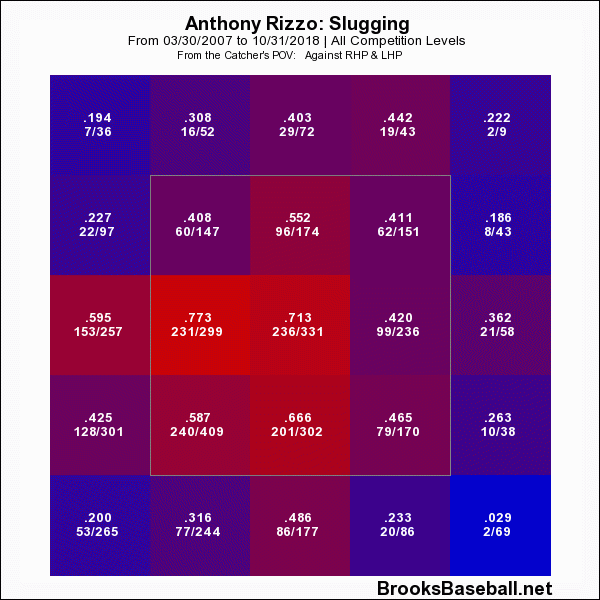
Even more encouraging, considering Rizzo’s age, is that he was deadly on inside pitches this year. Here’s his career slugging by zone before the year and then this year:

You don’t think of Rizzo yanking outside pitches over the wall, because he stands so close to the plate it doesn’t look like they’re outside pitches. This year he turned on the pitches that jammed him even more. The worry with players crossing the age-30 threshold is that they can’t catch up to velocity and can get jammed inside. Neither of those things were a problem for Rizz this year.

If there are red flags with Rizzo, it’s health. 6-4 first-basemen who have had back issues for three straight years now should make anyone breathe a little deeper for a moment. This year was by far the most amount of games he’s missed. Some of that was due to a freak ankle injury, which isn’t anything chronic. The rest was the back issue in August and April, and now that he’s in his 30s that’s probably just going to be a thing that happens. When it starts to slow down his performance, that’s anyone’s guess.

Contract: Rizzo has two team-option years left at $16.5M each.

Welcome Back Or Boot In The Ass: Face it, there would be a small to medium uprising if the Cubs ever thought of moving Rizzo. Given his production and salary, he would have huge value of course, but this is essentially the heart and soul of the team. The real debate will be in two years when he’s a free agent and also 32, but let’s table that as long as we can. Given his adjustments, it’s hard to see Rizzo falling off a table production-wise in 2020, unless that back causes him to miss more than just 10-15 games a year.

Perhaps the only thing new we’d want to see from Rizzo is something we can’t quantify and don’t actually see–which means we’re only guessing–is his leadership of the team. It’s not that he isn’t a leader, because he’s THE one. But this team played loose all year, in the bad way, and we know that Maddon’s style caused some of that. But players should hold their teammates accountable too, and Rizzo hasn’t really been that type of guy. He’s a loose, fun dude too. And while he might seem boisterous to us from the outside and leading things in the dugout, those in the know will tell you he’s not really a hard ass ever or trying to keep the team coloring within the lines. That’s mostly going to come from the new manager, but it wouldn’t hurt that if inside the clubhouse there’s a sword that needs swinging, it’s Rizzo who’s doing it. But this is nothing more than a minor complaint or tweak.

While we read too much about trades that didn’t work out for the Cubs, remember the Cashner-for-Rizzo one helped get Josh Byrnes fired. We’ve got at least two more years to not worry about first base. And probably a lot more than that, before Rizzo’s #44 is on the right field foul-pole.