Everything Else

With only the second line having any kind of predictability, there looks to be a lot of open space for the younger crop of players in the bottom six. One of the more intriguing options is the massive Victor Ejdsell, who came over in the Hartman trade last year. Though he’s not likely to serve as a savior for anyone, he’s young, large, and has a big shot, so at least he’s something to look forward to.

2017–18 Stats

6 GP – 0 G, 1 A

43.3 CF%, 60.0 oZS%

Avg. TOI 13:19

A Brief History: Ejdsell is a curious combination of size and skill rarely seen around these parts. When Nashville shipped him over, his 6’5”, 214 lb. frame screamed, “Annette Frontpresence!” But Ejdsell, for all his largeness, has never been a plop-in-front-of-the-net guy. He came up at the end of the year for a cup of coffee, and outside of a surprisingly strong first game, which found him centering Brandon Saad and Patrick Kane, he looked lost and timid playing primarily between Alex DeBrincat and Dylan Sikura in his final five games with the big club.

Last year’s AHL playoffs is where Ejdsell shined, though. In 13 games, he scored 12 points (seven goals, five assists), including two series-clinching goals against the Chicago Wolves and Manitoba Moose. The biggest question mark on Ejdsell’s ledger was whether he could skate in stride, both based on his size and adjustment from the larger European ice. According to Jon Fromi, he never looked lost on the ice in terms of skating while with the IceHogs. Coupled with his booming shot and strong on-ice vision, Ejdsell has potential to come into his own this year.

The question will be where can Ejdsell play? He came over as a center, but there’s a bit of a logjam for the Hawks at center, and that’s not necessarily because of depth. With Jonathan Toews, Nick Schmaltz, Artem Anisimov, and Marcus Kruger all pretty much chiseled in as your centers, there’s not much Ejdsell can provide there (read: he won’t have an opportunity to provide there).

Fortunately, between the AHL playoffs, training camp, and preseason, Ejdsell has found himself on the wing more often, which likely will suit a man of his significant carriage more fittingly. Whereas the scouting report has often said that Ejdsell projects as a playmaker, given the heat on his wrist shot, he might find additional success pounding shots off of passes rather than making passes himself. Moving Ejdsell to the wing can also cover a bit for any holes in his skating and defense, which he projects to have based solely on his size and inexperience.

It Was the Best of Times: Best-case scenario sees Ejdsell blossom not as simply a winger but as a winger on his off-wing. A workable combination of DeBrincat–Toews–Ejdsell brings a ton of scoring potential to the de facto top line. For this to happen is to expect probably too much from Ejdsell. Because he’s not a crash-the-net type, Ejdsell would be responsible for making plays while Toews went to get the puck below the goal line. You’d also need to expect Ejdsell to improve on his backchecking skills, which might also be asking too much based on the fact that he’s probably never going to be anything more than an average skater.

But if everything went perfectly, a combination of Ejdsell’s instinctive playmaking abilities, big shot, and talented linemates could make Ejdsell a dangerous wild card on the top line. It would also solve the “Toews needs to score more” problem, since that onus would fall mostly on DeBrincat as a sniper and Ejdsell as a playmaker/shot pounder, leaving Toews to take the Marian Hossa two-way player responsibilities.

Finally, Ejdsell steps up as a key contributor on the power play. He found time on the PP in the AHL and did decently, and he parlays that potential into success on the second unit with Erik Gustafsson.

It Was the BLURST of Times: Ejdsell doesn’t make the team at all because his skating simply isn’t up to snuff. This would mean he would have to be a worse skater than Anisimov, which is almost inconceivable. He toils in the AHL all year and can never put it together. This opens the door for a third line of Kunitz–Anisimov–Andreas Martinsen, which is not a line that teams that make the playoffs have.

Prediction: Ejdsell breaks camp as a third-line winger next to Anisimov and Sikura. When Quenneville finally comes to terms with the fact that Chris Kunitz is not a first liner, Ejdsell gets a shot next to Toews and DeBrincat. He becomes a 15-goal scorer, three of which come on the power play with Gustafsson and Kane, and works well as a setup man for DeBrincat, racking up 40–45 points on the year. His defense is never outstanding, but it gradually improves as he learns his angles and how to use his length as a weapon when he feet aren’t up to the task.

I’m bullish on Ejdsell’s ability to take the leap forward this year. But I think that unlocking Ejdsell’s potential is tied to playing him on the RW with DeBrincat on LW, because as teams realize that they have to focus on DeBrincat’s ability to snipe, it will leave Ejdsell with more space to capitalize on his hard shot, especially his wrister. Playing Ejdsell on the right side will open up those shot opportunities nicely.

Previous Player Previews

Corey Crawford

Cam Ward

Duncan Keith

Connor Murphy

Brent Seabrook

Brandon Manning

Jan Rutta

Erik Gustafsson

Henri Jokiharju

Nick Schmaltz

Alex DeBrincat

Chris Kunitz

Artem Anisimov

Marcus Kruger

Everything Else

Box Score

Hockey Stats (SKY POINT)

Natural Stat Trick

The Hawks logged their first preseason win against a team that’s an anthropomorphic therapy session. I watched the game so you didn’t have to. Let’s kick it quick, because I have a couple double Cheesy Gordita Crunches I want inside me, ONE WAY OR ANOTHER.

Collin “Cucamonga” Delia and his superfluous L was one of the more surprising bright spots on the night. While he allowed both goals, neither were really his fault. The first came after Jokiharju (whom McClure tells me we are calling HJ from here on in, so remember that) and Dahlstrom decided to compare whose shit erupted out of the toilet bowl higher at the offensive blue line, leaving Alex Formenton alone on a breakaway. The second goal came after Delia made a strong save on Duchene during a penalty kill, only to have Duchene stuff the rebound past him. After that he was nails, shutting an admittedly shitty Senators team down, including a highlight-reel split save on Duchene in the second. He’s nowhere near ready for any meaningful time, but he’s nice to have in the back pocket.

– HJ looked abysmal in the first. He had a 33.33 CF% in the first while pairing with Carl Dahlstrom, whose only real skill appears to be winning second place in any Jared Dunn lookalike contests he enters. Away from Dahlstrom he was infinitely better, posting a 100 CF% (7 CF, 0 CA) primarily with Brandon Davidson for a grand total 54.55 CF%.

– Foley floated the idea of a Kruger–Johnson–Martinsen line out there, and after tonight, that might make sense at some point. Each had a goal and an assist. Again, this is against the Ottawa Senators, a team that traded Erik Karlsson for a pile of recycled toilet paper, but there was some cohesiveness out there. Kruger should be a lock to make the team, but Johnson and Martinsen might be OK in spots, too.

– It’s good to see Dominik “Screw You Guys, I’m Going Home” Kahun contribute as well. His third-period pass from behind the goal line to John Hayden for a goal was legitimately nice. It’s hard to figure where he’d fit on the roster, but it’s nice to know he’s not a complete schlub.

– Luc Snuggerud also looked decent tonight. He’s a lot bigger looking than I expected, and he came through with a solid 56 CF% at 5v5 in just under 15 minutes. He made a great sliding block on a 2-on-1 about midway through the second period. He also took the point shot that led to Kahun’s goal in the second. He’s another nice “if you need him” option back there, and with a little more seasoning, might become a nice third-pairing guy in the near future.

More than anything, I think we learned that even when they dress most of their good players—including Matt Duchene—the Ottawa Senators are an affront to not only the game of hockey but also theology and geometry. There were a lot of retreads and babies out there for the Hawks, but no one who matters looks utterly putrid, which is all you can ask for a game like this.

Everything Else

Kruger is only one season removed from being the firefighter you remember here, and we know that Q knows exactly what he is. Let’s say he’s an improvement on David Kampf. And he only has one year on his deal, so if he’s another charred remains of a beloved warrior of victories past, well whatever. . . . At this point in his career if Kruger matters too much you’re fucking sunk.Sam Fels, July 12, 2018.

Well shit.

Everything Else

If you believe that time is a flat circle, then there are two signings that make perfect sense. One is Brandon Manning, whose performance Q recently described in an after-camp interview as pleasing in the same breath as saying that Jokiharju will need to work on his decision-making if he wants to make the team. The other is Chris Kunitz. He came into the league when the Hawks were really bad and, barring a lot of ifs becoming yeses, will likely go out of the league when the Hawks are really bad.

2017–18 Stats

82 GP – 13 G, 16 A

50.2 CF%, 46.8 oZS%

Avg. TOI 11:57

A Brief History: Kunitz has been playing professional hockey since 2004. And believe it or not, he’s played mostly good hockey by the numbers over 14 years. Kunitz is a rare combination of GRITHEARTFAAAAAAAAART and actual talent, and unlike many other plugs teams sign simply because DEY WERE ON DA TEAM DAT WON DA CUP SO DEY KNOW HOWDA WIN, Kunitz usually contributed to his team’s success in ways that didn’t get the blood pumping to Mike Milbury’s gnarled shillelagh. Over all four Cup runs, he posted a healthy 51.5 CF% and contributed 29 points (five goals, 24 assists). His career 55 CF% is nice, and reflects both the talent he’s played with (Crosby, Malkin et al.) and the 55.4 oZS% he’s accrued over his career.

So what the silly shit is he doing in Chicago?

Last year saw Kunitz in a full-fledged fourth-line grinder role. For only the third time in his career, he started more often in the defensive zone than the offensive zone. Despite spending just 46.8% of his time on the offensive side of the ice, Kunitz still posted a 50.2 CF% with the infinitely talented Ning. He also scored 29 points, which would have made him #8 in the Hawks’s scoring totals last year, just two points off Artem Anisimov.

Given his contract this year (one year, $1 million) and usage last year, Kunitz would have been a no-doubt improvement for the Hawks on the fourth line. He’s a bit long in the tooth, but he can still be a gigantic boil on his opponents’ asses in terms of agitation and offensive production.

The problem, of course, is that Joel Quenneville has no intention (and perhaps no option) to use him as he should be used. Early in camp, he’s on the top line with Jonathan Toews. With all the what-have-you about how Toews needs to up his scoring if the Hawks want to stand a chance, it’s hard to understand how having Kunitz on his left side helps him do that. Kunitz is slower and less handsy than he was in his heyday. Maybe, if you really, REALLY squint, you can justify having him on the right side next to Alex DeBrincat and Toews, but if it’s come to that, then this year is already a burning clown car with a stuck horn.

And of course, in the organ-I-zation’s constant attempt to tie their own hands behind their backs while pissing into a headwind, Kunitz has a No Movement Clause. So, if he manages to have a decent year and turns into trade bait, he will have all the leverage in picking which team the Hawks can even potentially trade him to. That’s fine from a high-level players’ rights lens, but I don’t see any reason why the Hawks had to give him an NMC in the first place, and I’ve given up on trying to figure it out.

It Was the Best of Times: There might still be some gas in Kunitz’s tank. In a best-case scenario, he hunkers down the fourth line with Marcus Kruger and I guess John Hayden, and they serve as a strong shutdown line with a bit of scoring flair in Kunitz and Hayden. In small doses, Kunitz plays on the right side of the first line with Toews and DeBrincat, playing the role of Annette Frontpresence and taking the Wide Dick route of having Toews and DeBrincat fire shots at him instead of the net. He scores 15–20 points by the trade deadline and agrees to a trade to Toronto for a second- or third-round pick in 2019.

It Was the BLURST of Times: Kunitz spends most of his time on Toews’s left side, which is where DeBrincat should be if Q is dead-set against throwing Top Cat–Schmaltz by the Bowlful–Garbage Dick out there regularly (and of course he is). This means that either DeBrincat has to play on the right side (recall that even though Top Cat is righthanded, he’s goofy-footed in that he’s more comfortable on the left wing) or, god forbid, on the third line again. When approached by upper management about a trade, Kunitz declines.

Prediction: With this team looking more and more like the West Lake Landfill—which, I shit you not, is a smoldering landfill fire approaching a radioactive waste dump outside of St. Louis, a more apt metaphor for that dogshit city I cannot think of—I suspect Kunitz will play more time than anyone wants on the top line. But with Dominik Kahun promising to fuck off back to Germany if he’s not on the team this year, maybe Q does DeBrincat–Toews–Kahun (which is a problem itself) and lets Kunitz troll around the bottom six, which is where he belongs at this point in his career.

The nice thing about Kunitz is that he’s fine. He’ll be OK if in the bottom six, frustrating on the top line. Much like how this season looks to bode, his presence is an overall shoulder shrug, a constant reminder that nothing gold can stay.

Previous Player Previews

Corey Crawford

Cam Ward

Duncan Keith

Connor Murphy

Brent Seabrook

Brandon Manning

Jan Rutta

Erik Gustafsson

Henri Jokiharju

Nick Schmaltz

Alex DeBrincat

Everything Else

As we move down the Hawks’s agonizing back-end, which at this point resembles someone who’s fallen into a porta-potty in a Super Mario Bros.-esque attempt to warp to a different place after the mushrooms really started to kick in, we reach a relative bright spot. We often bemoan the fact that the Hawks don’t have a puckmover on defense anymore, given Duncan Keith’s wrestling match with the ravages of time and Joel Quenneville’s hatred of everything beautiful in Michal Kempny. But if you squint, Erik Gustafsson can maybe fill that need.

2017–18 Stats

35 GP – 5 G, 11 A

55.4 CF%, 57.4 oZS%

Avg. TOI 18:33

A Brief History: You may remember Erik Gustafsson from such films as Signing a Two-Year, $2.4 Million Extension in the Middle of March and Scoring 11 of His 16 Points After the Extension. (What do you know? A guy scoring a bunch after his extension.) While that’s clearly a coincidence, Gustafsson does bring some intrigue.

In 35 games in 2017–18 (all of them post-Corey Crawford), Gustafsson posted a 55.4 CF%, good for second among all Hawks D-men in that category, behind Cody Franson (58.44 in 23 games). Couple that with his 54.0 CF% in 2015–16 over 41 games and you have a D-man with a cumulative 54.7 CF% over 76 games. That’s a pretty good start.

Additionally, Gustafsson’s xGF% last year sat at a robust 52.78, meaning that the Hawks could expect to score more than their opponent when he was on the ice. Even better, Gustafsson’s Rel xGF% was an obscene 8.42, meaning the Hawks were 8%+ more likely to score as a function of Gustafsson’s presence. Small sample sizes be damned, those numbers portend potential at the very least.

It’s important to look at whom Gustafsson played with to get those numbers. Last year saw Gustafsson skate a glut of his time next to Brent Seabrook and behind the Patrick Kane line, which you may have deduced based on his 57.4 oZS%. And really, it’s been that way his entire 76-game career: Gustafsson has skated with Seabrook and Kane more than anyone else.

Gustafsson also contributed a bit on the power play, which is where he has the potential to be most intriguing. In just over 49 minutes of PP time, Gustafsson racked up four assists—two primary and two secondary. For comparison, it took Keith almost 213 minutes to rack up two goals, three primary assists, and five secondary assists. It took Seabrook 171 minutes to post two goals, one primary assist, and five secondary assists. So, the rate at which Gustafsson contributes PP points vastly exceeds the rates Keith and Seabrook—Q’s go-to guys on the PP—contribute. Granted, the sample sizes are askew, but it’s something interesting to consider, since the Hawks PP has been beaten around the head with an oversized marital aid the past two years.

Of course, Gustafsson did all of this while spending nearly 60% of his time in the offensive zone. And there are legitimate questions about his defensive abilities: Namely, does he have any? But some of the fancier numbers show that he might not be a total loss on defense. His HDCF%—the measure of high-danger chances for vs. high-danger chances against—was 51.03% last year. His CF% Rel was a robust 6.6. And his 2:1 giveaway/takeaway ratio at 5v5 was the best among Hawks defensemen (Keith, Murphy, and Forsling were the only other D-men who had ratios under 3:1, not counting Franson).

Make no mistake: Gustafsson is an offensive defenseman. But he’s not the worst defender the Hawks have ever seen. With the right pairing and more exposure, the Hawks might have an advantage in Gustafsson’s offensive skills.

It Was the Best of Times: Best-case scenario, you pair Connor Murphy and Gustafsson, which essentially makes them your top pairing. This creates another problem regarding whom to pair Keith with, but pairing Gustafsson with Murphy gives him more range to be creative with the puck and start rushes with the Nick Schmaltz line while Murphy hangs back. I don’t have any proof of this other than my eyes, but Gustafsson and Kane look to have natural chemistry on the ice.

In this scenario, Gustafsson is your PP1 unit’s QB. For nearly a decade, we’ve screamed into the rain about how for all of Keith’s greatness, he’s never been much of a PP QB. Handing the reins to Gustafsson can’t possibly make the PP worse, and it has an added bonus of relieving Keith of his duties, giving his legs a couple hundred minutes of desperately needed rest.

With more time and more responsibilities, Gustafsson becomes a 40-point contributor and puts the Hawks’s PP in the Top 10 for the first time since 2015–16.

It Was the BLURST of Times: Quenneville’s galaxy brain does what it did to Gustav Forsling and uses Gustafsson as a defensive defenseman alongside Jan Rutta. Gustafsson struggles horribly, and halfway through the year, the Hawks trade Gustafsson to St. Louis for the rights to install three Imo’s stands in the concourse where Bobby Hull pisses and pukes on himself when he’s not on camera. He goes on to score 20 points in 30 games, vaulting the Blues to the playoffs. He proceeds to develop into Duncan Keith Lite, spending the rest of his career assisting Vladimir Tarasenko and posting 30–45 points regularly.

Prediction: Gustafsson plays most of his time on the second pairing with Seabrook, but moonlights with Keith for a few small stretches. Barring injury, he contributes 25–30 points over 75 games, most of which come playing with the Schmaltz line. He splits time with Seabrook as the PP2 QB and still manages to contribute 10 PP points.

Of course, Quenneville finds a reason not to like him at some point, and there are spots where Brandon Manning plays instead of him, especially in games when Gustafsson posts a 60+ CF% but happens to be on the ice when, I don’t know, Artem Anisimov pukes all over himself in the neutral zone, leaving Gustafsson alone to defend a 4 on 1.

I think Erik Gustafsson will be good. I sincerely believe that he has Top 4 potential (though he’d be the fourth man in the Top 4). I think I’m the only one here who believes that.

Previous Player Previews

Corey Crawford

Cam Ward

Duncan Keith

Connor Murphy

Brent Seabrook

Brandon Manning

Jan Rutta

Everything Else

Motherfucker.

Diving into the 2018 free agency pool for defense was never going to go swimmingly for the Blackhawks. Sure, there were rumblings about John Carlson’s availability, but even if he hadn’t re-signed in Washington, paying him $8 million per over a two-term presidency was neither realistic nor wanted, given all the griping we’ve done about Seabrook. Calvin de Haan may have been nice, but he ended up in Carolina for $4.55 million per over four years. Thomas Hickey also could have maybe been a thing, but the 2007 #4 overall pick signed with the Islanders at $2.5 million per over four years. Once those three came off the board, you’d have thought the Hawks would scrape the bucket for a PTO guy like Franson to throw maybe $1 million at.

Instead, the Hawks went out and gave a two-year, $2.25 million per contract to Brandon Manning, a PTO talent at a Thomas Hickey price. ARE YOU HAVING FUN YET?

2017–18 Stats

65 GP – 7 G, 12 A

50 CF%, 45.6 oZS%

Avg. TOI 17:57

A Brief History: First off, fuck this guy. Brandon Manning spent most of his junior career sucking, and in an effort to get noticed, he—in his own fucking words—”fought nine or 10 times that year and stuck up for my teammates and made some big hits.” Jesus Christ bare-assed on the cross, Stan Bowman and Joel Quenneville actually called Brandon Manning and told him, “We need a guy who doesn’t really score and can play physical.” Just keep giving Q the biddy, StanBo, it’s worked so fucking well in the past. Really good start here.

Manning went undrafted before latching on in Philadelphia—a place nothing less than perfect for a booger-eating buffoon whose calling card was protecting grown men on skates from other grown men on skates—in 2012. He spent most of his career with the Flyera doing nothing aside from tripping and breaking the collarbone of Connor McDavid in 2015, allegedly telling McDavid that he hurt him on purpose during a game in 2016, recanting when McDavid talked about it publicly, then getting his ass punched in by the aptly named Patrick Maroon as retribution in 2017. WHAT’S NOT TO LIKE ABOUT THIS SIGNING?

In his first two full years, Manning spent most of his time in the offensive zone not contributing offensively. Last year was a bit different. He spent just 45.6% of his time in the offensive zone but contributed a career high 19 points. He broke exactly even at 50% on the CF% front. That’s somewhat encouraging, especially since he played most of his time next to living ghoul Radko Gudas and his aircraft carrier forehead.

But as we are wont to do, once you dig into the fancier stats, things look less than good. His xGF% (expected goals for percentage) was 48.89, which means that Manning’s opponents were expected to score more often when Manning was on the ice than the Flyera were. The closest Blackhawks comp Manning had in this category was Jordan Oesterle (49.00), who, as we all know, is one of the suckiest sucks who ever sucked on defense.

Further, his Rel xGF% (relative expected goals for percentage) was -2.22, which means Manning brought the likelihood of the Flyera scoring a goal down about 2% while he was on the ice. The closest Blackhawks comp from last year is Jan Rutta (-2.24).

And fuck it, let’s go even deeper, because the Hawks brass obviously couldn’t be bothered, as evidenced by the fact that they signed Brandon Motherfucking Manning. Manning’s HDCF%, which measures the percentage of high-danger chances for vs. high-danger chances against, was 47.31, good for second worst on the Flyera. This means that when Manning was on the ice, opponents were more likely to take shots from high-danger zones. High-danger shots are more likely to become goals. Since Manning himself doesn’t generate offense and apparently isn’t great at suppressing high-danger shots, it would seem that having him on the ice against anything but bottom lines is a recipe for disaster, especially if anyone but Crawford is in net.

So, he’s a combo of Oesterle without the KEEP FIRING ASSHOLES mentality and Rutta. And all this for just $2.25 million a year for two god damn years. Whose loins aren’t frothing?

It Was the Best of Times: Best case, Manning becomes part of a trade package for Erik Karlsson. Or, with contract negotiations for Darnell Nurse reportedly breaking down, they do Hall for Larssen II with Manning for Nurse. Barring those miracles, Manning plays fewer than 10 games because Jokiharju pulls a DeBrincat and makes it impossible not to play him. In the time he does play, Manning puts three or four points up and wins a fight or two, and the Hawks can trade him for something not called Brandon Manning. If he can’t be traded (he can’t), Quenneville shocks us all by learning what a sunk cost is and makes him a consistent healthy scratch.

It Was the BLURST of Times: We cannot stress enough how asinine this signing is. The fact that he was signed at all is a worst-case scenario. But he’s here now, he’s going to play, it’s going to suck, and it’s up to us to imagine how badly it’s going to suck. Worst case, Manning slots with Seabrook on the second pairing, because Manning played Top-4 minutes in the playoffs for the Flyera last year, a series in which Manning tossed a 48.77 CF%, 35.83 xGF%, and a hilarious -14.88 Rel xGF% against the likes of Crosby and Malkin.

StanBo throws his entire dick into his pet theory that Manning has gotten better with age and is on the verge of a breakout. That doesn’t happen, of course, because Brandon Manning sucks and would be better served in the boxing ring having his dome caved in nightly like the palooka he is. He channels his inner John Scott and becomes an insufferable monolith, both on and off the ice. After serving as a $4.5 million paperweight in his two years here, Manning uses his money to buy and close Al’s so he can open a Wawa there.

Prediction: Brandon Manning is the most Tom Smykowski signing the Hawks have had since Jordan Oesterle. He spent most of his career doing much of nothing, couldn’t hack it on a team that started Radko Fucking Gudas with a straight face, then got a seven-figure settlement as Bowman (read: Quenneville) went drunk driving and smashed into him with a HOCKEY REASONS contract.

So, he’ll spend time on the Top 4 with Seabrook. He’ll be an unmitigated disaster at all times and still get looks over Jokiharju and Murphy because HE’S HARD TO PLAY AGAINST. He’ll stumble his way into 10 points and then be considered for an extension. We’ll get all sorts of think pieces about how much his teammates like him, yet none of his teammates will offer that thought without priming from whoever’s in charge of pushing that narrative that day.

Just burn the whole building down.

Previous Player Previews

Corey Crawford

Cam Ward

Duncan Keith

Connor Murphy

Brent Seabrook

Everything Else

Today is the first day in our monthlong look at what the ‘18–’19 Men of Four Feathers have to offer. We’ll give you a review of each player, a best-case scenario, a worst-case scenario, and a prediction. The style’s new but the face is the same. Let’s kick this pig into life, after the first missed playoffs in a decade. We hope you enjoy.

In times of doubt and sorrow, there are always coping mechanisms. Wild Turkey 101. Watching The Crow on a loop. Asking strangers to put on a clown mask and open-hand slap you until you feel something, anything. And with the organ-I-zation’s handling of Corey Crawford’s status since last year, we might have a chance to experience all three at once this year.

2017–18 Stats

28 GP – 16 W, 9 L, 2 OTL

.929 SV%, 2.27 GAA

.935 EV, .931 PP, .902 SH

30 SA/Game

A Brief History: Last year, we had a chance to test McClure’s theory that the Hawks will live or die by Corey Crawford. And boy, did we find out. Prior to Evgeni Malkin catapulting himself into Corey like the bag of over-ripe compost and chewed-off thumbnails he is, and Crawford’s subsequent December dizzies in New Jersey, Crow was on his way to having the best year of his career.

– His even-strength SV% of .935 and short-handed SV% of .902 at the time of his demise eclipsed his final stats from his Jennings-winning year in 2013 (.934, .895), in about the same number of games (28 vs. 30) and with a less talented team in front of him.

– His overall SV% of .929 was the best of his career to that point.

– His GAA of 2.27 was tied for third-best of his career—behind only a 2.26 in 2013–14 and a comical 1.94 in 2013.

He managed these numbers despite facing 30 shots per game, as Joel Quenneville regaled us with his yearlong “I can touch my asshole with my elbow” strategy of pairing piss and poutine on his blue line in front of Crow. It may be folly to assume he could have maintained all of those numbers, but it’s clear that Corey was putting together a Vezina-contending year before he got shelved.

Before his unexplained 30-week absence, the Hawks sat at a disappointing but still-in-contention 39 points through 35 games. In those 35 games, they only lost more than three in a row once, losing five in a row at the end of November/beginning of December, four of which Forsberg started. They proceeded to post 37 points over the next 47 games—including losing streaks of four games, five games, and eight games—without Crow in net.

While there are several reasons why this happened, none loom as large as losing Crawford.

It Was the Best of Times: Going forward, best-case scenario, Crawford rises from the grave and doesn’t miss a beat. He plays his usual 55-game, 3,300-minute year at a .920+ clip, bailing out the defensively declined likes of Erik Gustafsson and Brent Seabrook, giving Jokiharju a chance to take risks, and preventing teamwide deflations from the kinds of backbreaking goals Forsberg and Berube were so primed to allow. This lets Cam Ward channel his 2005 essence in relief, and we all go back to gushing about how the Hawks know how to pick backup goalies. Assuming that guys like Saad and Toews rebound; Sikura, DeBrincat, and Schmaltz continue to grow into Top Sixers (I’m banking on both happening); and Quenneville puts down his fucking copy of House of Leaves before he pairs his defensemen, having Crawford back makes this a playoff team.

And since we’re doing best-case scenarios, let’s go even farther. Crawford finishes as a Vezina finalist behind Jonathan Quick or some other such horseshit because the NHL drinks from the piss troughs at Wrigley before they give out awards. Pat Foley finds time in between chugging Night Train and giggling at his own jokes to heap praise on Crawford like an incel at a sex doll brothel. Eddie O. openly admits that Crawford is the best goaltender the Hawks have had since Tony O. The Hawks team up with Taco Bell to give away free cheesy gordida crunches for every Crawford shutout, and we all get 10 free cheesy gordida crunches.

It Was the BLURST of Times: Crawford disappears from hockey completely. Like a scorned lover, StanBo and Q answer all “Do you have a timeline on Crawford?” questions with a dead-eyed “Cam Ward is our goaltender.” The narrative turns to “He told us he’d be ready, but now he refuses to skate for us.” Cam Ward tosses a .870 SV% on the year, and the Hawks finish dead last in the league. Edmonton wins the draft lottery, and the Hawks name Bobby Hull as the GM. The Hawks trade Crawford and DeBrincat for Patrick Marleau and Jake Gardiner, and sign Roman Polak to a 1-year deal. Everyone eats Arby’s as we wait for the Yellowstone Caldera to explode and finally end the fucking madness.

Prediction: Because I take Crawford’s word over StanBo’s or Q’s expectations, I suspect we will start the year without Crawford between the pipes. Crawford misses the first 10 games, but comes back and posts a tidy career average .919 SV% and 2.37 GAA on the year. He drags the Hawks into the last playoff spot by himself and still has his GRIT N’ HEART questioned by people who unironically wish Scott Foster were the starting goaltender. His brilliance goes underappreciated all year, but it doesn’t matter because the Hawks squeak back into the playoffs.

It can’t rain all the time.

Everything Else

It’s been 19 days since the Blackhawks drafted Adam Boqvist with their first pick. It’s been 10 days since they signed Cam Ward, Brandon Manning, and Chris Kunitz. It’s been at least a week since any new flareups of the Hawks discussing a trade for Justin Faulk. And until someone of significant carriage traverses into the Convention to reach out a taint-damp hand to low-five the only player who can save the Hawks by himself, we won’t be able to confirm that Corey Crawford is even alive, let alone fit to play hockey.

While it is the doldrums of hockey summer, what the Hawks haven’t done stands at odds with all the scowling and growling about how things need to change and the unacceptability of quick-ending or absent playoff runs over the past three years. The dearth of activity is mostly in line with what the rest of the Central has done so far, save the Blues, but the Hawks were never really in a position to do as others have done this offseason.

But what it is that they can do now? They were spurned by John Tavares, and even if they had been allowed into the room in the first place, can you see the Brain Trust signing Tavares for more money and a higher spot on the depth chart than Jonathan Toews? Erik Karlsson—however unrealistic it is to hope for him—is still out there, but what would it take for Ottawa to even consider that? Are you comfortable shipping DeBrincat and Schmaltz out as part of that deal? The Hawks likely don’t have enough to offer even if DeBrincat and Schmaltz were both part of the deal, but if they did, would it worth it, especially if Karlsson wouldn’t want to re-sign?

The last big rumor we heard on the Faulk front was that Tom Dundon—who is working hard to establish himself as Not a Moron™ with his acquisition of Dougie “Don’t Call Me Yancey” Hamilton—wanted Brandon Saad in return, which the Hawks declined. So, we have an idea for what Dundon would want for Faulk as it stands, and it doesn’t look like he’s willing to sell short on him. The Hawks don’t have anything close to a player comparable to Saad (who would have thought that large, fast, 25-year-old, two-way wingers would be hard to come by?), so what can they even offer that’s in the same ballpark? Can you justify trading Schmaltz or DeBrincat for Faulk? In a perfect world, you’d jettison Wide Dick and Sikura. But given the original asking price of Saad and all the reports that say that the Hawks prefer to keep Anisimov, that seems vain (and maybe undoable, since we don’t know which 10 teams Arty has on his no-trade list).

Of course, all of this is probably moot if Cam Ward takes the lion’s share of starts. The continued silence around Crawford is a huge cause for concern, even when the Hawks go back to their boilerplate, “We expect him to be ready.” They’ve been expecting him to be ready since January, so the song remaining the same doesn’t really tell us anything.

And that’s where you might start to get itchy. The Brain Trust has been pounding their fists on the table about how things are going to change, but the only changes they’ve made so far include signing two guys who are old enough to use their ages as a basis for a calendar and a REAL HARD-WORKING defenseman who doesn’t move the puck and whom not even the Flyera wanted. As the summer churns on and the Hawks sit stagnant like an above-ground pool in Naperville during divorce proceedings, it becomes more and more likely that those were the changes they wanted to make. That’s a terrifying idea for next year.

I get that the Hawks have no obligation, and probably no desire, to keep any of us abreast about what they are or aren’t doing. It might be possible that they know for sure that Crawford will be OK and just aren’t telling anyone for HOCKEY REASONS. They might believe that this team as constructed is a playoff team. If I squint, I can maybe see it. But that requires Saad to show that last year’s shooting percentage was an anomaly. It requires Toews to dig himself out of an offensive decline that’s gotten worse over each passing year. It requires DeBrincat, Schmaltz, and Vinnie to further elevate their offensive games, and for guys like Sikura, Ejdsell, and Hayden to prove they belong in the NHL.

And then there’s the defense. Without a puck mover like Faulk or Karlsson, what is this D-corps supposed to be? Past a pairing of Keith–Murphy, which is by no means guaranteed in the first place, you’re working with what, Gustafsson–Rutta and Manning–Seabrook? That’s a whole lot of borderline 2nd pairing guys at best, AHL fodder at worst. It’s possible, and perhaps necessary, that Jokiharju can make the leap to the NHL at the tender age of 19, but even if he does, is Q going to use him?

There’s still some time and opportunity for the Hawks to make a splash at a puck-moving defenseman, which they desperately need as Keith’s engine starts to falter. Whether they can make a trade for one of them with what they have is becoming increasingly doubtful. But if they don’t, the silence that we want to interpret as calculated trade scheming must be viewed as the silence of men without answers whose asses will be one big blister if this year is a repeat of last year. And because no one from the front office can or will clarify exactly which direction the Hawks are going in, all we can do is assume that we’re in soft rebuild mode and hope that guys like Jokiharju, Boqvist, Schmaltz, and Top Cat are a core they can build around.

They told us change was coming. It might already be here.

Everything Else

There’s a bit of a fuzziness to it, but John Hayden ended up playing more than half of the games on the schedule for the Blackhawks. He was here until January, got sent down to Rockford, then came back up in March. Do you remember much about what he did? Because I sure don’t.

John Hayden

47 GP, 4 Goals, 9 Assists, 13 Points, -4, 54 PIM

47.6 CF% (Evens), -6.4 CF% Rel (Evens), 48.97 SCF% (5v5), 45.06 xGF% (5v5), -5.5 xGF% Rel (5v5)

 44.8% oZ Start (Evens)

What We Said: He probably won’t be more than an answer to a trivia question in a few years (Who was the 20th Yale Bulldog to crack an NHL roster?).  He’s the Atlas Shrugged of hockey players: not nearly as great as his proponents say, an overhyped tome of theoretical muck whose pedigree rests mostly on his size and standing out among the mediocre.

What We Got: Going into the season, we asked, “Who is John Hayden?” Well, he’s not quite a scorer, and he’s not quite a fighter, but man. . . . So to answer the question, I don’t know.

The best answer I can come up with is probably no more than a bottom-six puck absorber. And really, that’s all Hayden will ever have to be on the Hawks. In the time he was up, he spent most of his time with other Blackhawks castoffs, Lance Bouma and Tommy Wingels. You’ll certainly take the 13 points he provided skating primarily with and against the dreck of the league.

The most surprising thing about his year was his zone-start ratio. When we previewed Hayden at the beginning of the season, I wondered whether Hayden was a “start in the offensive zone” kind of guy, and this year showed he wasn’t. He tended to fall more into what would have been a Marcus Kruger–line role. And all of his advanced stats reflect that: His Corsi and expected goals for percentages all reek of a guy who spends most of his time in the ass-end of the ice.

Hayden also played the role of tenured fighter, leading the team with four fights. I had always held out hope that with his improved skating, Hayden could be a sneaky scorer on the bottom half, but it looks like the Blackhawks expect him to be the guy who initiates fights for HOCKEY REASONS. Much like every Yale graduate ever, the idea of John Hayden being more than an exhausting waste of time and money always flatters to deceive.

Where We Go From Here: Assuming Hayden doesn’t get traded to a team looking for some dick-swinging grit (looking at you, Tom Dundon), he’ll likely do the same thing he did last year. He’ll putter around on the fourth line, have a few fights, then play a few shifts with Toews because he’s DA BIG BODY WIT A BIG HEART DEY NEED IN FRUNNA DA NET. We’ll see a few flashes of skill from him before he bares his red, overeducated ass, because the myth of the rough-edged hockey fighter scraping out a living despite the odds gives no quarter.

Ideally, we’ll see Hayden on the fourth line with guys like Kampf, Wingels, and Highmore. He’s a useful guy if you’re looking to build a line that acts as a big meat slab, which looks like the direction the Hawks are going to go with him, judging by his fancy stats and zone starts. He might even be able to find a home next to guys like Ejdsell and Sikura, and that might work out too. He’s got just enough skill to run with guys like them, and doing it on the bottom lines might open the Hawks up to some much needed depth scoring.

At the end of the day, John Hayden is like the Kevin Orie or Jorge Fabregas of the Blackhawks: Just good enough to stick around, but never much more than a hazy memory.

Everything Else

Brandon Saad’s year was an extended cut of Lisa explaining why the electric violinist was better than she seemed. You had to look at the stats Saad WASN’T underwhelming at to appreciate his year. But when the whole point of bringing the guy back was to give Toews more support and even shoot for a 30-goal season, it makes the My Chemical Romance-ian angst over losing Panarin for him more understandable (even though it’s misplaced).

Brandon Saad

82 GP, 18 Goals, 17 Assists, 35 Points, -10, 14 PIM

56.7 CF% (Evens), 5.7 CF% Rel (Evens), 54.93 SCF% (5v5), 52.15 xGF% (5v5), 3.63 xGF% Rel (5v5)

 60.2% oZ Start (Evens)

What We Said: While I can see a 30-30-60 year from him, expecting 70–80 points might be asking a bit much . . . Having him out with Toews could bring about a renaissance for The Captain . . . His all-around game is a welcome aspect for a team that lost one of the greatest back-checkers of all time, and should help re-establish the Hawks as a strong possession team.

What We Got: Saad had a year of unexpected firsts. It was the first time that he finished with a negative goal differential. It was the first time he finished with a shooting percentage under 10%. It was the first time he finished the year with fewer points than the last. By their powers combined, these aspects turned what was supposed to be the rekindling of our love affair with Hossa Jr. into a season of grumbling and disappointment. And as painful as it is to admit, by the metrics that matter most—namely, goals and points—this was a massively disappointing year for Saad.

We can go on about how Saad had his best possession year since 2013–14 (in which he had a 58.5 CF% in 78 games). We can talk about how Saad’s CF% Rel this year was his best ever in a Hawks sweater (trailing only last year’s 6.4 in Columbus). And you know I want to tell you how all of his problems were anomalous, the result of a precipitous and unforeseen drop in his shooting percentage. (If he had shot at his 11.8 S% average he had prior to this year, he would have had 28 goals this year.)

But with Saad coming off three consecutive 50+ point seasons, that all looks like a bunch of excuses for a poor performance or a stubborn justification for trading Panarin, even though it isn’t. All those numbers bolster the “Saad is still a great player” argument, but they don’t explain why his shooting percentage was down so much.

If you go back and watch some of Saad’s scoring opportunities, you’ll notice that there seems to be about a half-second delay between when you’d expect him to shoot and when he actually took his shot. I don’t know whether this hesitation is a matter of confidence, timing, or simply losing a little bit off his fastball, but it was more noticeable this year than ever before. Rather than puckering your sphincter for what you’d assume would be a scorching one-timer, most times Saad had a good scoring chance, you’d find your shoulders slouchier than usual and your gut hanging over your jeans just a little bit more woefully, knowing that if he didn’t launch the puck straight into the goaltender’s chest, it was going to go a little too high or a little too wide.

Not knowing why is the hardest thing to process. As unfulfilling as it is to read what amounts to a shoulder shrug and a “what can you do,” it looks more like a season-long malaise than some underlying problem, given Saad’s body of work over the last five years. Everything else looked as good or better than expected, except, ironically, for his play with Toews.

While the Saad–Toews tandem was by no means bad, bringing Saad back didn’t have the effect we had hoped. In the 750 minutes they played together at 5v5, they were a possession monster, with a 57+ CF% and a 52+ High-Danger Chances For Percentage (HDCF%).

But they also got pummeled in High-Danger Goals For Percentage (HDGF%), to the tune of 42+. Away from Saad, Toews sported a throbbing 61+ HDGF%. Away from Toews, Saad had a flaccid 38.89 HDGF%.

Additionally, both Saad and Toews had better—albeit below their average—on-ice shooting percentages away from each other: Together, they had a 6.41%; Saad without Toews had a 7.39% (7.6% individual on the year); and Toews without Saad had an 8.62% (9.5% individual on the year).

All of this is to say what we’ve been saying all year: The chances were there for Saad, and they just didn’t go in. Unless you buy the idea that Saad peaked at 24 (and if you do, go back to work, Peter Chiarelli), there’s no explanation for it other than sometimes the bear just eats you.

Where We Go From Here: Saad was an offensive disappointment, but he did everything else as good or better than before. And if Crawford stays healthy, maybe we’re sitting here talking about how Saad overcame his scoring demons in the playoffs and laughing about how stupid hockey can be. Instead, after an underwhelming year from both the team and the man, we’re subject to asinine chatter about trading Brandon Saad (for what, who knows?). Anyone who tries to sell you that tripe is probably a good candidate for the ol’ Moe Szyslak fork in the eye, given Saad’s career trajectory to this point.

Saad will be 26 next year, right in his prime. He’s still a possession dynamo with outrageous transition speed for a skater his size. And if he produced at just his career rates, he would have had the best offensive season of his career this year. Saad is still young, still important, and still capable of being everything we hoped he would. He just seemed a little hesitant this year. It could just be that Saad–Toews needs a finisher—whether that’s Kane, DeBrincat, or potentially Vinnie—to complete that line. And I can hear the “DAT SOUNDS LIKE ARTEMI PANARIN IF YOU ASK ME” snark a mile away, but when it comes down to it, I’ll take a younger, more well-rounded Saad at $6 million than an $8–10 million sniper like Panarin, if I have to choose one.

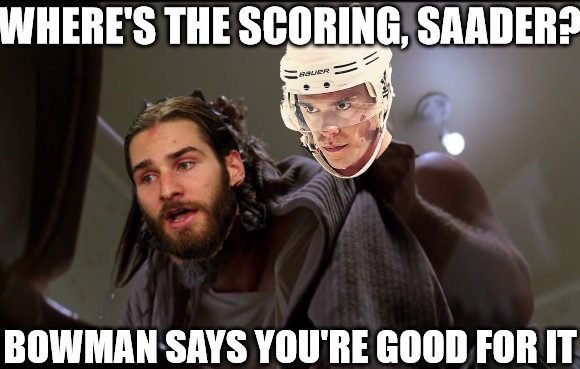
Still, Saad will need to prove, for the first time in his career, that this year was a blip for his offensive output. Bowman said he was good for it, and it’s down there somewhere. Let’s let him take another look.