They blow chunks.
Let’s not waste anymore time on this.
Previous Team Previews
They blow chunks.
Let’s not waste anymore time on this.
Previous Team Previews

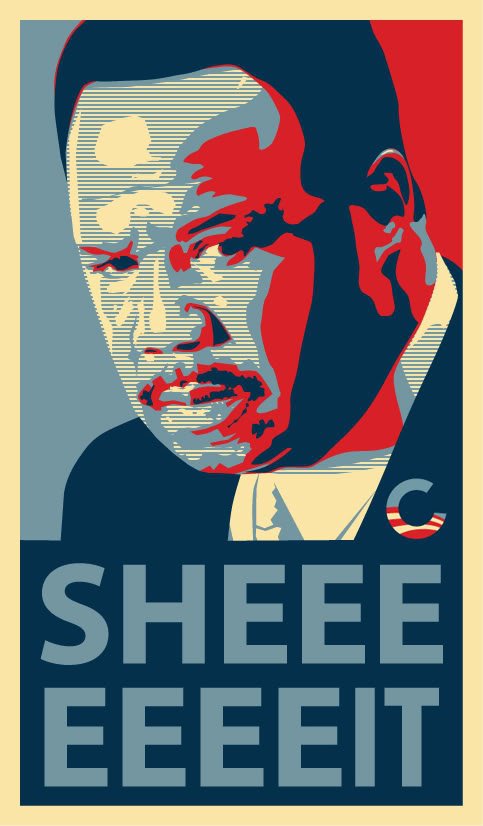
David Kampf is not a sexy player in any sense of the word—not in the general sense of a flashy player nor in the actual definition, see picture above as evidence—but he’s one of the Hawks’ only options for a defensive-minded center. He’s undeniably a bottom-six guy, but if he can flourish in a third-line role, so be it. He may not be Marcus Kruger when he was at his peak, but we’ll have to deal with what we have. Let’s take a look:
63 GP – 4 G – 15 A – 19 P
49.4 CF% (0.56 CF% Rel) – 36.4 oZS%
48.6 xGF% (4.85 xGF% Rel)
Avg. TOI: 13:55
A Brief History: Speaking of Marcus Kruger, Kampf was basically groomed to be Kruger 2.0 last year since the actual 2.0 version of Kruger the Blackhawk was a disappointment (sequels always are, and yet they just won’t learn). Kampf centered the third line most of the time, taking over 60% of his zone starts in his own end, and he had a month-long stint on IR with a broken foot. The Hawks pretty much sucked during his absence, but then again, they pretty much sucked a lot, including when he was around. They re-signed him at a bargain price of $1 million a year for two years, so at least they’re not repeating the Artem Anisimov mistake and overpaying for a 3C/4C.
It Was the Best of Times: Ideally Kampf grows into being a shutdown center and a component of a not-vomit-inducing penalty kill unit. You could see him with Drake Caggiula or maybe with his elder version Ryan Carpenter, where they do the Spiderman meme and one is on the wing and the other is at center. Or, maybe Brandon Saad ends up back on the third line (kinda feels like when, not if, with the only question being duration), or whatever other jamoke from the collection they got going will slot in.
If Kampf can adequately handle dungeon starts and improve his possession to being above water, we’ll be satisfied. If he can improve his scoring we’ll be downright pleased. If he can help the PK be anywhere close to functional we may even be happy (no we won’t).
It Was the Blurst of Times: Kampf remains the definition of “a guy” and contributes little other than literally taking up space. He sucks on the PK yet Colliton has few other options so we’re stuck watching him there. And, he’s offensively useless and the Hawks have no one better to replace him with and/or can’t include him as an extra piece in a trade before the deadline. That’s a pretty bleak picture. Given the amount of jamokes I just mentioned, I imagine SOMEONE could take Kampf’s spot and he would disappear to the land of wind and ghosts unless we can trade him.
Prediction: Kampf will likely fall somewhere between the best- and worst-case scenarios just outlined (wow, there’s some hard-hitting analysis, no?). He’s not going to become some elite scorer or anything else other than “a guy,” but he will be a decent guy. Young, cheap, and with a defined role that he only needs to meet, not some lofty position he must reinvent himself to achieve, Kampf will be reliable in his own zone, fairly uninspired in terms of scoring, and not the dregs of the bottom six.
All stats from Hockey Reference and Corsica Hockey

A ho-hum affair in which the Chicago Blackhawks kicked the shit out of the Wings in just about every way except the score. We’ll do a quick clean up, since I’m in preseason drinking form.
– Alex Nylander is clearly going to get every chance to make Stan Bowman look like not a moron. Tonight saw him with three good plays and one not so good one. First, the three good ones. In the first period, near his own blue line, Nylander dropped a good backhand pass to a streaking Toews, who nearly peeled away for a breakaway. Second, also in the first, he made a good drop pass to Keith for a nice setup that didn’t really go anywhere. Third, he made a subtle pick play in the second period that freed Kane to hit Keith on his slapper goal. All in all, not bad.
But Nylander completely boofed a wide-open opportunity. With Toews crashing the slot with possession east to west, Nylander had the near post yawning. Toews slipped a pass to the area Nylander was supposed to be in, but Nylander wasn’t at all ready. This is a perfect example of Nylander loafing when the puck isn’t on his stick. If he stays engaged on the play, it’s an easy goal. I truly hope he gets that out of his system soon.
Aside from that, Nylander was perimetery all night, but you wouldn’t know it with Eddie O lavishing praise on him for not shitting his pants. He’s the Jonah Falcon of the preseason so far.
– Dominik Kubalik is probably going to be good, even if his last 40 minutes were uninspiring. In the first, he had a nifty pass to a wide-open Saad in the low slot (which Saad couldn’t pot, because this is how it’s always gonna go) after some great pressure along the near corner from Kampf. I’d like to see Colliton roll the dice and put him with Kane and Toews just to take advantage of that wicked shot he’s got.
– If you are under 18, please don’t watch this video of Adam Boqvist.
He was quiet otherwise, but goddamn. If that translates at all to the NHL, all of our wailing and gnashing of teeth about this blue line may end up in the ether. Yes, he has a ton of work to do in his own end. But you can live with some bed wetting if that’s the offense you’re gonna get. Fuck, they’re gonna give Gus 6×6, and he doesn’t do shit like this.
– Crow didn’t get hurt and looked good doing it.
– Dennis Gilbert getting into a preseason fight was as unnecessary as a Betamax of your own conception.
– Based on Pat and Eddie’s coverage, we can safely state that the scoreboard was the best off-season acquisition.
– Maatta and Seabrook were paired tonight. They looked very good against the Grand Rapid Griffins, which was a serious question going into the game, which is exactly what you want from your presumptive second pairing.
Everyone else is either a lock on this team or AHL fodder, though I’d be surprised if Gilbert didn’t come up for air at some point.
Onward.
Booze du Jour: Bulleit bourbon and Miller High Life
Line of the Night: “Unlike the NFL, these guys wanna get their reps.” –Eddie O in mid-season form on players playing in the preseason.

Did you know the Habs finished two points out of a playoff spot last year? I sure didn’t. Considering all the noise they make and all the complaining they do that you have to pay attention to them because of HISTORY and CULTURE (that being that they speak the French language like they’ve had an aluminum bat taken to their cranium, I guess), that’s probably the quietest Canadiens season in history. They certainly are more loud when they just plain suck because of what a travesty of justice that is. But when they simply fade into the background…well, that’s rare. We should cherish it. And it could happen again.
44-30-8 96 points (4th in Atlantic)
3.00 GF/G (14th) 2.88 GA/G (13th) +10 GD
54.4 CF% (3rd) 54.6 xGF% (3rd)
13.2 PP% (30th) 80.9 PK% (13th)
Goalies: As it has been, as it will be, Carey Price takes the torture chamber that is the Montreal crease. It all begins and ends with him, which means any talking point about the Habs in La Belle Province has a 75% chance of being about him. At this point he must be used to it or totally deaf. Price was healthy last year, which was something of an upset, and he was…fine? A .918 in last year’s heightened scoring environment is better than it originally looks, but not up to the standard Price himself has set. It was also the second consecutive season he wasn’t up above .920, which is what the Habs are paying for with the $10M a year Price gets from here until AOC is on her second term in the White House.
At 32, there’s little to no reason to think Price is past it, other than maybe the higher-than-usual odometer reading thanks to his debut at a precocious age. The days of him putting up .930+ SV%s are over, but the Canadiens shouldn’t need that either. Price should be around .920 minimum, and another sustained season of health could see him creep up to .925 or higher which gets him back in the Vezina discussion, a place he used to call home. There are few goalies you’d take ahead of him if you needed to have a game to save your dog, that’s for sure, despite Pat Foley’s and drunken Hawks fan declarations that Corey Crawford is better.
Backing him up will be Keith Kinkaid, which as a backup is about as solid as you can get. He bailed out Corey Schneider in New Jersey for a couple years when Schneider’s body was turning into decommissioned flubber, though he himself was on one last year at .891. The two years before that were .913 and .916 though, and he definitely gives you representative-plus goaltending from the #2 spot. This is just about a question mark-less position for the Habs. Which they need, because everywhere else has more than a few.
Defense: As we tour the skaters of Montreal, you’ll notice they don’t have a frontline player in either spot. There’s no genuine top-pairing defensemen here, and really no genuine top line forward either. They are going to try and do it with faded stars, foot soldiers, or didn’t-quite-get-theres. I’m contractually obligated to tell you they think Shea Weber is still a top man, but injuries and time have eroded whatever mobility he had. Stand him up and give him time and he still has a doomsday gun of a shot, but that didn’t help their anemic power play much last year in the rare times he was actually upright.
They signed Ben Chiarot from Winnipeg, except no one has ever pointed out whatever it was Chiarot did with the Jets that’s supposed to make me shorts get tight. Jeff Petry and Brett Kulak are serviceable puck-movers down the lineup, and Jordie Benn has a beard. Victor Mete had a rough go in his first full go-around in the league but is the real promise on the squad here, if Claude Julien doesn’t have him racked in Victoria Square.
There’s just not that much special here, which makes their glittering metrics all the more shocking. The forwards once again will have to do most of the work in transition, which affects how much they can finish, as you’ll see…
Forwards: Again, no frontline talent. The Canadiens would love to argue that Max Domi is, but that would be the definition of pissing in my ear. He’s fine, he’s a good rhythm guitarist but not a lead. Jonathan Drouin has had every chance in the world now to prove all the hype he got and bed-wetting he did were worth it, and he hasn’t yet. Brendan Gallagher is a highly effective forechecker/net front pest/garbage-goal getter, but that’s it. Domi led this team with 72 points. Tomas Tatar was the second-leading scorer. When Tomas Tatar is among your leading scorers, that makes you the Red Wings of four or five years ago. And where did that get them? Face in the dirt, that’s what.
And the Habs haven’t really done anything to improve it this year. Ryan Poehling looks sure to be on the team, and Nick Suzuki just might, but to expect them to carry the flag…er, torch…sorry, hate to insult your tiring hands you pompous fuckwits, is beyond ambitious. We love Phillip Danault around here, but he’s a checking center who should chip in scoring. Not the engine of your second line. That’s what he has to be on this team.
The hope would be that Jesperi Kotkaniemi has an offensive leap in him at 20 to go along with his already stellar 200-foot game. And maybe he does, but again, that’s pinning hopes on a 20-year-old.
Still, as mentioned above, the Habs were able to carry some very impressive underlying numbers last year. They did that because even if the forwards aren’t blessed with dash and finish, they are with speed. All four lines here can really go, so they can pressure everywhere on the ice, help out their d-men deep in their zone and still get up to the offensive end. That leaves them pretty tired, and it doesn’t do a lot when you’re creating attempts and chances that you don’t have a lot of finish to make count. But if they can match those metrics again and get a slice of luck, maybe they could find the extra points they need to make the playoffs.
Prediction: They’re in the wrong division. It’s hard to see where they’re going to make up ground on any of Toronto, Boston, or Tampa, which leaves them scrapping for a wildcard. Luckily, there isn’t much impressive in the other division, and Columbus’s spot is certainly going to be marked available. Any bump up from Price, or an unforeseen SH% spike from a forward or two and the Habs could get there. Or their aging defense can’t be held up by Price, and the forwards can’t do most of the work again and they’ll miss by a lot.
Previous Team Previews

If you’re the NHLPA, or any member in it, headlines like this shouldn’t exactly settle well:
The smiling faces were real. NHL owners are ecstatic with the players’ decision. Now comes the tricky part. My column from today’s BOG meeting: https://t.co/nS4acBxmzW
— Pierre LeBrun (@PierreVLeBrun) September 18, 2019
Now, there may have been a time in my life where I truly believed that all that meant was that everyone was happy, everyone realized the damage that could be done by yet another work stoppage, and that everyone was interested in growing the game together. That was a wonderful time in my life. I work really hard to get back there, even though I know the road there is pretty much impossible to navigate and pass. It’s gone forever, and all that’s left is this broken down old man (yes, Shawshank was on late last night on IFC. Why do you ask?)
But when a billionaire is smiling and excited…well, one, flee the fucking room if you’re a woman, and two, the only other thing that gets them excited is the thought of more money. Seriously, that’s the only way their heart pumps, and this is how you get the state of the country today. Now again, maybe they’re just happy they can continue making money at this pace without a work stoppage, but you all know I’m more suspicious than that. I’ve been through this once or twice.
There definitely seems to be an element of relief in this, which means that the owners A) genuinely feared a strike by the players, B) feel like they gained something. Which means they had something to lose, which means the NHLPA actually had some leverage.
And we know what that leverage was. There’s an expansion franchise coming on the books in two seasons, which meant a strike the season before that carried over would have put at risk their start date. There’s also a new TV deal coming the season after that, which means talks for that start relatively soon, and you wouldn’t exactly be dealing with a position of strength with NBC or ESPN or Fox or wherever this goes if you weren’t playing games or a large threat of not playing games was hanging over the talks.
Now that said, this is almost certainly what the players were looking at. They want that TV deal to be bonanza too, or as close as hockey can get to a bonanza, and then grab more of the booty for themselves. That’s fair. They erred in not somehow including expansion fees into the last CBA as part of shared revenue (perhaps placated by the 25 extra jobs), and maybe that’s something they could have come after if they’d walked off the job. Don’t smirk, because the owners came after back-diving contracts in the last CBA that used to be legal, so we know retroactive action is on the table.
Maybe the TV deal will be much bigger, and maybe the tweaks the PA and the owners are working toward has enough included for the players with that TV deal that they feel they shouldn’t get in the way. That’s what we can’t know.
LeBrun in this piece says the two sides could hammer out an extension with tweaks to the CBA in the coming months, but I’ll believe that when I see it. The owners now don’t have any urgency and the players discarded the one card they have. While the players say their one bitch is escrow, I find that hard to believe and also don’t see a way around it. It also only really affects players up the scale on the payroll, though no one likes getting shit taken out of their paycheck (even when it’s for the things that everyone needs, but that’s another discussion).
Maybe the players have a plan to just go to a fixed amount that the salary cap is calculated from, instead of a formula that can change from year-to-year or month-to-month even. Maybe they’ve gotten more creative. Still, when you have smiling owners you know something is bad. And while the players may think they have pulled off a real coup here by letting the US TV deal play out unscathed, and they’ll just get a bigger slice simply because, it seems like they’ve forgotten whom they are dealing with here.
And we’re still talking about a system that has multiple restricted free agents waiting for contracts, who are the ones who are going to carry this league. That’s proof the system isn’t working correctly, and also proof that no matter what they say, owners will continue to spend money to win (at least most of them), if only to the cap. Perhaps they should have played on that more?
-There is one aspect of escrow the players take up that I’m not convinced I agree with. You can see it here or here. It’s this idea espoused by Jonathan Toews and others that the players have no responsibility in growing or marketing the game. I just can’t get there.
In one aspect, hockey players have created the unwritten rules or culture that individuality is bad or that anyone who stands out in a dressing room is a problem. Call it the “PK Subban Clause.” (include the racial undertones if you want or not) It’s the players who enforce this idea that everyone has to be the same and completely dull, and that anything with flash and sizzle is to be stamped out and discouraged from ever starting.
Except it’s flash and sizzle that sells, and perhaps if more players had a personality and weren’t afraid to show it, and spoke up in the press in ways other than tired cliches, people might take notice. Hell, you don’t even need the media now. Every player has access to Twitter and Instagram, and can be their own bullhorn if they want. You can get directly to the fans. How many do?
If the players are going to throw all their toys out of the crib over escrow and revenue not increasing how they were promises, are they really going to trust the owners to do that and give them more money? How many times do you have to be bit by the scorpion before you stop taking him across the river? Don’t expect them to do all the work for you.
Secondly, the players are the ones who could easily get rid of fighting and the other bullshit that holds the game back, but they don’t. And while they may think it’s an element that makes the sport unique and intriguing to the outsider, if that were the case we’d have seen major growth from the sport already. They keep the goons and talentless hobos in the league by blanching whenever the idea is brought up to get rid of it. “Part of the game.”
Well, no one watches your game. So maybe it’s not all that necessary?

Do you ever catch yourself? Maybe you’re sitting at dinner with a friend your significant other, talking about the news or whatever, and you have to stop a moment. A wide, ill-intentioned grin spreads across your face. You must look crazy. You start cackling like a maniac. You can’t stop laughing like you’re the fucking Joker. Your friend looks at you with deep concern in their eyes. People around you are staring. It’s uncomfortable for everyone. But you can’t help it. It’s just too hilarious to believe (You signed up for that look when you decided to write here – ED).
You just remembered that the Blackhawks got Alex DeBrincat in the second round.
Does that ever happen to you? Cuz, same. Now please come tell these cops I’m normal and bail me out of jail.
82 GP – 41 G – 35 A – 76 P
49.68CF% (0.48 CF% Rel), 59.75 oZS%
53.66 GF% (5.71 GF% Rel), 46.47 xGF% (0.93 xGF% Rel)
17:42 Avg. TOI
A Brief History: DeBrincat showed that his 2017-18 season was no fluke last year, building upon that and then going above and beyond the production. He became a nightmare for opposing penalty killers under Coach Cool Youth Pastor, posting 24 points (13G, 11A) with the extra man. You may be thinking that kind of PP success is artificially inflating his overall numbers, but as I detailed back in April during player reviews, that’s a pretty normal rate for elite scorers. Believe it or not, good offensive players score on the power play. This is news to Joel Quenneville.
DeBrincat also got something of a personal and personnel favor (folks, you get this kinda wordsmithing for just $3.99 a month, and that’s less than half it’s true value) in the form of the Dylan Strome trade. I don’t need to rehash it all, but obviously for Top Cat it must’ve been nice to get a linemate in Strome that A) he was familiar with and B) was not allergic to shooting the puck like Nick Schmaltz was. All of this resulted in Top Cat cementing himself as this team’s third best forward and likely has him positioned for a healthy contract extension this coming season.
It Was The Best of Times: DeBrincat continues to ascend with his offensive abilities, and being able to play with Strome for more of this season helps both of them elevate their games. It’s hard to ask too much more of a guy fresh off a 41-goal season, but DeBrincat is probably capable of pushing that number closer to 45, especially now that the Hawks will have a full season of the Colliton PP system. On top of that, his scoring ability becomes such a threat that defenses have no choice but to focus in on him, opening up the ice for him to use his vision and passing to find others, and he gets his assist total over 40 as well. He ends the seaon with 90+ points and leads the team in scoring, but not until after the Hawks lock him up at 6x$8.5M which will end up feeling like a huge discount.
It Was The BLURST of Times: The Colliton power play turns out to be a mirage, and even Top Cat can’t save it. Even with all the offensive talent the Hawks have, they return to the dark days of the early 2010’s (power play frustration wise, of course) and his production there drops to a meesly 10 points. Meanwhile, his linemates turn out to be huge duds, and he gets dragged down with them. He ends up with a paltry 55 points (oh, the horror!) and that 6x$8.5M extension feels a little expensive suddenly.
Preiction: It’s hard to ask much more from Top Cat than what we’ve gotten from him. He’s already done more than many scouts believed he would in the NHL, but that’s because hockey scouts are egg-brained. I’m somewhat inclined to believe that the Top Cat we saw last year is the Top Cat we will continue to see moving forward, though he’s certainly capable of giving or taking 10 more points. I predict he finishes the year with 43 goals and 40 assists, with something around 30 of the total points coming on the power play. Oh year, and he signs a 6x$8.5M extension. That feels fair, right?
Stats from NHL.com and Natural Stat Trick
Previous Previews
I’m a firm believer that preseasons in basically any sport are not worth getting stressed out about. They’re an extended audition for those on the fringes of the team, ostensibly they shake off some rust (debatable), and you’re just happy if the important players don’t get hurt.
With all that being the case, don’t take anything I say too seriously (like I normally demand serious consideration around here), because the Hawks looked pretty shitty tonight but I am not—I repeat NOT—letting it get to me, and neither should you.
–Robin Lehner looked less than comfortable tonight. He played half the game, gave up two goals and finished with an .882 SV%, which again shouldn’t give anyone ulcers but my bigger problem was that he was all over the place, and not in a good way. He was flopping around and losing his net; the second goal was a direct result of him using the crease as a slip-and-slide and the puck dribbled away from him and into the net. I get athleticism and all that, but flailing shouldn’t be the result.
–Kevin Lankinen did just fine, on the other hand, and the goals he gave up weren’t really on him—the defense got mesmerized (shocking, right?) on the first one, and the second was off Dahlstrom’s leg on a PK that looked characteristically chaotic. He finished with a .905.
–None of the core looked particularly impressive. Alex DeBrincat and Dylan Strome were quiet, Andrew Shaw whiffed on at least three or four shots and was pretty useless, Brendan Perlini did nothing, Slater Koekkoek was Slater Koekkoek, etc. Great seats still available.
–So Connor Murphy and Carl Dahlstrom are going to be our shutdown pairing, huh? At one point in the second period they had, respectively, 11 and 10 CF%. You did not mis-read that. But I know, I know, it’s a dumb preseason game, who cares. They ended with a 45 and 40 CF% so whatever, and Dahlstrom did get an assist, so yay?
–Who the hell is Philip Holm? I swear I was paying attention this offseason and during training camp, and I’m telling you I’ve never heard of this guy. But he scored a goal, he had a great keep on the power play that resulted in the third goal (he got the assist), and at 44.4 CF% he was behind only Murphy in possession for d-men. Sign him to a 7-year deal right now.
–The organ-I-zation is REALLY excited about Andrew Shaw being back and they want you to know it. During both intermissions they played an interview with him (hello, mute lounge), and I know my personal animosity towards him is clouding my judgement but I am already exhausted with this dummy. He nearly dropped the gloves in the third period—this is a PRESEASON game, lest you forgot. But there was plenty of stupidity to go around. De la Rose and some other oafs went after noted tough guy Alex DeBrincat late in the third after the Wings had re-taken the lead. So that shows you the level of play we’re dealing with here.
Two games, two losses, not freaking out yet. Onward and upward.
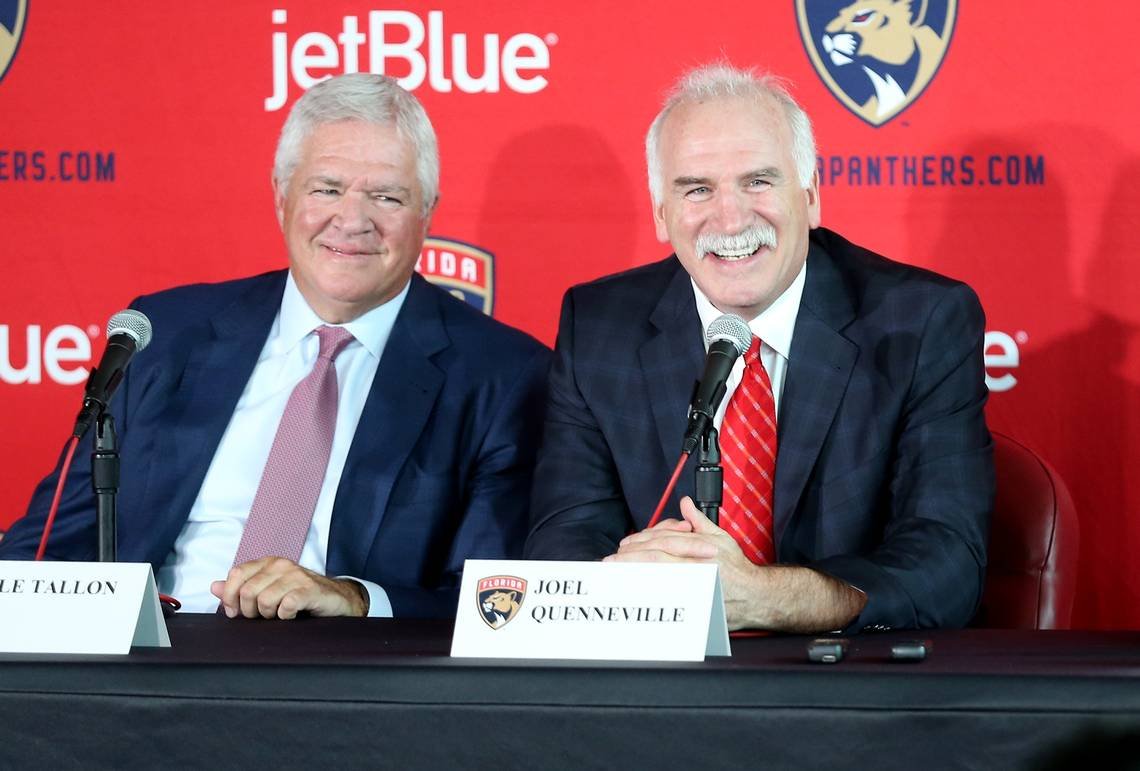
Well there are a couple of quite familiar faces, aren’t they? The departed namesake and an instant hall of fame coach will try to bring a level of sustained competitive hockey to south Florida that they haven’t seen since…well…ever. As batshit as it sounds, Uncle Dale and Joel Quenneville never even spent a full season together here in Chicago, but they’re going to try to make this thing work in Sunrise even if it kills them both. And it just might, but at least now they’ll leave behind nice bronzed and pickled corpses.
36-32-14 86 Pts, 5th in the Atlantic
3.22 GF/G (9th), 3.33 GA/G (28th), -13 GD
49.42% CF (16th), 48.45% xGF (20th)
PP 26.8% (2nd), PK 81.3% (10th)
Goaltending: In a full 180 from a trick they had been pulling for the couple seasons previous wherein the Cats got solid netminding from an aging Roberto Luongo and James Reimer filling in whenever something fell off of him, last season the Panthers got absolutely no goaltending to help out what was a pretty spiky offense. Luongo started 40 games last year and arguably posted the worst numbers of his era-spanning career with an .899 overall and only a .906 at evens. Reimer was only a hair better at .900 and .909 respectively. Luongo decided that was enough to call it a career, and did so officially which hilariously dicked over the Canucks in having to eat the recapture penalty for the contraband contract they signed him to. Reimer took whatever he’s got left in the tank up the coast to Carolina, leaving Uncle Dale to have to revamp his entire goaltending infrastructure. Fortunately for him, there was an aging veteran in Sergei Bobrovsky who couldn’t wait to get the fuck out of Columbus and take the bags and bags of money everyone knew Dale was going to throw at him. Bob got a max seven-year term from the Panthers at $10 million per, which should take him until he’s 37. Even with the goaltending career curve being far more protracted than other positions, there’s always a risk of Bobrovsky’s crotch detaching given the high wire style he plays, and Joel Quenneville isn’t exactly known for his judicious management of goaltending workloads. Still, the Panthers were looking for an infusion of excitement both by landing a name and by potentially making some noise in the post-season. Bobrovsky certainly should get him there even if a) his overall save percentage numbers have been in decline for three years while staying healthy, and b) only last season did he have even a representative playoff run, having absolutely shat himself with the Jackets two trips previous. As of right now, 22-year-old Sam Montrembleaut will get first crack at the backup role, but it could be a rotating cast of thousands if Bob doesn’t play 70 games. Which he just might.
Defense: Once again Joel Quenneville will have an honsest-to-god #1 defenseman to work with, in this case it’s Aaron Eklbad, who somehow is still only 23-years-old. Q likes his top pairing guys to be able to do everything, and Ekblad is certainly capable. Over the past few seasons his overall possession rate isn’t necessarily one that’d be associated with a do-it-all blue liner, but when taking into consideration that he’s had the toughest starts out of necessity and has been paired with Keith Yandle for two years, the picture starts to get a little clearer. And the fact that Quenneville hasn’t personally drowned Yandle with his barehands in some secluded corner of the Everglades and then chopped up his body on a fanboat is truly an upset. Anton Stralman moved a little east from Tampa to Sunrise in the offseason, and while he’s always been a textbook 2nd pairing puck mover, last year he finally started to show some signs of wearing down. No one is quite sure what it is Mike Matheson does or who he is, but Dale is paying him a fairly hefty salary at $4.75 mildo to do it until the entire state is submerged. Mark Pysyk is a hold over from the Computer Boys era, so Quenneville will hate him and put him at forward. At the very least he’ll call him Mike Kostka if only out of spite.
Forwards: Sasha Barkov is probably the best kept secret in the league, and if Q and Bob have any kind of positive impact on this team, that probably won’t be the case for much longer. Barkov is probably the second best two-way player in the league behind Patrice Bergeron now that both Toews and Kopitar have aged out of that level of effectiveness. Barkov absolutely erupted for 96 points nobody saw last year when he finally had two competent full time linemates in a healthy Jonathan Huberdeau and the very shoosty Mike Hoffman, who had 92 and 70 points themselves respectively. Evgeni Dadonov was a nice surprise (albeit at 30) with 70 points of his own despite the fact that a hurt Vincent Trochek only played 55 games last year, and was hindered when he did play. If he bounces back to his formerly reliable 50+ point output, particularly with Brett Connolly here to now provide a bit more scoring depth, the Cats could have a little bit more bite (GET IT?) to an offense that was already top-10.
Outlook: Barring injuries, or Sasha Barkov turning to dust under the workload Quenneville is certain to give him, the Panthers have made enough improvements to interject themselves into the playoff picture in the east, more than likely as a wild card, as the top three spots in the Atlantic seem fairly secure in Tampa, Boston, and Toronto. There are enough “ifs” here to not make it a completely foregone conclusion, but if Bobrovsky is even slightly above league average as he declines, Quenneville’s system is one of the few in the league that produces actual, tangible results almost immediately, and the Panthers weren’t that far off the playoff pace last year. And January 21st at Club 1901 is sure to be a highly emotional reunion, count on that.
Previous Team Previews

We may forget his name. We may forget his point. But Ryan Carpenter is here, so here we go.
68 GP – 5 G, 13 A, 18 P
58.77 CF% (3.9 CF% Rel), 56.6 oZS%
40.98 GF% (-16.27 Rel GF%), 56.99 xGF% (0.39 Rel xGF%)
Avg. TOI 12:37
A Brief History: There’s been talk about how Carpenter is a Kampf clone, which wouldn’t be a terrible thing, given the defensive rigmarole we’re going to be drinking off this entire year. It might be even better than that though, as Carpenter has shown a bit more offensive skill than our David.
Carpenter’s 18 points last year were a career best, as were his CF% and oZS%. He’s pretty good at limiting high-danger shots in his own end in the limited time he’s on the ice. And he’s good on faceoffs, which we think is sort of the appendix of hockey skill but sure won’t turn it down if he’s got it. He can play center or wing, so he’s got some versatility in the most literal sense of the word.
His value shines brightest as a dungeon master on 5v5. Last year saw him mitigate high-danger threats in his own zone and turn the ice with regularity. But then again, he started in his own zone at just a 43.4% clip. Still, he’s always been sort of a defensive plug throughout his short career.
There’s some talk about how Carpenter can play on the PK, but I’m not so sure I buy it yet. Although Vegas was in the top half of the league for killing penalties last year (12th overall), Carpenter was sort of a ninth guy on the PK unit (or 10th if you’re pedantic and count the goalie). But given how awful the Hawks were last year, that might still be an improvement, especially if it’s minimizing high-stress defensive time that Jonathan Toews has to take.
It Was the Best of Times: Carpenter ends up as a fourth line RW/C who wins more than half of his faceoffs. Though he doesn’t spend nearly as much time in the offensive zone as he did last year, he builds off last year’s career high in points, potting 20 on the year. He takes some time away from Toews on the PK.
It Was the BLURST of Times: Shaw gets hurt and Colliton gets a case of galaxy brain and puts Carpenter on the first line.
Prediction: Carpenter is 28 and has a three-year, $1 million per contract, and that’s about the player we’ll get. He’s an older David Kampf with slightly more offensive skill. He’ll score some kind of fluky, greasy goal in the first 10 games and replace John Hayden as Eddie O’s adopted son, number and all. More importantly, he’ll do a decent job battening down the PK2 unit.
That’s about all you can ask from a guy like Carpenter.
Stats from hockey-reference.com, NaturalStatTrick.com, Corsica.hockey, and HockeyViz.com.
Previous Previews
Schadenfeude: noun, 1. Pleasure derived by someone from another person’s misfortune. 2. When your rival team is even worse than your team. See: 2019-20 Detroit Red Wings.
32-40-10 74 Pts. (7th in Atlantic Division)
2.73 GF/G (21st) – 3.32 GA/G (27th)
47.1 CF% (28th) – 44.5 xGF% (31st)
18.1 PP% (19th) – 77.1 PK% (28th)
Goalies: In my mind Jimmy Howard is at least 65 years old, but turns out he’s only 34. Only. It’s safe to say his best years are behind him, and while he wasn’t a trainwreck or anything last year, his .907 SV%/3.07GAA at evens isn’t exactly going to save this shitshow of a team. Jonathan Bernier isn’t going to do it either. He’s certainly a serviceable back-up, and let’s be honest neither of these goalies are going to be what sinks the Red Wings’ season, but neither of them are good enough to bail out this team either.
Defense: Why is Mike Green still playing? I guess plenty of Wings fans could yell that right back at me but with the words “Brent Seabrook” in the middle of that sentence. But that doesn’t change the fact that if Mike Green is on your top pairing, you’ve got issues. Last season the Wings were 28th in the league in terms of shots against per game, placing them in the esteemed company of the Rangers, Hawks, and Senators. Only one defenseman (Filip Hronek) was above water in possession last year, and just barely—he had a 50.3 CF%. We know a few things about shitty defenses around here, and that’s what the Red Wings have.
Green will probably pair with Danny DeKeyser, Hronek and Dennis Cholowski maybe, and Patrik Nemeth and Jonathan Ericsson will round out to the main six. Will Trevor Daley stink up the joint for a while? Probably! But who cares? Fuck this team.
Forwards: A lot of teams are stuck with one top line and nothing else, but the Red Wings are really taking this situation to a new level. Bertuzzi-Larkin-Mantha is a decent top line—really, Dylan Larkin is probably the only good thing on this team. But all three are young and could be good pieces to build around. Or maybe they can gtfo to better teams, I don’t know.
Frans Nielsen and Valtteri Filppula are your centers behind Larkin, with Luke Glendening probably centering the fourth line. Andreas Athanasiou isn’t horrible, but I swear I hate that fucker so that’s literally the nicest thing I’m going to say. Justin Abdelkader is still playing on this team, for God’s sake.
Now, they have young guys like Filip Zadina, Taro Hirose, and Michael Rasmussen, who may develop into something, but that’s by no means certain and they weren’t lighting up the scorer’s sheet in the playing time they had last year. This team was dead-ass last in expected goals for. And so it goes with a rebuild—it’s going to be a lot of trial and error.
Prediction: Yes, Steve Yzerman is back and people will try to find the upsides, but let’s not kid ourselves—the Red Wings are going to suck this year. It’s entirely possible they’re at the bottom of the division, and I couldn’t be happier about it. If they’re not, it’s simply because the Senators are proving yet again why relegation is a viable strategy the NHL should adopt. The Wings will end up with somewhere between 75-80 points, and Larkin will be like a poor man’s Connor McDavid—not, he’s not anywhere near as good as McDavid so please do not misunderstand me, but he’s young, talented, and wasting it on a terrible team. But too bad. Fuck this team.
Stats from NHL.com, Hockey Reference and Natural Stat Trick
Previous Team Previews