
Everything you need for tonight’s tussle with the Thrashers…

 vs.
vs. 
RECORDS: Jets 3-2-0 Hawks 0-2-0
PUCK DROP: 6pm
TV: NBCSN Chicago
LOOKING FOR AN AIRPORT: Arctic Ice Hockey
The Hawks will try and get their first points of the season in the second of seven straight at home, and they’ll do it in their first division game of the nascent season. The Winnipeg Jets roll in having won their last two, steamrolling both the Penguins and Wild after opening the season being looser defensively than the current bond on my windshield wipers (minor car repair is not my thing).
In their first three games, Winnipeg surrendered 14 goals in the three-game New York swing. They’ve tightened up to only let in three in the last two, but this blue line is a mess either way. Jacob Trouba and Ben Chiarot are gone, Dustin Byfuglien is off looking for answers, and what’s left is a shallow and brackish pool. Or Poolman (KARROOOOOGGGAA!). When your top pairing has Dmitri Kulikov on it, you know you have issues. Neal Pionk and Josh Morrissey aren’t doing much to help, which is why the Jets are surrendering the third most shots per game at a touch over 36. That’s even worse than the Hawks! It can happen!
But, as you know after all these years with the Jets as division foes, if there’s any team that can outshoot its defensive waywardness and lack of possession, it’s this outfit. Patrik Laine and Kyle Connor have switched places on the top two lines, which hasn’t stopped the top one from scoring even though they have some truly whiff-tastic metrics. Bryan Little hasn’t started the season yet due to brain injury, but Andrew Copp has filled in admirably. The Jets still have that hybrid checking line of Mathieu Perreault, Adam Lowry, and now Mark Letestu. They can do just about whatever you ask.
Because the Jets’ defense is a whatever is hopping cargo trains into town, Connor Hellebuyck is going to need to have a stellar season. So far so good on that one, as he’s up at .927 in three starts. The Jets do play tomorrow, hosting the Penguins this time, so the Hawks might get a look at Laurent Brossoit, one of the league’s better backups last year.
For the Hawks, it took two games for the lineup that shook out of Magic Training Camp to be blown up. To be fair to coach Kelvin Gemstone, the new look lines do make some sense, with the top three having the Puck-Winner-Playmaker-Finisher combos that Quenneville favored. Alex DeBrincat will shuffle up to play with Toews and Caggiula, and Kane will slot down to play with Dylan Strome and Andrew Shaw. The third unit that started so brightly against San Jose before being broken up and torpedoing the whole arrangement remains intact of Saad-Kampf-Kubalik (A little bit of the Kubbly!)
The shuffling doesn’t stop at forward, as Calvin de Haan‘s season debut has rejiggered the d-pairs as well. After being the low-hanging target that Colliton could call out, Erik Gustaffson is dropped to the third pairing with de Haan, as Colliton was shocked to find out that Gus can’t actually play any defense. Connor Murphy will join Duncan Keith, a pairing that just hasn’t worked as well as you’d think in the past. Still, Murphy is just about the only d-man on the roster with the mobility to cover for Keith’s wanderings and meanderings at his own line and down low. Maybe this time it will be different.
Robin Lehner will make his Hawks debut so Corey Crawford can get some air.
There are no must-wins in October, but it would behoove the Hawks to get off the schneid tonight. 0-2 is nothing more than a blip, whatever worrying signs contained within. But 0-3 starts to border on a whole thing, and it wouldn’t be too much longer before the Hawks have to play catch-up for the whole season. There’s already a strain and pressure on the players and coach and front office, and another biffed start to the season is only going to make it worse. Maybe this time there will be real consequences.
As if.
Considering the state of each teams’ defenses here, this one should have some goals. Entertainment is all we ask, and should get it to kick off a Saturday night.

For most of the summer, it looked like the Jets might struggle to get either of Patrik Laine and Kyle Connor into the fold by the season’s opening. Getting both seemed just east of Oz on the possibility scale. And yet they managed it. The strange thing was that they chose to lock up Connor long-term, while Laine only got a two-year bridge deal that won’t even take him into unrestricted free agency. But was it that strange, really?
At this point, it’s pretty well-documented how much Laine ran into the rock wall painted to look like a tunnel by Wile E. Coyote last year. From 44 goals to 30, from 70 points to 50, a 33% drop in shooting percentage, and some metrics that were truly horrifying. Meanwhile, Connor racked up his second straight 30+ goal season on the Jets’ top line, although his metrics weren’t all that impressive either. But when you’re skating with Mark Scheifele and Blake Wheeler, you’re probably always going to outscore what your metrics say.
Still, the thought that Connor was a product of his linemates and Laine had to do it himself was a popular one. It was even one Laine felt necessary to voice himself during the summer. If they switched spots, would Laine be the one the Jets felt they had to keep, and Connor the one they would wait-and-see on?
Connor actually spent as much time away from those other two forwards as he did with them last year. His attempts and shots per 60 percentage do go down without them, but the team’s goals-percentage when he was on the ice without them went up. More worryingly, the expected-goals count when down about five percentage points. The only thing that went up significantly was Connor’s shooting percentage, which appears to be blind luck thanks to the expected goals mark, and thus would explain the goals going up without Wheeler and Scheifele.
On the other side, Laine only got about 200 minutes last year with Wheeler and Scheifele, though that’s just about 15 games worth or so. Laine’s numbers hold steady whether he was skating with them or not. But what’s worth noting is how much worse the whole line’s numbers were than they were when Connor was on the top line. It’s four to five percentage points across the board. Quite simply, Laine was dragging them down.
So in that sense, it makes sense to see what Laine does for a further two seasons, and that’s both on the top line and away from it, to see who’s a product of whom. Laine’s bitching has got him on the top line this year to start though, where he’s put up 10 points in five games. And while the points are nice, once again the metrics say this line doesn’t work at all. Their Corsi % together is 29.7%. xGF % is 37.3%. Laine is outscoring it for now, but that can’t last much longer.
Meanwhile. Connor has been put on the second line with Nikolaj Ehlers and Andrew Copp, though that will be Bryan Little‘s spot again when he recovers from concussion. Their metrics still aren’t in the black, but they’re far better than what Laine is doing on the top line, though not with the end-product (three goals between them).
So it would appear that Connor is the more all-around player, capable of doing work anywhere, though we’ll obviously need a much bigger sample size. Laine is going to have to continue to shoot the lights out to outrun the fact that his line almost never has the puck. He’s done it before, but if he wants bigger numbers on his paycheck when these two years are up, he’s can’t stop.

Newish feature we’re running this year instead of just one Douchebag Du Jour. We can run a collective this way.
Paul Maurice – He could have stopped this Blues thing at the first hurdle. Instead he got an immensely more talented team to quit on him and let the monster out of the box. Kept his job though, which you have to be impressed by. Continually runs one of the dumbest teams in the league.
Dustin Byfuglien – Actually, ditching out on Winnipeg to drink on a beach somewhere is all of our dreams.
Winnipeg Airport – Because it doesn’t exist.


Notes: The Jets play again tomorrow at home so Brossoit could get the start tonight…Little remains out with concussion…seven of Laine’s 10 points have come in the past two games…Roslovic is the one tipped for a breakout as he’s playing for a contract out of his entry deal…

Notes: Lehner gets the start, and it’ll have been over two weeks since he last played. If he plays well, what’s Colliton going to do going forward?…Shuffles all around, and Brendan Perlini will make his season debut to take the place that Alex Nylander pissed away by not showing up…de Haan is healthy and will also make his season debut…


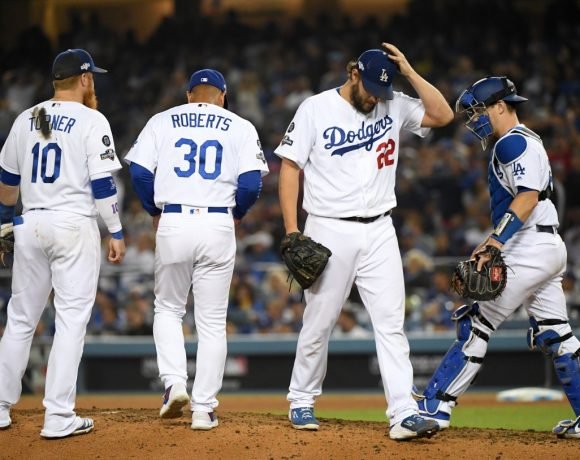
We might have to start calling Rob Manfred “Baghdad Bob” soon.
Anyway, if you didn’t see this yesterday, here you go. That’s Ben Lindbergh summing up at how the baseball is different this postseason than it was in the regular season. And if that’s not enough, you can use Rob Arthur’s Twitter account to basically give you the same stuff. Or his own article on BP. Or, if you watched Will Smith crush that ball in the ninth of Game 5 against the Nats, flip his bat, assume he was about to be LA’s biggest hero for a night and dreaming of all the velvet ropes that would be cast aside for him, only to watch it gasp for air and then wheeze out of life on the warning track, you knew something was up. Hell, even Howie Kendrick’s series decider, which he was celebrating in the box, only scraped the other side of the wall. There are other examples in the division round, but clearly what players knew all season to be homer contact/sound isn’t quite that in October.
We just went through a regular season where homers were flying at record and downright silly rates. And no matter what team you root for, you can think of a couple by your guys that when they were hit you couldn’t believe went out. For me, Schwarber’s arms only flip to the opposite field for his third homer of the day in Milwaukee immediately springs to mind. And yet for months, MLB and Manfred clung to the excuse that Rawlings had been “centering the ball” better as a reason for the greater aerodynamics of the baseball being used.
They finally relented, as if we could just ignore the fact that MLB itself bought Rawlings last season and this was the first time they were making baseballs under that umbrella for MLB. An organization worried about the lack of offense in the game. So MLB wanted you to believe that it either had no control over HOW A COMPANY IT OWNS MANUFACTURED THE VERY STARTING POINT OF ITS GAME, or that these things just happened naturally.
However, with the ball seemingly changing for its most important games, MLB has basically told you that what went on in the regular season is, at least somewhat, farcical. What they’re telling you is that they were terrified of some ridiculous homer deciding a series, a season, turning the direction of one or two teams for years possibly. Which means they think that homers in the regular season weren’t worthy of that, or hence not fair, or not right. They’ve essentially, partially negated all that went on between the end of March and the end of September. They’ve provided their own asterisk, which is a word that makes every baseball fan make a “blech” sound.
It’s not all that different than the NHL throwing shootouts out of its regular season tiebreakers and moving to remove overtime results from them as well. They’re moving in the direction of saying, “Yeah that’s fun to watch and all them but it really shouldn’t count. That was a sideshow.”
In the end, both teams are using the same ball, so it’s not like one team gets an advantage out of it or anything. But again, MLB will want you to believe that this just happened and they didn’t do anything to change the ball. We of course know this is horseshit, unless they think we’re that stupid. And they might.
Still, we can assume that MLB hyperactivated its baseballs because it thought that’s what fans wanted. And then when the most fans are watching, they kind of made a constipated face and thought, “Yeah, that was all kind of stupid, huh?” Which gives one the idea that MLB doesn’t really know what its fans want or how to get new ones, as TV ratings and attendance keep trending the wrong ways.
Me? I’m more along the lines of homers being dramatic and rarer than the mere “holding serve” feeling they took on during this season. That doesn’t mean that’s what everyone should want or the way MLB should go. I honestly don’t know. I just enjoy watching an entire league basically admitting it fucked up and not having the stones to see it through when the most important matters are decided.
Either MLB is deceiving everyone, or it simply cannot regulate how the actual baseball is produced. Neither speaks to a terribly competent organization.

In a rebuild, sometimes there are fan favorites who get left behind as the younger and more serious players are moved in. There was hope that Yolmer Sanchez would be the upset this year, a player not originally supposed to be part of the Sox upswing, could carve himself out a role when the games matter again. Yolmer didn’t really do that, but he might not have lost out totally either. Let’s run it.
2019 Stats
149 games, 555 PA
.252/.318/.321
7.9 BB% 21.1 K%
74 wRC+ .281 wOBA .638 OPS
7.0 Defensive Runs Saved 1.0 WAR
Tell Me A Story: Coming into the season, the hope must’ve been that after two full seasons on the Southside and entering his prime years at 27, Yolmer would see a jump in his offense to go with his above-average defense. And hey, his walks improved! That’s like, something, right? Sadly, the rest of his offense collapsed.
Two years ago, Yolmer managed 12 homers and a .400+ slugging, which for a third middle-infielder with a plus-glove would be almost a bonus. However, even with the flubber-ball in use this season, Yolmer homered exactly twice and slugged .321, which is like Patches and Poor Violet porous. Worse yet, Yolmer had a sub-30% hard-contact rate, so you can’t even argue a shred of bad luck for him. The mud is getting deeper here.
There was a difference in approach for Yolmer this year, as he was focused on going up the middle and the opposite way. Or he just couldn’t catch up to a fastball, your pick. But for a hitter like Yolmer who isn’t hitting the ball very hard, going up the middle and the other way can lead to even more soft contact and easy grounders and flares to a severely unimpressed and bored right or left fielder.
Another big difference for Yolmer this year was he simply couldn’t handle fastballs, and if you can’t do that you’re pissing up a rope. He hit .295 on fastballs in 2018, and that dropped to .201 this year. His work on everything else was acceptable-to-better, but if you can’t deal with a fastball that’s all you’re going to get, because most every pitcher in the Majors can execute a fastball (unless you’re MY GUY Dillon Maples).
As a left-handed hitter. Yolmer developed a hole in the upper part of the zone, which again, can quickly become death. For the visually-inclined:


Yolmer also saw huge jumps in the amount of whiffs at the top of the zone either middle or inside as a lefty. Whiffs above the zone you can live with. In the zone, well, you’re basically signed on for a pretty shitty year. Which is what Yolmer got. It was also a problem right-handed as well. Still, Yolmer was able to handle fastballs much better from the right side, hitting .317 against them then. He also had a an even 100 wRC+ as a righty, which may indicate where his future is.
Still, there’s nothing wrong with Yolmer’s glove, which is probably going to keep him in a job somewhere. Of all qualified second basemen, Yolmer had the best DRS in the American League and only trailed Kolten Wong in the whole of MLB. Considering he can fill in at third too when needed, he’s a good glove to have. Especially for a Sox team that could get a little goofy defensively.
Contract: Arbitration eligible, projected for $6.2M
Welcome Back Or Boot In The Ass: That arbitration figure is getting awfully high for a player that appears more and more to be glove only and is about to have his full-time job taken by Nick Madrigal. Which would make him an excellent candidate for a non-tender. He would be a nice security blanket late in games, but are you paying over $6M for that? Seems a stretch. Which sucks, because every team needs a guy with some goofy eyewear.

It’s funny that a bench player generates so much debate amongst a fanbase. Maybe it’s a result of signing a unique and somewhat unprecedented extension before the season. Maybe it’s just that David Bote was forced into more action than was ever planned thanks to Ben Zobrist’s four-month journey to catch the General Sherman. In the end, David Bote ended up being what David Bote was always intended to be: a pretty decent bench player. And he could be again.
2019 Stats
127 games, 356 PA
.257/.362/.422
12.4 BB% 26.1 K%
106 wRC+ .338 wOBA .785 OPS
-1.4 Defensive Runs Saved 1.5 WAR
Tell Me A Story: The season started for Bote when he signed a five-year extension that averages out to about $3M a year, though the actual salary escalates every season. It’s rare, maybe even unheard of, for a role player to sign an extension before even hitting arbitration. Or more to the point, it’s rare for a team to agree to it. It was Bote’s idea, and you can see why. What did the Cubs get out of it?
Well, you have to look past the contract a bit. One, Bote had been a loyal soldier, who’d been in the minors for six years before making his debut in 2018. It’s not necessarily a bad thing to show all the other guys in that spot that if you keep working, and stick with it, the Cubs will reward you. Second, Bote is a player who took to changes the Cubs wanted him to make because he was hitting the ball extremely hard in the minors but almost always on the ground. He took off after the changes, and again, it’s not a bad thing to show the rest of your system that if you listen and take notes and do the things they tell you, you’ll get rewarded. Whatever, Bote’s salary isn’t breaking the structure here or anything.
The original plan for Bote would have been to cycle in occasionally at second, third when Bryant went to the outfield, and probably start no more than two-three times a week. If that. But that all got blown up when Zobrist first didn’t hit at all, and then left the team. That made Bote essentially the starting second baseman, not something that was ever in the design.
And much like 2018, Bote started out really hot, with a 127 wRC+ in March and April, and an acceptable 106 in May. But also like 2018, there was a period where it felt like the league figured out that if you didn’t throw him low fastballs, you would get him out. He was awful in June and July, but closed hard in August and September, mostly through walking a ton (21% in August, 17% in September). He also slugged .565 in August, so he recovered or discovered something.
Perhaps what confounded Joe Maddon and the Cubs a bit is that Bote was reverse-split this season. 115 wRC+ and a.349 wOBA against righties, 80 and .296 against lefties. Which kind of combines with Bote doing better and better work as the season went along on breaking balls, but ones that broke away from him. And he actually ended up struggling on fastballs as the season went on.
Bote seemed to be concentrating on getting the ball in the air more, and he did better work up in the zone this year than last. It cost him so hard contact though, as his exit velocity went from averaging over 90 MPH last year to just 87 MPS this year. But his line-drive rate went up five points, and his launch-angle doubled. The dream would be if he could ever blend the two, and the Cubs might be inclined to think he can.
The problem for Golden Years here is that he makes contact way too infrequently. It’s below 70%, which is miles away from league-average. And the Cubs are going to be seeking contact wherever they can get it. Much like Happ, Bote can miss in the zone, which is something the Cubs are going to have to find a way to lessen. And seeing as how Bote will be 27 next year, the room for chance and improvement isn’t as large as it would be for a younger player. Doesn’t mean it can’t happen.
Defensively, Bote was mostly fine at second and better at third, his natural position. He could have gotten the Cubs out of more games at short to give Javy a rest than Maddon ever tried, but that’s not a huge cudgel to bash Maddon with. His versatility is probably what will keep him around.
Contract: Signed through 2024 for a total of $15M, two team-option years after at $7M per
Welcome Back Or Boot In The Ass: Considering he only makes $960K next year, there would be no reason to not have him back. And the only way you’d lose him now is via trade, and even in that he’d probably be something of a throw-in. Or a very minor deal returning maybe a reliever? But there’s no need. The plan is likely to just keep second base warm until Nico Hoerner is ready to take over full-time, be that April or June. Bote and Happ can certainly give you league average production for a month or two while waiting, and then be more than serviceable bench players after that. Obviously the trap door to that strategy is if Hoerner never claims the spot, and Bote and Happ are left staring at each other for a whole season there. Assuming both are here.
Bote walks a ton, so that mitigates some of his swing-and-miss ways a bit. If he can find a way to make more contact in the zone–he was another who eschewed going the opposite way and probably needs more of that–as well as rediscovering some of his hard-contact, he has the chance to be a real weapon. You can do a hell of a lot worse than Bote as a fifth or sixth infielder.

We joke a lot around here. Mostly it’s to keep from crying. It’s certainly better than thinking about anything you’ve seen seriously with this team the past couple seasons. Anyway, if you’re somewhat new or just missed it, we refer to “Magic Training Camp” because every excuse for the Hawks last year seemed to get back to the fact that Jeremy Colliton didn’t have a training camp. It’s why the penalty kill sucked. It’s why they were defensively awful. It’s why Duncan Keith and Brent Seabrook essentially un-velcro’d from the season. And we could keep going. It asked us to ignore that the fact that Colliton had five months in charge to install…whatever it was he was trying to install. The problem is we don’t really know.
So tell me, is this good?
Happy Friday, everyone!
PHI is good, CHI is bad, NJD is dull, and NYR/OTT are fun. That’s all I know.https://t.co/kE4W9SISMP pic.twitter.com/ZEtu4viqyk
— Sean Tierney (@ChartingHockey) October 11, 2019
Now it’s only two games. But it’s two games against one team that isn’t any good (Flyers) and another that wasn’t particularly interested in anything other than maybe getting their coach fired but couldn’t turn down the gifts the Hawks felt it mandatory to hand them (Sharks). So yeah, this is a problem. There’s all the time in the world to fix it, but it is a problem.
If it makes you feel better, the Hawks don’t have the worst PK in the league. Yet. The Devils have killed less than half their penalties. So we have that going for us. But still, batting 50% over two games, wherever they fall on the calendar, is less than ideal.
We probably all have a theory on why the PK sucks, and the thing is they’re probably all correct. Talent-level is an issue, Crawford probably could have made a save or two more, structure, entries, whatever. It’s all a problem. Ok, the goal on the PK against the Flyers was a fluke that bounced off Koekkoek, so let’s not hold that against them.
To me, the entries for the Sharks last night were way too easy. Again and again, the QB–generally Karlsson–would skate up to around the red line, hit a man along the boards on the blue line, and that player would immediately pop it to a charging teammates at the line through whatever Hawks forward thought it was a good idea to go charging out to the boards on the PK. Not only were they in the zone, they had possession and speed. From there you’re always chasing.
The first goal was off a scramble, but look at how it starts:
Somehow, Kampf ends up with three guys to cover. Karlsson at the point he’s fronting, then LeBanc on the wing, and Kane in the middle. Murphy and Toews both go out to Couture at the point. Now I’m no expert, but two guys covering one when you’re down a man already is a Custer-esque strategy. Maybe that’s just an individual goof…but when you’re fresh out of training camp–that got something of a bonus week thanks to the schedule–shouldn’t individual goofs not be a thing that happens? Also Keith never moves here, though never really takes anyone either.
So to the second PP goal against:
Again, another ridiculously easy entry, that has the Hawks chasing. Zack Smith (who is awfully close to the Bobs question of “What is it, you would say, you do here?”) chases Gambrell (who?!) far too low in the zone, and because he’s slow he can’t get back to the point to cover for Karlsson’s shot. Seabrook and Maatta can’t recover from the rush from Gambrell, then trying to get set up for the point shot, leaving all sorts of free sticks everywhere.
There were times last night when it also looked like the Hawks were moving out of the way of shots on the PK, which is…a choice. The idea of any kill is to front the point-men, force the puck to the wide areas and block off the cross-seam pass. You want the shots coming from beyond the circles from that angle. It’s easier to block off whoever’s in front of the net there. There is far less net to shoot at. The angles are easier to cover up. And yet it feels like the Hawks never force the puck there.
The other excuse I’m supposed to give you is that Calvin de Haan hasn’t played. That’s cool, but Calvin de Haan is Calvin de Haan. He’s not Larry Robinson circa ’77. He’s also not all that quick, so if everyone else is getting pulled out of position–or not in one to begin with–there is little he can do.
Not exactly the start they were hoping for.
