Everything Else

Over the past year or two a few different statisticians have been exploring ways to measure a player’s possession skills independent of his team. Team effects on a player’s possession numbers often have a heavy influence on a player’s stats. For example, early in the season, Dan Carcillo had the highest CF% at 5 on 5 of any other forward in the league. It should be obvious to anyone who has ever watched hockey that Carcillo is not the best player in the league and illustrates how important it is to understand that usage and team strength have a lot to do with these measures.

Everything Else

Robb Tufts (@robbtuftshockey on Twitter) from St. Louis Game Time (stlouisgametime.com and @StLouisGameTime on Twitter) and I decided to have a little fun with the fancy stats ahead of today’s NHL All-Star Game. This basically game about from a joke on Twitter, but it sounded like a good time so here you. Robb took Team Foligno and graciously allowed me to take Team Toews. Enjoy.

Team Foligno

Team Foligno Player Usage Chart

The player usage chart does not bode well for Team Foligno.  They drafted players who are predominantly either in the shut down quadrant (less oz starts and tougher competition) or the sheltered quadrant (more oz starts and weaker competition).  Considering that they are going up against the best of the best in the NHL, it would be nice to see the player spread a bit more evenly between the shut down and two way (more oz starts and tougher competition) quadrants.  The big question for Team Foligno is whether or not the players in the sheltered quadrant will be able to handle the quality of competition they’ll be facing on Sunday.

Team Foligno Corsi Chart

Looking at Team Foligno’s Corsi stats combined with points per 60 and PDO doesn’t make things look too promising for this team either.  A third of their team has above league average Corsi Against per 60.  And while Ekman-Larsson might be above league average in Corsi For per 60 and below league average in CA/60 he also has the lowest points per 60 out of all the players on the team.  As one of the players mentioned during the fantasy draft, defense is somewhat meaningless during the all star games.  So having someone like Larsson on the team could be a drag. The team is 50/50 when it comes to PDO.  Half of the team is above 100.0 while the other half is below. Most of the sub 100.0 players are in the prime quadrant for Corsi (above league average CF/60 and below league average CA/60).  It could be we’ll get to see what these players are really capable of when paired with other high caliber players.  This is Team Foligno’s bright spot in what could be a very challenging team.

Team Toews

I started to look at the Quality of Competition based on TOI (Time On Ice) for Team Toews but there was very little difference in the players. This is pretty predictable since All-Star Game players for the most part are some of the best players on their teams. Many of the forwards face the toughest competition and if they are not being used in a tough QoC situation, their teams are giving them offensive zone starts to optimize their unique offensive abilities.  As Robb mentioned above, defense in an All-Star Game is not really the focus of the event. The defensemen selected all have very good offensive skills so it is likely we will see them activating into the offense a lot during what is sure to be a high event game.

CORSI RATES VS AVG

The graph above shows each of the teams as well as the league average for players with at least 300 minutes of TOI during the season for comparison. Team effects on these rates are heavy so these are to be taken with a grain of salt. As you can see, most of the defensemen selected are fairly aggressive offensively (CF60) so this should make for a fun game.

ALL STARS TOEWS WITH AVG

Team Toews has a nice mix of players, both defensemen and forwards, who are used to working out of the offensive and defensive zones. Team Toews ended up with some of the hottest shooters in the league through the mid-season mark, particularly Tarasenko, Forsberg and Nash, as you can see by their high PDO marks. All of the defensemen and nearly all of the forwards are above the league average in P/60 (Points Per 60) at 5v5, again pointing to what should be a fun goal-filled game.

ALL STARS GOALIES AVG

The goalies for both teams are all having good seasons thus far. Below is a look at their Save Percentage at 5v5 versus league average (of goalies with 500 or more minutes TOI) as well as their SA60 (Shots On Goal Against Per 60). Price and Crawford have been facing shots at a higher clip than the others, although it is important to remember that Score Adjusted metrics include all score situations so some of the rates you see there are affected by teams having big leads and other teams pressing to get back in the game. Regardless of what is included, Halak has routinely faced shots against at a lower pace than the others. Elliott has the highest Sv%, but also the lowest ice time. While playing the highest number of minutes at 5v5 and facing shots against at a pace higher than the league average, Carey Price has maintained a terrific Sv% of 93.78%. All of the goalies involved are probably going to give up some goals so these marks probably don’t mean all that much for this game, but it is interesting to see how they match up against each other.

*Data used herein collected from war-on-ice.com

Everything Else

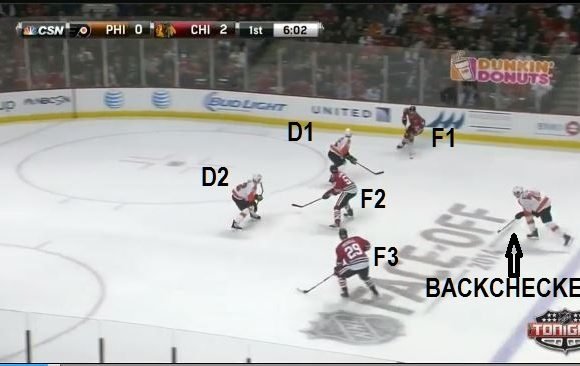
This is the first in a series of posts I will be doing on different plays and systems in hockey. Everything we strive to identify and measure with statistics, which is usually my focus, is based on what the players are doing on the ice, yet much of what happens there is shrouded in mystery for many hockey fans. Some of the most experienced and insightful hockey analysts I know are still learning about the game all of the time. Hopefully, this series will help you and I learn a little more about the X’s and O’s (or F’s and D’s) of hockey and give us a better understanding and appreciation of the game. Just like different coaches and teams have different approaches to playing the game, my approach here may be a little different than what you learned or know. That’s okay. Discussion about the different ways to handle these situations will lead to more learning for everyone, me included.

The first thing I want to tackle is something that is usually pretty exciting during the game, a 3 on 2. For this article, we’ll focus mainly on the attacking players. The 3 on 2 happens when three players are attacking the offensive zone against 2 defending players. The attacking players should try to build up speed or continue with speed so that other players cannot catch up to the play and defend against them. Obviously, having an extra body on your side is an advantage so unless there is no other feasible option, slowing the play down is not what the attacking players want to do. There are several set plays that teams use in 3 on 2 situations, but of course, upon reading the coverage by the defensemen and pressure from the backcheckers, many times the attacking players need to improvise. So long as the play keeps moving forward to take advantage of the odd man rush situation, most of these improvisations work pretty well.

Everything Else

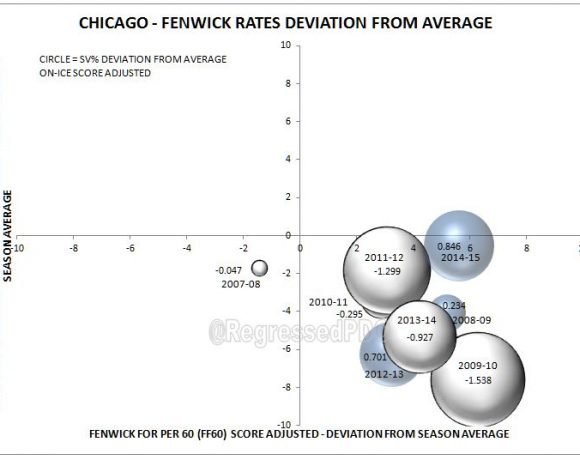
Chicago has been known as a puck possession team for quite a while now and rightly so. Over the last several seasons, they have proven to be one of the better and at times the best puck possession team in the league. Possession is important for obvious reasons. When you have the puck more, you have more chances to score. Possession metrics are also important for less obvious reasons. Shot suppression is very important to team success. I’ve used the graph below before, but it’s worth adding again here.

07-14 FF FA SCF LABEL

Everything Else

Chicago has been known as a puck possession team for quite a while now and rightly so. Over the last several seasons, they have proven to be one of the better and at times the best puck possession team in the league. Possession is important for obvious reasons. When you have the puck more, you have more chances to score. Possession metrics are also important for less obvious reasons. Shot suppression is very important to team success. I’ve used the graph below before, but it’s worth adding again here.

07-14 FF FA SCF LABEL

Everything Else

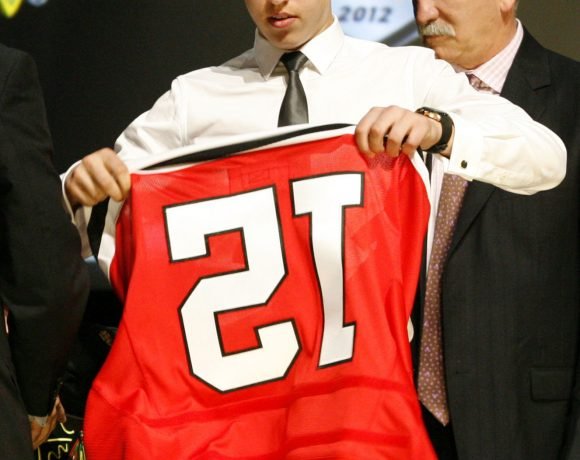
Back in 2011, Michael E. Schuckers published a study called “What’s An NHL Draft Pick Worth? A Value Pick Chart for the National Hockey League” that details a way in which to attach a numeric value or worth for each pick in the NHL Entry Draft. Mr. Schuckers used statistical models to assign the values. The paper details how the model essentially bases the values on the number of NHL games each draft pick can be forecasted to play during his career. The values assigned do not forecast the quality of the player of course so there are differences in what a team will actually get but the number of games is helpful in general terms.

The picks near the top of the draft have the highest values, while the picks near the bottom have the lowest. We all know that large numbers of drafted players never actually play a game in the NHL. So the decrease in value is logical and makes practical sense. The stated purpose of the paper was to help NHL decision makers figure out how to package picks for trades and other transactions.