Everything Else

Box Score

Natural Stat Trick

Corsica

At least the Colliton Era already has a familiar pattern.

Once again, the Hawks were the better team in the first period. They had the better chances, they looked faster and more creative than they have for most of the season, and yet they couldn’t solve a goalie who for the most part has struggled for a while. And then a defensive miscue causes them to fall behind. They don’t panic, but can’t scratch one out. At least it didn’t all fall apart like Thursday. Progress?

But then two veterans completely shit it on a power play, including some really questionable effort, and now you’re down two. The Hawks couldn’t crack a Flyers team that could then just sit back and wait, because they don’t have enough of those players. You know where it goes from there.

Let’s sort it out.

The Two Obs

-Let’s start with Duncan Keith. In the first period, the broadcast was all gaga about his “activity,” which pretty much amounted to impersonating that shortstop on your little league team who chased down every ball, even if it was deep in the outfield. And while activity looks nice, there’s a problem.

It’s not what supposed to be happening.

The main reason Henri Jokiharju was paired with Keith, other than there being no one else really and his veteran tutelage, was to take that part of the game off of Keith’s plate. Keith simply can’t be all over the ice anymore, he can’t be jumping into the play because he can’t get back, and he wasn’t that good at it anyway. As he settles into the sunset years of his career, a free safety role where his still useful mobility would be better suited is what’s on the menu. It’s Jokiharju the Hawks want jumping into the play. They want him making those passes and taking those shots. That’s where his game is. He’s not going to develop by having to catch all the fly balls Keith loses in the sun behind him. If Keith can’t, or won’t, reel it in, then there’s going to have to be another solution. This is part of the reason HarJu is drowning in his own zone. He’s there on his own a lot. And when his instincts to be aggressive come up, he’s finding his partner already there.

As for the first goal, yeah it’s a bad turnover, and a symptom of the Hawks still trying to do the things they used to. But still, when Keith does look, Anisimov is in that circle. Anisimov then proceeds to just float backwards toward the blue line, letting Giroux in front of him, for no discernible reason. Keith is under pressure and facing the boards, how’s he going to get that puck to you at the line, Arty? If you want to know why Anisimov’s possession and defensive numbers blow, there you go.

-Now to the second goal. Keith biffs a puck, admittedly rolling, at the blue line, letting Couturier in. And then Chris Kunitz…well I’m not sure what the verb is here. Blobs on Coots? Attempts to confuse him with his taco breath? Whispers in his ear about the emptiness and meaningless of life in an attempt to get Coots to be buried in ennui? I can’t tell.

I’m not going to rant and rave about him being on the power play at all, though I want to. With Saad out and the first unit loaded up, the alternatives are like Kahun, Fortin, and….well, you. So whatever. But if that’s the best effort that Kunitz can muster, to be shrugged off that easily, then he’s not an NHL player anymore and should be on waivers tomorrow. If he didn’t bother to do more, well that’s some veteran presence you’ve got there.

-Every time David Kampf, who does have use, makes a move at the offensive blue line to put his teammates offside, he should have to spend five minutes with a weasel in his pants.

-The third goal is mostly unlucky, except for the part where Jan Rutta is hesitant, takes a shit angle, and gets beat to the outside. Otherwise there isn’t even a shot to bounce off Crow and Manning to go in. Ain’t no coach going to do anything with Jan Rutta or Manning or Davidson. Too bad Connor Murphy is dead.

-At least Crow looked more like Crow than he has in weeks.

-A word on the broadcast. First, the barely concealed contempt Foley and Olczyk have for Barry Smith during that interview is excellent television.

We went through this last year. I know this team is a tough watch, but Pat and Eddie are getting paid a fair sum to be professional about it. I don’t need them to agree with the firing, I really won’t argue with anyone who does. But it’s not their job to sit around and lament it two games later. To make it clear how miserable you are having to broadcast this team. No, it wasn’t a great game today, but the mark of a broadcaster is what you do with the bad games. We’re all wondering what we’re doing here, but it doesn’t help when the broadcast of the game sounds like they’re narrating a trip to the DMV. Do better.

Onwards…

Everything Else

Ever been all excited for a vacation and then while you’re there everything goes wrong? You get sick, or the hot water heater breaks, or your wallet gets stolen, or all three? Well, that’s pretty much what the Western Canada trip has been for the Hawks, who come home with no points and instead have lost five straight. This is a bit of a truncated wrap because, c’mon guys it’s early!

Box Score

– The Hawks played basically the whole game without Duncan Keith because he mashed Dube’s head into the top of the boards and got a game misconduct within the first minute. However, it wasn’t malicious and wasn’t even a hit from behind (Dube saw him coming and braced for it, but their positioning and bad luck led to his head getting pushed into the boards). I’m not going to complain about it because I kinda appreciate the refs enforcing the letter of the law, even on an elite defenseman. I bitch and moan when they aren’t consistent with punishing the types of plays that lead to head injuries since without that, the behavior of oafs won’t change. Should it happen because of an accident or bad luck, oh well. And while of course I’m pissed about the outcome of the game, it’s the Hawks’ fault for not being able to hold onto a lead, which they had established well after Keith was out of the game, and not the refs’ fault for doing their jobs.

– About that blown lead…the Hawks were up 3-2 at the start of the third period but stupid Matthew Tkachuk scored to bring them within one just before the end of the second, which had an ominous feel. And indeed, Sean Monohan tied it up about midway through the period, and Michael Frolik gave them the lead in just another minute or so (et tu, Frolik?). Again, the Hawks have no one to blame but themselves. Crawford faced 41 total shots, and the Flames are fast as fuck. They were aggressive in the third and kept generating chances. Would things have worked out better if Keith was in? Most likely yes. But for the team to give up that many shots you can’t really pin it on the absence of one guy. The Hawks are currently tied for 8th-worst in the league in shots given up (averaging 33.5 per game), and none of this is going to get better if that shit doesn’t get better.

– Relatedly, Crawford did the very best he could. I know I’m a fluffer for Crow, and Tkachuk’s goal was sort of a miss for him (but it was incredibly precise placement over his shoulder, so whatever), but again I don’t think this loss gets pinned on him. The fifth goal was an empty net so he actually ended the night with a .900 SV%. Granted that’s not good enough (obviously), but shit, facing over 40 shots, what the hell is he supposed to do?

– Hey, Jonathan Toews got his 300th goal! Way to make a cool milestone mean absolutely nothing, guys. Also, Brandon Saad scored, so that’s nice. And DeBrincat ended a scoring drought with an assist. Jan Rutta also scored but fuck him, I don’t care. All those things are nice, but the Hawks managed a measly 15 shots on goal, and as I mentioned gave up nearly three times as many. Woof.

The other night I said it’d be a long plane ride back if they didn’t get any points, and while I generally love being right, in this case it kinda sucks. Hopefully Quenneville is feeling nervous because fuck him too, I don’t care. So here they are with their tail between their legs and a few days to think about what they did before they play Carolina on Thursday. Onward and upward.

Everything Else

I don’t know that we’ll make it strict blog policy, but I think it’s important that when analyzing and discussing the Hawks we always keep in mind their “real” record. That’s hard to decipher in the NHL at times, as they do everything they can to ensure the standings are what are interpreted as what a team really is. So the OT results can cloud things a bit, or sometimes more so. Right now, the Hawks are a 3-5-6 team. That’s essentially what they’ve earned. They have six ties, and three regulation wins: in Columbus where they were severely outplayed for most of it, and over the Ducks and Rangers who both suck eggs. If viewed through that prism, then recent results don’t really surprise.

Coming into this season, the biggest problem the Hawks had was that they were a bad defensive team last year. And that’s being kind. You might be tempted to describe them as “abominable” defensively. While the goaltending was awful without Corey Crawford, no one was pretending that he wasn’t Atlas-ing a very creaky if not downright faulty ship. The team didn’t seem to lie to you about it either, as they knew they were terrible in their own end and the neutral zone. Clearly changes had to be made not just personnel-wise, but structurally as well.

We’ll get to those changes in a minute, but the story so far is that they haven’t worked. The amount of attempts the Hawks give up at even-strength has gone from 58.1 per 60 to 58.0. Not exactly a cataclysmic improvement. Their shots against per 60 at evens has gone from 32.1 to 31.8. Again, an improvement but not enough and still one of the worst marks around. And their expected goals against per 60 has actually gotten worse, and by a noticeable margin, from 2.54 per 60 last year to 2.74 this year (about an 8% increase). So even if they’re giving up a shade less attempts and shots, they’re giving up even better chances than they did last year, and last year was a veritable waterfall of chances against (which you shouldn’t go chasing, as you well know by now).

What’s been clear in the season’s first 14 games is that Joel Quenneville appears to be trying to install a more aggressive tweak to the defensive system. It’s not an overhaul, and the Hawks were always aggressive–trying to stop rushes ahead of their line, going into the corners and half-boards as the slightest sign of an opening, etc.–as well as going with a more zonal system. But now the Hawks, at times, send two guys after the puck, are chasing behind their own net far more than I can remember, and are trying to step up even higher into the neutral zone.

The question one might ask is if this is a prudent change with a defense that overall has gotten even slower. Because the Hawks just don’t get there, which is leaving even bigger gaps than they had last year. Let’s look at some goals from recent games. Now, the following may seem like we’re trying to single out Brandon Manning, and we’re not….well, ok, that’s not the sole intention. But he is a good example of a player ill-suited to what the Hawks are trying to accomplish, or at least what I think they’re trying to accomplish. And I will admit that using a third-pairing on a mediocre team at best is cherry-picking, But there are things to learn.

Take the fourth Oilers goal last night:

Manning makes a bad pass, which is not systematic. There’s a turnover at the blue line. Davidson, who’s already cheating to the middle before, is by far the closer to the play and cuts across. Because Manning was already backing up when passing and is somewhere near his left circle, the read should be his partner cutting across and Manning being something of a free-safety. Instead, much like Gallahad, Manning comes charging to where Davidson and a Hawks forward already are, leaving an entire side of the ice open. And because it’s Brandons EAT ARBY’S, they both get beat and it’s a 2-on-0.

Let’s move back to Wednesday:

Again, it’s Manning and Davidson. Manning wants to step up on Granlund before his own blue line, but his gap to start before the pass even heads to Granlund is too big. And because he’s slow and a clod, he gets turned trying to make it up too late, leaving Davidson with about two and a half guys to cover.

But it’s not just them. Take St. Louis’s second goal on Saturday:

Jokiharju goes chasing the puck and Ryan O’Reilly around and up to the boards, even though ROR is basically in the corner and can be easily “contained.” Keith is now on the right side of the net. If that’s where he’s supposed to be, then Alex DeBrincat has to be crashing down low to deal with Perron. Toews is late to cover for Jokiharju and Keith as they try and scramble, but he has about four different places to be. At the beginning, Toews was the one who seemed to think ROR was at least accounted for along the boards and isn’t expecting Jokiharju to come flying out there.

Now, this is easily the result of a teenager learning at the highest level, and mistakes you can live with. Except they’re happening multiple times a night to everyone. The amount of times the Hawks leave an entire side of the ice open per game is simply confounding. No one seems to have any idea what the other guy is going to do, and they hence end up doing everything and nothing at the same time. Communication seems to be somewhere around the level of whatever that shrieking was on the NBCSN broadcast last night

Before we start breaking glass to get our axes, these are changes that would take some time to bed in, but the clock is ticking. You’d have to think that if the Hawks still look this iffy and unsure at the end of this month, then real problems are going to need real solutions. But by that point, it may be too late.

It should also be noted that the Hawks most consistent defender from last year, Connor Murphy, is yet to play. But when you’re really depending on the return of a 6′ 5″ d-man with back problems now, who is also Connor Murphy–a fine player but nowhere near a great one– that makes a statement of its own.

Which makes the Hawks’ personnel decisions on their blue line the past couple years all the more strange. The perfect d-man for this souped-up system in their own zone of course is Michal Kempny. But I don’t want to litigate that whole thing again. The blue line is just another area where the disagreements between coach and GM and how they see how a roster should be built are clear. Stan Bowman liked Kempny, and brought him back for a second year even though he spent the first being spit on by Quenneville. But when that didn’t work, Stan has provided Q with Jan Rutta and Manning, which more and more seem like decisions with a “Fine, here are the fucking monoliths you prefer” tinge of attitude to them. And Q’s now running a defensive system based on what he thinks Stan wanted with the players he was stuck with.

That’s all just a theory, and not even all that likely. On the ground, what we know is that Stan tried to make the blue line more mobile last year with bringing back Kempny and swapping out Hjalmarsson for Murphy. And this year he’s made it less so by bringing back Rutta and bringing in Manning. They were forced into playing Jokiharju, who isn’t really all that quick either, just smart though learning the hard way.

At the end of the day, through their performance, decisions, changes, and whatever else, none of it really makes sense.


Everything Else

As Sam goes on his Duncan Keith Appreciation Week, I asked him if I could jump in on the fun, because we all need to express more appreciation for Duncan Keith. Sam has already gone through a lot of praise and declarations about Duncs the other day. Everything Sam said was A). correct, and B. awesome (Adam is on many drugs. -ED). Duncan Keith has meant more to this franchise and the decade of success we as fans were able to experience with them than a lot of people realize, and maybe even more than Keith would want credit for. What he has meant to the team is almost difficult to put into words, and yet Sam has done it well time and time again.

I am here to talk about what Duncan Keith means to me, which is just as sappy and emotional as it sounds.

Unlike most of the others around these parts, I did not grow up with the Blackhawks. I was born in 1994 (please don’t yell at me for bringing that up), so I grew up in Dollar Bill era of Blackhawks history. They were never on TV. The most exposure I got to the Hawks as a kid was using them in NHL 2K4 on my PlayStation 2. To give you an idea of how little that meant, Tuomo Ruutu was one of the best players on the team in that game, and he was a rookie. It had Eric Daze listed as the captain, and when I learned later that he was never the captain of the team I felt betrayed.

So when the Hawks went to the Western Conference Final in 2009, that was the first real exposure I got to the team. I had watched hockey sparingly prior to that, usually just the Stanley Cup Final, so I didn’t know who Patrick Kane or Jonathan Toews were; all I knew was what some of my friends were telling me – these guys are the truth and the future. The first Hawks game I ever watched all the way through was the clinching game against Vancouver that year, and then a few of the WCF games against Detroit. The only names I really recognized on the TV were from the Wings.

But my interest was piqued, so I started watching the Hawks regularly in the 2009-10 season. That season was also the first time we saw the full beauty and ascension of Duncan Keith. He was brilliant throughout the whole season and finished second on the team in points with 69 (NICE) in 76 games, which from the blue was a point total at the time that was seemingly reserved for Nick Lidstrom. He was the best player on the team in that playoff run – despite Toews’ team-record breaking production that ended up winning him the Smythe that Keith deserved – and the best defenseman in the NHL, and deservedly won the Norris Trophy over Lidstrom.

I played sports my whole life, and I was always more of a defensive player regardless of the sport. I was a shortstop and catcher, drawn to the positions because of how important they were to the defensive side of baseball. My 8th grade basketball coach always made me the primary defender on presses. I only played football one year, but I was a cornerback. Defense was my thing. So it was easy to be drawn to Keith, who was playing defense better than anyone else at the time.

I was a sophomore in high school (again, please don’t kill me for saying that) when the Blackhawks won that 2010 Cup, still young enough to play backyard sports with friends and at least pretend you were one of the players from your favorite team. A bunch of my buddies took to hockey because the Hawks were the talk of the town, and we had a whole ring of street hockey players (this is your only chance to make Jeffler jokes at me). I was a righty, but I still always imagined myself as Duncan Keith.

The next two years of Blackhawks hockey were not the best, as they bowed out of the playoffs in the first round in back-to-back years, but as I was finishing high school, the Hawks were one of my only reliable escapes from the typical bullshit of being a teenager, and Duncan Keith was the steadiest presence through all of it. He only missed eight games through those two years. And despite his best efforts, he wasn’t quite his dominant self.

Skip to me starting in college. There was no hockey for my first semester in 2012, which was probably a blessing, but once the lockout ended and we had that shortened 2013 season, what we got to experience was the most dominant three years of hockey Hawks fans had known to that point, and quite possibly will ever know. My memory of specific moments is sincerely awful, but there was never any secret that Duncan Keith was always the straw stirring the Hawks drink in that run, and as I was growing the most I ever had as a person, the Hawks were doing the most they ever had as a franchise because of him.

And let me tell you a bit more about this play that Sam talked about earlier today. I have to tell you guys, when Duncan Keith scored that goal, I almost jumped through the ceiling, and then had to keep myself from crying like a baby.

I had nearly died about three months earlier, after falling through a glass table in a truly exquisite show of idiocy – there wasn’t even alcohol involved in the incident, if you can believe it. My lung was punctured and collapsed, and over the next month (between March and April of 2015) I spent a total of 11 days in the hospital over different spans and ended up needing a surgery called a Thorocotomy which involved, as the surgeon described it, peeling scar tissue off my lungs like an orange peel.

I missed the rest of my college semester and was unable to do a lot of things I normally would’ve been able to do. The only normal thing in my life over those few months was the Blackhawks, and thus Duncan Keith being dominant. That playoff run kept me from falling into a dark place. Duncs’ goal in Game 6 let me release months of frustration and pain. Sports matter, guys.

I didn’t grow up with the Blackhawks through my youth, but I did grow up as a man with them, and I almost mean that literally because they were growing up as a team as I was growing up as a person. And as much as it must’ve been so beautiful for people like Sam, Matt, Slak, and others to get to watch it all happen as adults after slogging through the bullshit years, being able to grow up with this team was special. And Duncan Keith was a huge part of that for me.

So Duncs, even though you will probably never see this, ahead of your 1000th game, I wanted to write this and thank you. I might not be who I am today without you.

Everything Else

Let’s continue Duncan Keith Week with a video:

I could talk about this goal for hours, probably. One, I’m not sure I’ve ever yelled louder at a sporting event than this one, and you can ask former editor Matthew Killion to confirm. There was a lot going into this night for all of us, and me especially, but we don’t have to get into that here. Surface level, the Hawks had a chance to clinch the Cup at home for the first time since dinosaurs roamed the Earth. A scoreless first period only built up the tension, and the fact that much like the rest of the series, the Hawks were kind of outplayed up to this point. Corey Crawford had to stop Steven Stamkos twice on the same breakaway, they didn’t create much, and slowly what seemed a certainty began to be a question.

And much like the rest of that run, Duncan Keith decided he’d simply had enough. Usually, when there are four opposing skaters back in the zone is not the time to go shotgunning up the ice if you’re a d-man. But Keith has never continually bent to logic, and what made his game so special is that he didn’t and it usually worked. After all, Kane had the puck, so if he could find a pocket of space, chances are Kane would find him.

Maybe my favorite part of this is Keith simply streaking around Cedric Pacquette for the rebound, as Pacquette didn’t shut his yap for the first half of the series amidst all the press about how he was the ultimate checking center and pest, especially after the Lightning’s Game 3 win. They didn’t win another game and we didn’t hear much from him after that. Keith left him with his dick in his hand and that’s all he’d win after this.

In the building, it happened in slow motion. The rebound we never expected to see lying there, practically teasing everyone, because Keith’s initial shot wasn’t all that strong. The arc he took around Pacquette at a speed that didn’t seem possible, and the realization, “He’s going to get there.” And that he would have an open look from three feet (and one you’ll recall he whiffed on in 2011 against the Red Wings that would have gotten the Hawks into the playoffs, which they backdoored into anyway). It’s the amount of separation he gets from everyone else at this moment. No one would have caught him with a jet engine up their ass.

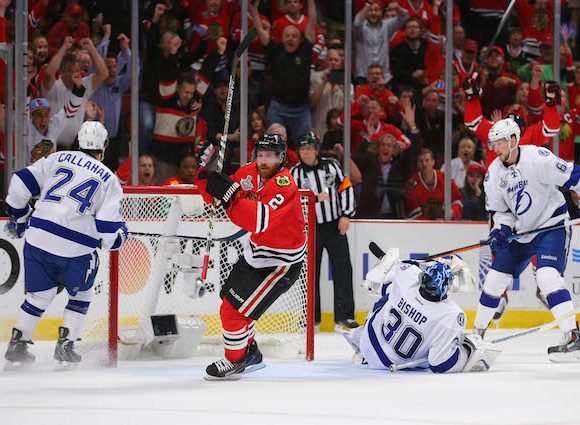
One of the few things Eddie Olczyk and I agree on is that the United Center has never been louder than when this puck flipped up over Ben Bishop. Sure, it was only the second period, but the Hawks weren’t giving up that lead. The catharsis at the moment in that building was real. Clawing back a dream we’d had all our lives. Mostly because they had Duncan Keith and the Lightning didn’t.

That 2015 run is not only Keith’s masterpiece, you’d be hard-pressed to find another playoff performance in this city anywhere that doesn’t involve the words “Jordan.” Both the Cubs and Sox World Series runs were basically team-efforts. The Hawks’ two previous runs were the same, though Keith was among the standouts in those. I guess we’ll have to wait until Khalil Mack’s 10-sack run to the Super Bowl sometime soon.

He scored three goals in that run. One was the OT winner in Game 1 against Nashville. The second was the series clincher against the Predators, and the Hawks desperately needed both or at best they would have been facing a Game 7 on the road. The third was this. That’s certainly making them count.

In between, Keith averaged 31 minutes a night. He gobbled up 44% of the team’s even-strength time, a number only topped by Kris Letang in ’16 for a team that went beyond the second round in the last seven years (fun note: the hightest TOI% of a playoff year is also Keith’s, which was 47% in 2016’s first round). His relative-corsi in the spring of ’15 was +5.4. His relative-xGF% was an unholy +8.7. When Keith was on the ice the Hawks were dangerous and dominant. When he wasn’t, they were clinging with their nails to the side of the dock.

You don’t need the numbers to know how good he was that spring. Thanks to Kimmo Timonen being dead and Michal Rozsival’s ankle becoming a modern art piece against Minnesota, the Hawks only had four d-men for the last two rounds. They had to survive them, and I’m not quite sure how they did other than Bruce Boudreau’s team playing with both hands around its neck again when the lights were brightest and Keith and Crawford at their best in the Final. If it seemed like Keith was never off the ice in the last 13 games, it’s because he wasn’t. The least he played in the last two rounds was 27:23 in Game 5 against the Ducks. Against the Bolts it was never less than 29 minutes. And again, he was utterly dominant in those.

It was barely controlled fury. It was more than the usual Keith-stepping-up-into-the-neutral-zone shit. He was on both sides. He was up the ice and then back. He was stripping someone behind the net, calling Kesler a fuckwad, and then joining the play, seemingly in one motion. You can only play four d-men in a game if on is insistent on being two or three at the same time.

This goal was kind of a microcosm of all 23 games. Keith deciding he’d had enough, streaking somewhere you never figured him to be and no one able to get in his way. Whether it was a goal to be scored or a forward to be dispossessed, Keith was on it like a pissed off bowling ball. Keith basically decided the Hawks were going to win a Cup. And then he did almost all of the heavy lifting.

We know that Keith will never do that again, and maybe that tapped all the reserves for good. I know it was worth it.


Everything Else

Let’s jump ahead about two and a half years or so. Basically, the ’20-’21 season. It doesn’t really matter what the Hawks fortunes are then, though it will have an influence. During that season, barring a major injury before, both Jonathan Toews and Patrick Kane will play their 1,000th regular season game.

Now imagine the build-up to both. How long do you think it is? A week? Maybe more? Certainly more than a few days. Clearly, a couple national publications will get in on the fun. There will be reminiscing of the Hawks’ glory days, and a rehashing of the debate about where they rank in the pantheon of all-time great teams. Certainly it will be an event, two of them actually, and assuming you can ignore the particularly grossness of one of them, you won’t be able to miss it. The team’s best ever winger and perhaps it’s second or third greatest center getting a silver stick.

So why isn’t there more of a buzz about the player who was more important than both of them?

Duncan Keith will play his 1,000th game on Saturday night. He is the best Hawks d-man of all-time. Of this there can be little debate. Two Norris Trophies, a Conn Smythe (unanimously won, and really should have been a second for him after 2010), two gold medals. There is no Hawk who can come close to matching this haul of silverware. Three rings to go along with it, as well, and a couple more Conference Final appearances.

You could only make an argument for Chris Chelios, really. Two Norris Trophies as a Hawk, a World Cup winner’s medal, one Conference Final appearance and one Final appearance. And folks, let me tell ya, Chris Chelios is not Duncan Keith.

Some may bristle at the notion that Keith was the most important Hawk. You can if you’d like, except you’d be wrong. When Keith was good, the Hawks were good. It was that simple. When he was quite simply Daredevil right in front of his blue line, the Hawks did no worse than a conference final in ’09, ’10, ’13, ’14, ’15. When his play dropped off, so did the Hawks’. Patrick Kane has played his best hockey the past three seasons. The Hawks have three playoff wins. When Keith played his best hockey, they were at least in touching distance of the Cup.

I know why Keith hasn’t gotten even the buzz that Seabrook did. Seabrook’s night came at the end of a lost season, and the Hawks needed anything to glom onto to make fans feel good. Keith’s night comes at the beginning of the season when the Bears are still very much on everyone’s mind and interest in the team is low overall.

Seabrook has always been more media friendly than Keith. Keith has been prickly at times, outright dismissive at others, and is still the only Hawk who has occasionally raised a middle finger to John McDonough’s media policies (such as always wearing a Hawks hat during scrums, and this only endears him to me even more). Keith has a couple ugly suspensions on his record (he should have gotten way more than he did for trying to behead Charlie Coyle). Though I suppose Seabrook trying to turn David Backes into plaster in ’14 is a blotch as well (though it’s something we’ve all dreamed of, and strangely led to the best two games of Sheldon Brookbank‘s career. The world is indeed strange).

We probably can’t ignore that Keith was somewhat front and center of the first off-ice controversy of this Hawks run, you may remember it as “Patrick Sharp And His Lack Of Traveling Pants,” though he was more an innocent bystander. Tellingly, it was Seabrook who took the lead on trying to quash that in the dressing room. Keith remained silent, which is basically how he’s always preferred it.

Keith has never been the pivot in the Hawks’ ad campaigns or marketing drives. He’s left that to Toews and Kane or Sharp. It just hasn’t mattered to him. He’s had his charity and his fundraising nights, but even those were a little more underplayed than Brian Campbell‘s or others’. That’s another reason you don’t hear as much as you might think about his upcoming milestone.

But on the ice, Keith was the Hawks when they were rolling over the league night-in and night-out. It was his ability to step in front of traffic before the line that was the root of their entire game. To turn around the play before it ever got dangerous, and get the puck quickly to the forwards in space and with the opposition caught.

Keith’s unnatural quickness and physical condition allowed him to do things no other d-man could get away with, and to do it for 25 minutes a night at least. He could travel outside the circles to dispossess a forward or chase behind the net, because A. he was on them so quickly he almost always won the puck before anyone had time to calculate what to do and B. he could recover in time to get away with not doing so. Those skills have gone now, but they were vital to everything the Hawks did.

What’s funny about Keith is that he’s not nearly as talented as some. He’s never been a great passer. He’s nowhere near the puck-handler that Karlsson or Subban are. You know about his shooting skills. He’s not particularly big, though he’s far stronger than you’d think. What he was wasn’t just fast, but fast-twitch like no one else. Keith’s entire game, his instincts, were basically a constant, “Fuck it, I’m going.” And he’d get there. Every damn time.

He was the anchor for the only three Cup teams almost all of us have ever known. The picks and development of Henri Jokiharju, Adam Boqvist, Nicholas Beaudin…are all meant to try and replicate what Keith was.

And it’s not like Keith’s dead. He’s looked better given a partner who can do some of the stuff he used to, when it’s not dependent on only him to do it. He’s 35 now, and while he’s always been a conditioning freak, who knows how much longer he wants to do this. He’s backed off his claims of wanting to play until he’s 45, though given his fitness he probably could have made a run at it.

Perhaps the most rewarding thing for fans is that we got to watch the whole arc of Keith. He didn’t come up anywhere near the finished product like Toews or Kane or even Seabrook was close to being. Those first two years under Trent Yawney or Denis Savard, it was like watching Nightcrawler on a coke binge (what can I say? I’m in a Marvel mood. Blame the Spider-Man game). He was flashing everywhere, and most of the time is was where he wasn’t supposed to be. And he was doing it in front of no one. You’d see an amazing play about once per game, and then he’d spend the next period on the wrong side of the ice pointed the wrong way and all four of his limbs flailing away like he was drowning in sewage. Which he mostly was.

Given a real coach though, who only had to put light harnessing on it all, and Keith took off. Suddenly that raw power and speed was pointed in the right direction, without taking away from it, and no one could live with it. We saw the whole arc. Keith went from uncontrollable, festering energy to the league’s best. So did the whole team.

Keith’s the best to ever do it in the Red and White from the blue line. He doesn’t chase or probably want the acclaim. But he’s going to get it here. He should be getting it from everywhere.

So thank you, Duncs. None of this happens without you, whether you care or not if anyone knows that.


Everything Else

As we move down the Hawks’s agonizing back-end, which at this point resembles someone who’s fallen into a porta-potty in a Super Mario Bros.-esque attempt to warp to a different place after the mushrooms really started to kick in, we reach a relative bright spot. We often bemoan the fact that the Hawks don’t have a puckmover on defense anymore, given Duncan Keith’s wrestling match with the ravages of time and Joel Quenneville’s hatred of everything beautiful in Michal Kempny. But if you squint, Erik Gustafsson can maybe fill that need.

2017–18 Stats

35 GP – 5 G, 11 A

55.4 CF%, 57.4 oZS%

Avg. TOI 18:33

A Brief History: You may remember Erik Gustafsson from such films as Signing a Two-Year, $2.4 Million Extension in the Middle of March and Scoring 11 of His 16 Points After the Extension. (What do you know? A guy scoring a bunch after his extension.) While that’s clearly a coincidence, Gustafsson does bring some intrigue.

In 35 games in 2017–18 (all of them post-Corey Crawford), Gustafsson posted a 55.4 CF%, good for second among all Hawks D-men in that category, behind Cody Franson (58.44 in 23 games). Couple that with his 54.0 CF% in 2015–16 over 41 games and you have a D-man with a cumulative 54.7 CF% over 76 games. That’s a pretty good start.

Additionally, Gustafsson’s xGF% last year sat at a robust 52.78, meaning that the Hawks could expect to score more than their opponent when he was on the ice. Even better, Gustafsson’s Rel xGF% was an obscene 8.42, meaning the Hawks were 8%+ more likely to score as a function of Gustafsson’s presence. Small sample sizes be damned, those numbers portend potential at the very least.

It’s important to look at whom Gustafsson played with to get those numbers. Last year saw Gustafsson skate a glut of his time next to Brent Seabrook and behind the Patrick Kane line, which you may have deduced based on his 57.4 oZS%. And really, it’s been that way his entire 76-game career: Gustafsson has skated with Seabrook and Kane more than anyone else.

Gustafsson also contributed a bit on the power play, which is where he has the potential to be most intriguing. In just over 49 minutes of PP time, Gustafsson racked up four assists—two primary and two secondary. For comparison, it took Keith almost 213 minutes to rack up two goals, three primary assists, and five secondary assists. It took Seabrook 171 minutes to post two goals, one primary assist, and five secondary assists. So, the rate at which Gustafsson contributes PP points vastly exceeds the rates Keith and Seabrook—Q’s go-to guys on the PP—contribute. Granted, the sample sizes are askew, but it’s something interesting to consider, since the Hawks PP has been beaten around the head with an oversized marital aid the past two years.

Of course, Gustafsson did all of this while spending nearly 60% of his time in the offensive zone. And there are legitimate questions about his defensive abilities: Namely, does he have any? But some of the fancier numbers show that he might not be a total loss on defense. His HDCF%—the measure of high-danger chances for vs. high-danger chances against—was 51.03% last year. His CF% Rel was a robust 6.6. And his 2:1 giveaway/takeaway ratio at 5v5 was the best among Hawks defensemen (Keith, Murphy, and Forsling were the only other D-men who had ratios under 3:1, not counting Franson).

Make no mistake: Gustafsson is an offensive defenseman. But he’s not the worst defender the Hawks have ever seen. With the right pairing and more exposure, the Hawks might have an advantage in Gustafsson’s offensive skills.

It Was the Best of Times: Best-case scenario, you pair Connor Murphy and Gustafsson, which essentially makes them your top pairing. This creates another problem regarding whom to pair Keith with, but pairing Gustafsson with Murphy gives him more range to be creative with the puck and start rushes with the Nick Schmaltz line while Murphy hangs back. I don’t have any proof of this other than my eyes, but Gustafsson and Kane look to have natural chemistry on the ice.

In this scenario, Gustafsson is your PP1 unit’s QB. For nearly a decade, we’ve screamed into the rain about how for all of Keith’s greatness, he’s never been much of a PP QB. Handing the reins to Gustafsson can’t possibly make the PP worse, and it has an added bonus of relieving Keith of his duties, giving his legs a couple hundred minutes of desperately needed rest.

With more time and more responsibilities, Gustafsson becomes a 40-point contributor and puts the Hawks’s PP in the Top 10 for the first time since 2015–16.

It Was the BLURST of Times: Quenneville’s galaxy brain does what it did to Gustav Forsling and uses Gustafsson as a defensive defenseman alongside Jan Rutta. Gustafsson struggles horribly, and halfway through the year, the Hawks trade Gustafsson to St. Louis for the rights to install three Imo’s stands in the concourse where Bobby Hull pisses and pukes on himself when he’s not on camera. He goes on to score 20 points in 30 games, vaulting the Blues to the playoffs. He proceeds to develop into Duncan Keith Lite, spending the rest of his career assisting Vladimir Tarasenko and posting 30–45 points regularly.

Prediction: Gustafsson plays most of his time on the second pairing with Seabrook, but moonlights with Keith for a few small stretches. Barring injury, he contributes 25–30 points over 75 games, most of which come playing with the Schmaltz line. He splits time with Seabrook as the PP2 QB and still manages to contribute 10 PP points.

Of course, Quenneville finds a reason not to like him at some point, and there are spots where Brandon Manning plays instead of him, especially in games when Gustafsson posts a 60+ CF% but happens to be on the ice when, I don’t know, Artem Anisimov pukes all over himself in the neutral zone, leaving Gustafsson alone to defend a 4 on 1.

I think Erik Gustafsson will be good. I sincerely believe that he has Top 4 potential (though he’d be the fourth man in the Top 4). I think I’m the only one here who believes that.

Previous Player Previews

Corey Crawford

Cam Ward

Duncan Keith

Connor Murphy

Brent Seabrook

Brandon Manning

Jan Rutta

Everything Else

While he has one of the worst contracts in hockey, Brent Seabrook showed last season that while he is definitely not worth the ridiculous cap hit (and please lets not think about how long is left on it), he really isn’t bad either.

2017-18 Stats

81 GP – 7 G – 19 A

51.55 CF% – 55.58 oZS%

20:12 Avg. TOI

A Brief History: In a cap league with small revenue (relative to other sports) like the NHL, there are only a few defensemen worth nearly $7-million annually, and Nacho is not one of them. But he can still be useful, if effectively utilized, and Q started to do that a bit more last year. With a 51.55 CF% at 5v5 last year, Seabrook at least kept his team on offense more often than not when he was on the ice. He also started almost 56% of his faceoff-started shifts in the offensive zone, and rightfully so. It doesn’t take a genius to watch Seabrook at this point in his career and see that what’s missing is the legs. That’s a huge problem in today’s NHL if you’re gonna go against top competition. But Seabrook’s vision, passing, and shot have always been better than he got credit for, and last year that became obvious. He can still whip the puck up the ice and make things happen offensively as long as he isn’t getting torched defensively. The vitriol for Seabrook among Hawks fans has ramped up in recent years, and myself and others at this site are probably not without fault in spurring some of that on. But in a 2017-18 that saw Jordan Oesterle play way too many meaningful minutes for this squad, it didn’t become too difficult to start to appreciate what was still left of Seabrook’s game.

It Was the Best of Times: Much like Murphy over the weekend, how good Seabrook can be this season will ultimately come down to the utilization. Seabrook can still flip the ice for you somewhat well against teams’ less potent attackers, so as long as Q doesn’t start sending him out there against the McDavids and Crosbys and players of that ilk, Seabrook still has a decent shot at a solid season, at least within the context of this team. I know that the podcast guys brought up the way Zdeno Chara has been utilized in Boston for a few years now in reference to how Keith can still be effective for the Hawks, but I think the same kind of deployment – against lesser competition, mind you – could be the key to Seabrook still being a fixture for this team. Let him play with Gustafsson or Forsling, someone fast who can jump into the rush while he floats back and just flips the puck back up the ice when necessary, and things should be fine. He should still get some solid PP time so he can still flirt with 25-30 points as well.

It Was the BLURST of Times: In the other reality, Quenneville sees that Seabrook can still do the passing and the shooting well on offense and decides to try to generate that against the McDavids and the Crosbys and players of that ilk. This would be disastrous. The speed is no longer there, and if Seabs is asked to play too many meaningful minutes against too much strong competition, those wheels might just fall off. Even the best scenario here might be overly optimistic due to what Seabrook has left in the tank at this point, so trying to over exert that is certainly going to end up being a terrible idea.

Prediction: Based on what we saw from Q’s usage of Seabrook later in the season last year, I don’t think it’s unrealistic to think that he starts the season on the bottom pair in a bum-slaying role, as long there are other blue-liners who can find a way to stick out in training camp. You still have the obvious guys above him in Murphy and Keith, and with Gustafsson, Jokiharju, Hillman, Forsling, Rutta, etc. all there as options to make the team as well, Q will have some options at his disposal that he can get creative with to avoid stretching Seabrook too thin. But rest assured, if things don’t immediately go smoothly, Q will go back to what he knows and you will see Seabrook on the ice against players much better than him, and bad things will happen when he does. I still think Seabs gets around 25 points on the season, and if he can be in the 51.5-52.5 CF% range I will be pleased with his season.

Previous Player Previews

Corey Crawford

Cam Ward

Duncan Keith

Connor Murphy

Everything Else

Let’s move on from the acid-reflux-inducing situation that is the Blackhawks goalies, and instead start pondering the black hole of the blue line, which saw notably pitiful changes from last season, despite the obvious need for more talent right now. After giving up 2,683 shots against, their worst number since 2013-2014 (when at least they made the Conference Finals), and finding new ways to plumb the depths of clumsiness and stupidity nearly every night, the Hawks defense was the glaring eyesore of the season. Duncan Keith wasn’t anywhere close to being the main offender in last year’s shit show, but for the defense to have any chance at rebounding this year they need him to improve. And for better or for worse, he will probably still be on the top pairing. So we start with him…

2017-18 Stats

82 GP – 2 G – 30 A

52.4 CF% – 60.5 oSZ%

Avg. TOI 23:50

A Brief History: It would be foolish to say that last year was anything other than a disappointment for Duncan Keith, and it’s not just because of the measly two goals. Yes that was all sorts of pathetic, but it’s not like he was scoring tons of goals in years prior and besides, it the defense that matters. No, the real problems were his lackluster numbers overall despite taking over 60% of his even-strength zone starts in the offensive zone, and the fact that he was basically dragging around a useless clod in Jordan Oesterle all season. These two things are connected and the latter is most certainly not Keith’s fault, but it’s concerning given the defensive roster this season.

With a 52.4 CF% (again, at evens), he wasn’t too off his historical average but—one more time for the cheap seats—this was following a decrease in defensive zone starts. So last year’s numbers don’t bode well, Also, Keith is slower and trending continually in that direction (he turned 35, and the ravages of age come for us all). It’s tough to watch sometimes because he still knows where he should be, but he just can’t get there. And oh yeah, who the fuck is he going to be paired with? Let’s consider the possibilities.

It Was the Best of Times: In the rosiest outcome (SEE WHAT I DID THERE) Keith and Murphy would click in the way I kept hoping they would last year, but never did. They only played a handful of games together last season and I’m convinced that Q’s irrational disdain for Murphy torpedoed what could have been a pairing of the smartest-yet-aging and best-yet-green defensemen. In this utopia Murphy could at least cover for Keith when he can’t make it to the corners or behind the net, and maybe taking the pressure off a little will allow Keith to get a few more assists or even goals. But most valuable would be extending the abilities Keith still has by not running him into the ground, also while having him become the elder statesmen passing along his knowledge to Jokiharju et. al, who each get some time with the guru.

It Was the BLURST of Times: In place of you-could-mistake-him-for-a-fencepost Jordan Oesterle (who doesn’t even merit a skypoint), Q falls back into a comfortable situation that is well past its prime, as he is wont to do—pairing Keith and Seabrook together. Our Nachos preview is still to come so I won’t dive into the details here, but you know as well as I do that he’s only going to be slower and more bloated this year, and pairing him and Keith together would not only be viciously counterproductive, it would be a sad coda to what was once a great partnership. Equally awful would be pairing Keith with Brandon Manning, the literal definition of “just a guy.” In either of these situations Keith’s diminishing speed and possession problems will only become more glaring.

Prediction: In all honesty, Keith probably gets stuck with a rotating cast of jamokes, as Q desperately searches for a pairing that works but that for some reason doesn’t involve Connor Murphy. There will be parts of games where he’s paired with Seabrook, and the collective scorching of retinas will force him to abandon that plan. Then Rutta and Gustafsson will get their turns, neither of whom will be able to compensate for Keith’s slower step. There very well could be a 20-game stretch of Keith-Rutta where Keith does his best at damage control and we all hide behind our couches for their shifts. And yet somehow, Keith will end the season with 8 goals and over 40 points. Hockey is weird and it’s bound to happen for REASONS that won’t make sense. Welcome to 2018.

Previous Player Previews

Corey Crawford

Cam Ward

Everything Else

Once thought of as merely a depth signing, Jordan Oesterle went from playing a combined 25 games over three years for the corroded sewer piping that is Edmonton’s defense to taking first-pairing minutes with future Hall of Famer Duncan Keith. Like you, we often wondered how on Earth a team that relied so heavily on its defensemen to win games and Cups ended up throwing a guy who couldn’t hack it in Edmonton into meaningful minutes. At the end of the day, Oesterle wasn’t the underground landfill fire approaching a nuclear waste dump that we worried he could be, but that isn’t saying much. Let’s see what we have here.

Jordan Oesterle

55 GP, 5 Goals, 10 Assists, 15 Points, -11, 8 PIM

52.4 CF% (Evens), -0.6 CF% Rel (Evens), 53.15 SCF% (5v5), 49 xGF% (5v5), 0.44 xGF% Rel (5v5)

 56.5% oZ Start (Evens)

What We Said: If truck stops served oysters, they’d be called Oesterles . . . He’s billed as a no-frills blue liner, which essentially makes him the Tom Smykowski of the NHL. If he’s afforded any meaningful playing time, you’ll beg for someone to set the whole building on fire.

What We Got: If not for Jeff G.L. Ass, Jordan Oesterle would have taken the “WHAT A GREAT STORY” mantle. He scored his first goal ever this year, played in more than half of his team’s games for the first time ever this year, and—per Scott Powers—averaged 21 minutes per game in the Hawks’s final 53 games, trailing only Duncan Keith.

Like everyone’s favorite Irishman, Oesterle found most of his success playing on his off side. Of his 986 minutes, he played 553 of them as the right-side D-man next to Keith. In doing so, he finished with a 52.99 CF% and six points (1 G 5 A) next to Keith (5v5). That’s not bad for a guy with 25 games of experience to his name prior to this year. I’m being entirely sincere when I say that’s really great for him.

What isn’t great is that when you start digging into the numbers, you can quantify what your eyes saw game in and game out: Jordan Oesterle probably sucks, and was at the very least in way over his head.

When you consider the fact that Oesterle started in the offensive zone more than 56% of the time, his overall 52.4 CF% loses some of its sheen. And it only gets worse from there. Despite the plush zone starts, Oesterle posted a team-worst 43.86 High Danger Chances For Percentage (Hillman doesn’t count because he only played four games). This means that even though Oesterle started in the offensive zone much more often than not, he still managed to give up more high-danger scoring chances than he and his linemates took, and by a wide margin.

Oesterle also contributed an abysmal 43.02 Goals For Percentage (GF%), second worst behind Duncan Keith; a -3.55 Relative Goals For Percentage (Rel GF%), third worst behind Keith and Gustav Forsling; and a 49 Expected Goals For Percentage (xGF%). This means that in both practice and theory, when Oesterle was on the ice—especially with Keith—the Hawks scored much, much less often than when he wasn’t. Again, this is while starting in the offensive zone 56% of the time.

This isn’t to say that Oesterle can’t be useful. But as a first-pairing defenseman, Oesterle was overwhelmed more often than not. Granted, he was placed on his off side for most of the year, next to a cowboy with increasingly dull spurs, and was asked to take on the best his opponents had to offer on a nightly basis. That’s probably not the wisest use of a guy who, again, couldn’t hack it on a team that thought Adam Larsson was a comparable player to Taylor Hall.

But that’s also not Oesterle’s fault, as Q’s THROBBING GENIOUS BRAIN simply couldn’t contain the temptation to breathe life into a player who is the hockey equivalent of a lump of clay and call him man.

Where We Go From Here: Realistically and unfortunately, Oesterle will probably saddle up next to Keith to start the season again, as Q embarks on another campaign to prove what a smart and forward-thinking coach he is with one of HIS GUYS. But if we’re looking at this as a “maximizing potential” proposition, Oesterle would be the 7th D-man, spelling guys like Rutta and Forsling (God willing) when necessary.

The problem with this is twofold. One, we still don’t know whether the organ-I-zation is going to go out and get a legitimate top-pairing guy. If they do, that’s going to push Oesterle out, as you figure to see combinations of Keith–New Guy, Gustafsson–Seabrook (because fuck you), and Murphy–Rutta (kill me).

Two, though it’s clear to everyone outside the organ-I-zation that Brent Seabrook is now a third-pairing guy, there’s no guarantee that he’ll slot there. If he does, and Seabrook has a crystal-clear understanding that he is to play centerfield and nothing else, you can see Oesterle fitting in there, maybe. But given that Quenneville tended to lean on Seabrook when he was out of answers, it’s unlikely that we’ll see Seabrook as a designated third-pairing guy anywhere but in our dreams.

The important thing to keep in mind is that Oesterle is a complete trainwreck in his own zone—hell, he couldn’t take advantage of a 56% oZ start ratio—so pairing him with guys like Keith, Forsling, or Gustafsson needs to be completely off the table. That doesn’t leave a lot of room for him, and that’s probably for the better.

Oesterle can be a serviceable third-pairing D-man in spot situations. He’s proven that he can play his off side without completely filling his diaper, and if you want to be outrageously generous, you can maybe see him as a second-unit power play QB, if the Hawks stand pat with the blue line in the offseason. But like we said at the beginning of this year, if the Hawks are relying on Jordan Oesterle to play meaningful minutes next year, it might be time to start making and filling some upper-level-management vacancies.