Category: Everything Else
-
This Is A Jetsetter Music Letter: Jets at Hawks Preview/Pregame Thread/Dog Grooming
 vs.
vs. 
FACEOFF: 7:30pm Central
TV/RADIO: CSN, WGN Radio
SO COLD, SO COLD: Arctic Ice Hockey
Nothing like a rare four-day break to illustrate how empty our lives are without Hawks hockey. So I’m pretty primed for this one, if only to have purpose again. I doubt I’m alone. And the Hawks return from this mini-sabbatical to what is something of a big game, at least in trying to set things right from earlier in the year and maintain the heat on the now understaffed Preds. A lot going on in one night, no?
-
Breaking Down 3 on 2 Plays
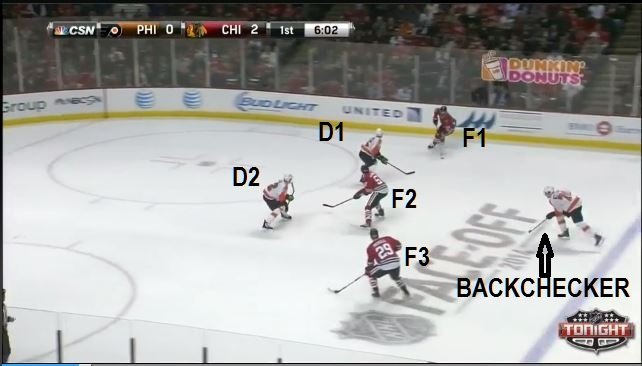
This is the first in a series of posts I will be doing on different plays and systems in hockey. Everything we strive to identify and measure with statistics, which is usually my focus, is based on what the players are doing on the ice, yet much of what happens there is shrouded in mystery for many hockey fans. Some of the most experienced and insightful hockey analysts I know are still learning about the game all of the time. Hopefully, this series will help you and I learn a little more about the X’s and O’s (or F’s and D’s) of hockey and give us a better understanding and appreciation of the game. Just like different coaches and teams have different approaches to playing the game, my approach here may be a little different than what you learned or know. That’s okay. Discussion about the different ways to handle these situations will lead to more learning for everyone, me included.
The first thing I want to tackle is something that is usually pretty exciting during the game, a 3 on 2. For this article, we’ll focus mainly on the attacking players. The 3 on 2 happens when three players are attacking the offensive zone against 2 defending players. The attacking players should try to build up speed or continue with speed so that other players cannot catch up to the play and defend against them. Obviously, having an extra body on your side is an advantage so unless there is no other feasible option, slowing the play down is not what the attacking players want to do. There are several set plays that teams use in 3 on 2 situations, but of course, upon reading the coverage by the defensemen and pressure from the backcheckers, many times the attacking players need to improvise. So long as the play keeps moving forward to take advantage of the odd man rush situation, most of these improvisations work pretty well.
-

The Window Opens
So I was going to do a Sugar Pile today, and we didn’t really mean to stop doing it. We simply forgot. However, at this point you know who would go where so we’ll save it for the All-Star Break and then pick it up regularly from there. And there’s other news that concerns the Hawks.
Pekka Rinne is going to be out 3-5 weeks, and that’s a very big deal for the Hawks.
-
Morning Links 1/15/15
Captain A Little Less Serious: NHL
Sometimes it still feels like yesterday: ESPN Chicago
Reinforcements?: CSN
Not how it should end: PD
He’s a keeper: TSN
-

Halfway Point: Chicago’s Shot Suppression
Chicago has been known as a puck possession team for quite a while now and rightly so. Over the last several seasons, they have proven to be one of the better and at times the best puck possession team in the league. Possession is important for obvious reasons. When you have the puck more, you have more chances to score. Possession metrics are also important for less obvious reasons. Shot suppression is very important to team success. I’ve used the graph below before, but it’s worth adding again here.

-
Halfway Point: Chicago's Shot Suppression
Chicago has been known as a puck possession team for quite a while now and rightly so. Over the last several seasons, they have proven to be one of the better and at times the best puck possession team in the league. Possession is important for obvious reasons. When you have the puck more, you have more chances to score. Possession metrics are also important for less obvious reasons. Shot suppression is very important to team success. I’ve used the graph below before, but it’s worth adding again here.
-
Morning Links 1/13/15
Does this count as HRR?: Blackhawks
Yes Spiegs he does workout: ESPN Chicago
A little r&r: CSN
Because of course: PD