Everything Else

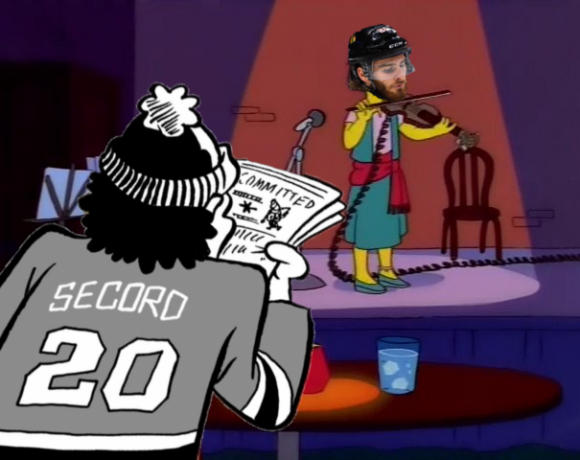
David Kampf ended up being a mildly pleasant surprise this year as basically our best defensive center. And to think, I called him wadded beef! (But seriously, he’s still kind of wadded beef and besides that’s some impressive Photshopping, no?). Let’s do it:

63 GP – 4 G – 15 A – 19 P

49.4 CF% – 48.5 xGF% [5v5]

It Comes With a Free Frogurt!

Kampf was another solid European scouting pickup a couple years ago, and on the cheap too. He was the closest thing to a shutdown center that the Hawks had this year, particularly as Artem Anisimov sucked out loud and Marcus Kruger got slower and less effective. The numbers aren’t going to wow you, but they should all be viewed in light of this one: 63.6 dZS% at even strength, 70% in all situations. At even strength, his shots against were 371, goals against were 25, and his xGA was 26.6—all of these were second-best to Kruger (among centers) but not by a large margin and Kampf played more minutes. Kampf had 31 takeaways to a paltry 6 giveaways. During the stretch in February-March when he was out with a broken foot, the Hawks barely stayed above .500, going 7-6 (I know, not exactly unique to that time but here me out), whereas they went on a five-game wining streak once he came back and ended on a 9-4-3 record. And while it’s not the most enlightening or useful stat, for shits and giggles his faceoff percentage was 45.3; again, not outstanding yet not awful either in light of his zone starts. All of this is to say that Kampf has shutdown-line center written all over him or, in a worst-case scenario, fourth-line center. With contract negotiations said to be underway, the Hawks can give him a small raise to around $1 million a year and have this shit locked up.

The Frogurt is Also Cursed

David Kampf is a bottom-six guy who was on the worst penalty kill in the league. And he was a big part of that PK unit—of all forwards he had the fourth-highest minutes. So I’d like to say he’s an up-and-coming defensive star for the forward corps, but nothing about the Hawks defensively was good enough this season for me to make a statement like that. He’s basically “a guy” for the bottom six who will go no higher than that on the depth chart. And can the slightly better record really be attributed to him coming back from injury? Not entirely, to be generous. And besides, what did it matter anyway? The whole team shat the bed when it mattered most at the end.

Can I Go Now?

The Hawks should re-sign Kampf for a low cap hit and he’ll be an effective 4C, and maybe just maybe we’ll get him, Caggiula, and Kahun making an honest-to-goodness checking line. He could also be part of a penalty kill that somehow learns to play its way out of a paper bag (which it can’t right now). Being wadded beef should be perfectly suitable for David Kampf—unappealing but will keep you from starving in an emergency.

Previous Player Reviews

Corey Crawford

Cam Ward

Collin Delia

Duncan Keith

Connor Murphy

Henri Jokiharju

Gustav Forsling

Erik Gustafsson

Carl Dahlstrom

Brendan Perlini

Alex DeBrincat

Chris Kunitz

Artem Anisimov

Marcus Kruger

Dylan Strome

Jonathan Toews

Brandon Saad

Dominik Kahun

John Hayden

Everything Else

Once again, fun loses out to evil.

There’s something about poetic about the way the Carolina Hurricanes bowed out this spring. For years, their supporters and analysts have said that if they only had a top line and a goalie, they would be a Cup contender. All their metrics pointed to a really good team of a hive mind, but they couldn’t rise above. And they were also the cudgel that the anti-analytics crowd could use to prove their covered-in-dust tenets. “Well if these mean so much,” they would belch,”why does a team like Carolina never make the playoffs?”

And for a brief moment in the sunshine there, it looked like the Hurricanes might prove them all wrong. Oh, they got there because they got goaltending for once, and Sebastien Aho played like a top-line player. While it took seven games, they were clearly better than the Capitals. They ridded the world of Trotz Plauge, and we can all be thankful for that. Could a system and style win out over what we know to be true? For all the bloated cries that hockey is the ultimate team sport, would the Canes finally be the collective to overcome the brightest lights?

And then they were thwacked by a genuine top line and a goalie. There are some truths that you can’t ever get around, and any attempt will leave you seeing stars from the back of their pimp hand.

It probably didn’t help that Mr. Game 7, Mr. Leader, Mr. Playoffs, Mr. Man Justin Williams, who invented the Storm Surge and seemed to embrace actual fun and created perhaps the most unique team atmosphere in the league, only needed to be in the same zip code as Brad Marchand to become skinny David Backes. We don’t understand Torey Krug either, but we also don’t understand an urge to crack him open on the ice to see if he’s made of bugs. Not quite the tone of a leader. Tell you what Canes, why don’t you take on Brent Seabrook to talk Williams down next time? On us.

Still, you have to admire the balls on the Canes to attempt to get out of the East with Jordan Staal as a second-line center. It’s a bar bet, and they came closer to pulling it off than you would have guessed. You can’t crash harder out of that though than him wandering into Jaccod Slavin and dislodging the puck from him like an abandoned drunk at 3AM on Clark St for the Bruins killer second goal. That was just about his biggest contribution to the series. Staal has made many millions convincing people he was more than just a checking center. He’s a magic trick. He is Kaiser Soze.

The Canes were the thumb in the eye to hockey jackasses like Don Cherry, but then fell at the worst possible hurdle, which is Cherry’s favorite Bruins who go about things “the right way.” (which means Cherry likes to lick people, so there’s an image to keep you from sleeping for a month). Now we’re doomed for another year of gloating from grunt-farters (or fart-grunters). Thanks a lot, assholes. You couldn’t have lost to a worse place, where you dismissed for having a southern accent or by beat writers somehow shocked that the local establishments, 0n Tobaccos Road mind you, would have basketball on the TVs on a non-game night. You had a chance to finally put these provincial fuckwards in their place and you whiffed. Now you’ve just added to the pile they draw from. And we’ll all pay.

The problem with being what stands for all that is righteous, fun, and good in hockey is that not only are you doomed to fail (except for Ovechkin once), but your shelf-life is akin to a butterfly’s. Next year, as the Canes struggle to come up with more celebrations for wins among the group 7th-grade education hockey players have, they’ll be increasingly met with eye-rolls instead of chuckles. They’re “Bunch Of Jerks” shirts will go from ironic to a statement of fact to an increasing amount of people. Nothing lasts in the NHL, especially fun, because that means you either have a brain or don’t eat bricks in the summer getting ready for another season.

It’s all there for the Canes, of course. They’re a fun, young team that just made a run and should be an attractive destination for anyone. You may think Raleigh, N.C. isn’t a place players want to go, but lucky for the Canes it’s less of a shit-kicker town than where most of these dumbasses grow up. If you don’t think it compares favorably with Swift Current or Kitchener, then you must be a Canadian hockey writer. A goalie, a top-line player or two and the world would be theirs. They could be what the Predators have told us they are for years but actually aren’t.

Sadly, the Canes have as big of a shithead owner as you can, who folded up an entire football league and then when anyone asked pulled the, “What league?” defense. There’s also Don Waddell, whose previous GM stint went so well the team up and moved away from the city in order to lose him. Between Thomas Dundon (how amazing is it that his name is the exact same sound as the organ beat when evil descends?) and Waddell bashing their heads into a wall I think we all see a Brian Boyle signing coming.

So fare thee well to our dearest, sweetest boy and his companion. As always, you were too good for this world. At least your current team won’t trade you for not spending the offseason in Carolina.

Everything Else

Oh this is certainly a great use of everyone’s time. The only people who liked John Hayden were the broadcast, who will believe that if he’s just given a chance he’ll really make an impact for the next 10 years. Even when he’s on another team, which hopefully is next year, you can be sure Olczyk will be bleating on about how he never got a fair shake in town even when he’s spending 80% of his time on a bus in the AHL for the next three organizations he plays for in the next five years. But hey, we’re being thorough, so let’s do whatever this is for the Ivy Leaguer, which everyone loves to point out.

Stats

54 GP – 3 G – 2 A – 5 P

46.1 CF% (-3.5 Rel)  46.9 xGF% (+2.1 Rel)

It Comes With A Free Frogurt!

I guess the expected goals are nice. That’s about it. Hayden never rose above a fourth-line role except for the occasional audition on the power play which he always biffed. But on the fourth line, if you’re creating better chances and more of them than you’re giving up, that’s good enough. And I think that’s it. I don’t know what else there is.

The Frogurt Is Also Cursed

Other than the above complaint about the broadcast, this is the third season that the Hawks have given Hayden a chance to be something of a useful power forward, and then watched it bounce off his stone hands or him not even get there thanks to his even more stone feet. He got a couple chances to play the role of “Annette Frontpresence” on the power play and in the middle six, and he didn’t do anything with any of them. He can’t get there in time to make his size count, and he doesn’t have the hands to make up for it when he ends up around the net magically at the same time the puck is there. He also ended up with 27 penalty minutes somehow and I’m sure all 11 minors he took were of the dumbass variety. You can see the Hawks moving away from their older ideas with their European signings and most of their draftees, where they’re willing to sacrifice size for speed. So Hayden’s presence must be service to some dinosaur in the front office who still believes in GRITHEARTSANDPAPERFAAAARRRRTTTT. Maybe that’s Stan, who knows. Anyway, Hayden has never done anything and will never do anything. The end.

Can I Go Now?

Hayden is signed for one more year at a nothing, which means it can be buried in Rockford and never heard from again. And then he’ll go on some streak there of like 10 goals in 15 games for no reason, get called up, Pat and Eddie will pant, and then he’ll do nothing and the whole cycle will start over again. In our dreams, there’s really no room for him on the bottom six. You have locks like Kampf, Caggiula, and Perlini (maybe?). Dominik Kahun should be on the bottom six and will be moved there with any upgrade on the top half. Dylan Sikura should probably be up full-time next year. Anisimov is still around, so that’s all six spots without any moves whatsoever. And there have to be moves. Hayden will soon be passed on the depth chart by Entwhistle, and there’s also Kubalik coming over as well next season. So we don’t have to deal with this anymore. Thank God for small favors.

Previous Player Reviews

Corey Crawford

Cam Ward

Collin Delia

Duncan Keith

Connor Murphy

Henri Jokiharju

Gustav Forsling

Erik Gustafsson

Carl Dahlstrom

Brendan Perlini

Alex DeBrincat

Chris Kunitz

Artem Anisimov

Marcus Kruger

Dylan Strome

Jonathan Toews

Brandon Saad

Dominik Kahun


Everything Else

God bless our friend Scott Powers. Here, even in this nuclear winter of Hawks news while the playoffs go one without them, he’s got seven thousand words on Hawks prospects, some of whom might even matter! I need to take whatever it is he’s taking.

Anyway, the meat of this stuff is right at the top, and concerns Bowen Byram. Scott does something I do a lot, which is to look at players drafted in the same or similar position that play the same spot. That list of first d-men taken certainly makes you sit up straight when you see names like Heiskanen or Makar, and then make your asshole itch when you see Gudbranson or Reinhart get mentioned, though some of this is varied based on the depth of forwards in the draft as well.

Let’s go one better than Scott, and just go through any d-man taken in the top three picks the past few years: Dahlin, Heiskanen, Ekblad, Ryan Murray, Gudbranson, and Hedman in the past 10 years. So that’s possibly three franchise-turners in Dahlin, Heiskanen, and Hedman (Heiskanen is the only reach there but he sure looks like he could be). One just below that in Ekblad, and then two whiffs in Murray and Gudbranson. And even Murray found some use this year.

No one would say Byram is a reach at three, and every projection you read says he’s a future #1 d-man, and could even be ready to play in the NHL next year. He’s certainly more certain and projects out better than anything the Hawks already have. But Powers goes on to note the wealth of other prospects the Hawks have on the blue line, the ones they already have signed, and says the Hawks might skip over him because of that.

Which I think is horseshit.

Look (say that like Terry Boers), if the Hawks think Alex Turcotte has the hands to take the torch from Jonathan Toews one day to anchor this team from center, then I or no one else could have complaints. He might be that. We wouldn’t get the immediate satisfaction of seeing him, because he’s going to Madison for a year (lucky boy), but long-term that could be just as good of a pick and prospect. Fine. If he’s higher on their board than Byram, you do that.

But if Byram is highest on their board, you take him and you worry about the rest later. That “wealth” of defensive prospects puts you on the radar for any big piece you want to trade for (say, what’s up, PK? You like Italian beef?). Having too many prospects or players for a position is a better spot to be in than not having enough. It’s not like any of these guys are on the cap yet anyway.

And none of the prospects the Hawks have are projected to be all-world, do-everything ass-kickers for the lord. They may become that, or combine with Byram to be that. But that’s built on more hope than it seems to be with Byram. There are no sure things after the top two picks, but Byram certainly is close enough.

We’ve run over this again and again, but you can’t talk about this without discussing what the Hawks already have locked in for next year. You know the list: Keith, Seabrook, Murphy, Jokiharju Gustafsson. And you know what we’ll say. Seabrook shouldn’t even be a consideration. Saying he has to play and play a lot simply because of his salary is doubling the mistake. Maybe the Hawks are doing this, and they would never say it publicly, but maybe they know that Seabrook is the #7 next year, and not just the number on his back.

Here’s another thing. The Hawks aren’t the only team badly needing defensive help, and there’s only one true difference-maker on the UFA market, and you know that by now. There’s one or two more that might help a team, but spending in the middle of the market is what gets you in cap hell. So a few teams are going to miss out on Erik Karlsson, and I’m willing to bet you could sucker them into Erik Gustafsson in a hurry. That points total is going to be the light that blinds some GM to his faults. He’s only going to be here one more year anyway, then be far too expensive for a glorified Lubomir Visnovsky. You were a dogshit team with him popping off for 65 points anyway, so what’s the difference here? I’d make the bet that Jokiharju can do most of the stuff he did on the power play with a little prodding. Byram or Boqvist certainly can, if they prove ready from the off.  You can do something here.

If you were to take that tack, you only have three spots locked up for next year, and fuck Jokiharju could play himself out of one just like he did this term. You never know. That’s plenty of room for an actual prospect or two to take a dive, not Gustav Forsling or Carl Dahlstrom. It’s also enough room for an acquisition. And it probably saves your cap space for help at forward.

There, I’ve done it. I’m so smart.

It would be a mistake for the Hawks to draft for need when they may not have another swing at a pick like this for a while (and when they do, it won’t be this front office taking it). They also need to have a frank discussion of what they really have, not what they want us to think they have. There’s a lot of ways to screw this up, but there’s a lot of ways to get it right too.

Everything Else

Full disclosure at the top: Everyone here, whether you’re writing this stupid blog or reading it, finds the happenings last night in St. Louis utterly hilarious and maybe even life-affirming. I cannot wait until the Blues meltdown the next two games and lose this in five games, maybe to the tune of a combined score of like 11-2. I will almost certainly think of these days during the next bout of mediocre sex. Good, now that’s out of the way.

So right, there’s going to be a lot of teeth-gnashing about what to expand replay review to and what not. It seems simple to add this instance to the list of things that can be reviewed, but it isn’t. And it’s a prime example of why you don’t react to things in the moment or try to correct one mistake, no matter how egregious.

Because what will be the standards for reviewing a hand-pass? Right now it’s if it goes straight into the net. The easy answer is to amend it to “directly leads to a goal” but what is that? Say Binnington makes the save on Karlsson but Meier or Nyquist pots the rebound? Can you go back that far? What if the puck circles back out to the blue line and the goal is scored 20 seconds later? It’s still a hand pass, and because of it the play kept going, but did it lead directly? What’s the definition there?

Would you restrict it to if it’s the primary or secondary assist, as Meier ended up being? That could take place out in the neutral zone. And the answer you’ll find is that there is no answer, at least not until some officiating AI is created that can see everything and instantly call everything.

Unless you’re in a blind rage from last night (and we’re laughing at you if you are because it’s what we do), it’s pretty easy to see how that got missed. The ref closest to it was moving from around the net, had at least Robert Thomas and possibly Nyquist in his way. It was an instant, and there’s every reason to believe he was blocked off. The other ref would have had multiple bodies in his way, and the only linesman who would have been looking might have had the same problem. And that deep in the zone, it’s not really his call. This is just where the challenge of how fast hockey moves is insurmountable right now.

This is where the challenge system is stupid, and it seems pretty fair to say just have a replay official who can call down when something screwy happens and tell the refs what went down. But again, how far back does that go? Common sense tells you what leads directly to a goal and what doesn’t, and we went through this with offsides reviews, but you try telling some coach or team that gets a bad call in a playoff game about common sense. Everyone is going to want a hard line or two, and I don’t know if they’re possible.

Hockey’s greatest fear, and I wrote about this with soccer too, is that every goal will be met with a “Did it count?” feeling. You get it in football now, where after every catch we wonder if it actually happened or not. And because hockey is a goal-sport, the one thing the NHL doesn’t want to do is erode the explosion and excitement of a goal being scored. That’s why we’re all here after all, what all of our enjoyments is predicated on. Losing that and really what is your fan experience? Certainly greatly diminished.

But like I said in that earlier post, this is just the unfortunate part of being in the middle of the process. One day, there will be an instant check on offsides and other calls, and we won’t need to take a pause to find out. I don’t know how that comes about, but it probably will. Same for other infractions leading to goals. But in the meantime, how do we help the refs get more of these calls right?

One idea the NHL explored a while ago, and then never went anywhere with, was moving a ref off the ice. They sort of had this platform above the penalty boxes. It sounded ridiculous, it looked a little silly, but the more I think about it the more sense it makes. If you ever watch the refs during a game, it’s a little startling how much time they have to spend moving around players and also avoid getting a puck in the teeth. They do a remarkable job of it, but there is a lot of time when the ref isn’t watching the play but maneuvering himself out of the way of play (Hilda…I have invented a maneuver!). The two-ref system was supposed to solve this, but the other reft is outside the zone and that might not help all that much when the puck is in the corners.

So why not move the refs out of the field of play? NBA refs stand out of bounds. Four of the seven football refs do, and the other three are way off where they aren’t really affected by play. Hockey is unique in that there is no out of bounds, but would the ref have seen that hand pass if he didn’t have to worry about moving himself out of the way of the action while still officiating the action? All he’d have to worry about is watching the play.

It never got past their developmental camp, and perhaps owners and the like would be worried about some of their highest priced tickets having a referee platform in the way. It doesn’t have to be above the glass, but raised enough above to see everything. It would also have the added benefit of opening up some more space in the offensive zone. The trouble there is that no one would be able to get around to the net for scrambles there to see if the puck went in or not. It’s whack-a-mole.

It’s not going to happen, and because of this we might just have to live with this in-between world. I think soccer is on the right track, with a separate official watching the game on TV can calling down if he thinks something was missed or gotten wrong. It’s not a perfect system, but it’s probably better than the one we have.

But there are no definite answers. Just as there were no definitive answers without replay at all. These are the same debates we had then with just different elements. Those aren’t going away.

Everything Else

About the only thing wrong that Kahun did this year was nothing to do with him, as Eddie Olczyk insisted on calling him “The Big Kahun-a,” which drove us all to the point of swallowing knives. Maybe Eddie was afraid no one would get the joke, or he thought this was the funnier version, but it would be like Sharks fans calling Joe Pavelski, “The Big Lebowsky But With A Pavel- At The Front Instead Of A Lebow-.” Eddie, everyone gets it. “The Big Kahun” is fine. Good even. Just leave it alone. Anyway, let’s run through it.

Stats

82 games – 13 G – 24 A – 37 P

50.1 CF% (+1.17 Rel)  47.7 xGF% (+3.7 Rel)

It Comes With A Free Frogurt!

Once again, the Hawks’ European scouting turns up another useful player, if not an outright star. Kahun started the year on a line with Jonathan Toews and Alex DeBrincat, and for a minute there they were lighting things up. Kahun has a couple of beauty assists and certainly helped Toews with the dirty work to keep possession for DeBrincat to do his thing. As the year went on and his lack of finish moved him down the lineup, Kahun continued to be an intelligent, diligent player who was rarely caught out of position. Kahun got hot at the turn of the year, putting up seven goals in January and February over 23 games, which would be a 25-goal pace over a full year. And hey, the Hawks had a dearth of players who actually drove possession, and Kahun was one of them.

The Frogurt Is Also Cursed

Again, some complaints about Kahun really have to do with his usage than the player himself. He was on the top six for most of the year, and he looks just short of being that. He flattened out in the season’s last five weeks, probably due to playing more games and heavier travel than he’s used to. For as smart as Kahun appeared to be, he got very little penalty kill time, though the unit could have used all the help it could get. Kahun did get his fair share of power play time, because there wasn’t really anyone else on the second unit, and that went about as well as you’d expect. For the chances he got, you’d like to see Kahun bury a few more than 13 of them. Maybe that will come. Whereas Kahun does a fair number of things well, you wouldn’t suggest he excels at any portion of the game. He’s got decent skill, but nowhere near game-breaking stuff. Decent vision, but not great. More finish. Pretty quick, not lightning. Still, the Hawks could do with a fair more of him on their bottom-six.

Can I Go Now?

No question Kahun has earned a role on this team, and you know this team will be good again–at least at forward–when he’s restricted to only bottom-six assignments. A checking line of Caggiula-Kampf-Kahun already appeals, especially if the Hawks could rig it to be the fourth line (though they’re someway short of that right now). Kahun is only 23, so his best days should be ahead of him, and after acclimating to the North American game and schedule he should be able to finish out a little better than he did this year. Kahun will also be on the last year of an entry-level deal, so he will have the added mojo of trying to play himself into a good contract the following year. In a world where you have to have top-market players and then value with your bottom-level payouts, Kahun definitely fits in the former. He’s not going to make or break your team but can be a hell of a support-beam if not asked to do too much.

Previous Player Reviews

Corey Crawford

Cam Ward

Collin Delia

Duncan Keith

Connor Murphy

Henri Jokiharju

Gustav Forsling

Erik Gustafsson

Carl Dahlstrom

Brendan Perlini

Alex DeBrincat

Chris Kunitz

Artem Anisimov

Marcus Kruger

Dylan Strome

Jonathan Toews

Brandon Saad

Everything Else

We turn now to the most confounding Blackhawk, Brandon Saad. Since coming back to Chicago in the Panarin trade, no Blackhawk has managed to do so much and not do enough. Of all the “get the band back together” trades/signings StanBo has done in his tenure, this one stands out as one that worked. And yet, there’s a feeling that he’s never quite lived up to his potential and never will. Let’s try this.

Stats

80 GP, 23 G, 24 A, 47 P

52.69 CF%, 47.27 xGF% [5v5]

It Comes With a Free Frogurt!

Per usual, Saad logged an excellent year in terms of possession. He led all Hawks regulars with a 52+ CF% and a 5.1 CF% Rel. On the year, the only two Hawks who eclipsed him in both categories were Dylan Sikura (33 GP) and Henri Jokiharju (38 GP). Even better is that this was the first year that Saad played a higher percentage of his time in the defensive zone (50.1%). I’ll go to my grave babbling about how much more weight strong possession numbers have when you’re (a) spending more time in the defensive zone and (b) on a team whose defense is the personification of putting your dog down, mostly because this Hawks campaign made me want to fucking die. I digress.

Compared to last year, Saad had an offensive Renaissance. His 23 goals were his third-best yearly mark in his career. His 24 assists were his fourth-best mark. His shooting percentage bumped up to 11.8%, just above his career average of 11.1%. (This was the first year since 13–14 in which he took fewer than 200 shots, though.) His 0.59 points-per-game ratio matched his career average precisely. Everything about his offensive output was exactly where a normal, not insane person would expect them to be.

Saad also moonlighted (moonlit? This fucking language . . .) on both sides of special teams play. On the power play, his five goals were fourth behind the unholy chimera of Kane, Toews, and DeBrincat. On the penalty kill, Saad was by far the best among a bunch of bad in isolation. Of the Hawks who played at least 100 minutes on the PK, only David Kampf was on the ice for fewer goals against (17 vs. 16). Saad was also the best regular penalty killer in terms of suppressing high-danger shots (21.33 HDCF%) and goals (13.33 HDGF%) on the PK.

All in all, Saad was dinner at a sensibly priced restaurant followed by a night of efficient German sex.

The Frogurt Is Also Cursed

The problem with Saad is that, if you’ll pardon me going Q on you, you always sort of feel like he could be doing more. Admittedly, some of that might be of our own creation, as few people have carried Saad’s water like I have. You see 47 points over 80 games and think, “Yeah, that’s pretty good.” You can look at his fancier stats and see that Saad is at worst a strong hockey player. He’s the Dean Malenko of the Blackhawks. But when the expectation is Marian Hossa II, which is what he flashed early in his career (or at least what we saw), there’s always a twinge of disappointment with Saad when the dust settles.

You’ll occasionally see him simply overpower everyone on the goal line, putting his shoulder down and stuffing the puck toward the net. You’ll see him turn on the afterburners through the neutral zone and make defenders look like drunks who didn’t wipe well enough looking for a car they never owned. You’ll see this and wonder, “Why can’t he do this all the time?”

My soft belligerence toward Saad is that you sometimes have to listen to the notes he ISN’T playing to justify the point totals. You have to dig into the analytics to get a full picture of what he brings. His contributions aren’t intuitive, and so explaining why he’s good and why he’s important can easily sound like bullshit, even if we really believe it isn’t.

You sort of expect a guy with Saad’s speed, power, and awareness to crack 60 points at least once, especially when given the chance to play with guys like Toews, Kane, and DeBrincat. And though he probably should be playing with those guys regularly, he spent a lot of time on the third line with guys like Kampf, Sikura, and Kruger. He looked good doing it, but it falls short of the expectation we had for him.

Can I Go Now?

Saad will turn 27 before the first month of hockey ends next year. He’s still a possession dynamo who can contribute 20+ goals a year. He’s a stalwart on a bad PK and can chip in on the power play. The Hawks have him for another two years at a $6 million per cap hit. Though it’d be surprising to see him traded, of all the Hawks forwards, Saad likely has the most value in terms of movability (before you can say DeBrincat, just don’t). He’s a rhythm guitarist in a band full of shredders, and we’ll always wonder if he’ll ever be anything more.

And if he isn’t, that’s probably OK, too.

Previous Player Reviews

Corey Crawford

Cam Ward

Collin Delia

Duncan Keith

Connor Murphy

Henri Jokiharju

Gustav Forsling

Erik Gustafsson

Carl Dahlstrom

Brendan Perlini

Alex DeBrincat

Chris Kunitz

Artem Anisimov

Marcus Kruger

Dylan Strome

Jonathan Toews