Baseball

vs.

RECORDS: Cubs 24-14   Reds 18-23

GAMETIMES: Tuesday-Thursday 5:40pm

TV: NBCSN Tuesday and Thursday, WGN Wednesday

THEY ACTUALLY EAT THAT CHILI: Blog Red Machine

PROBABLE PITCHERS

Kyle Hendricks vs. Tanner Roark

Yu Darvish vs. Sonny Gray

Jose Quintana vs. Luis Castillo

PROBABLE CUBS LINEUP

Jason Heyward – CF

Kris Bryant – RF

Anthony Rizzo – 1B

Javier Baez – SS

Kyle Schwarber – LF

Willson Contreras – C

Daniel Descalso – 2B

David Bote – 3B

PROBABLE REDS LINEUP

Nick Senzel – CF

Joey Votto – 1B

Eugenio Suarez – 3B

Jesse Winker – LF

Yasiel Puig – RF

Derek Dietrich – 2B

Jose Iglesias – SS

Pitcher

Tucker Barnhardt – C


After swatting away their closest competitor over the weekend, the Cubs head to the bouncy castle that The Great American Ballpark is to face the NL Central’s wooden-spooners. But this isn’t the normal Reds team you might be accustomed to, and you might not need to prep for the normal diet of 12-10 games that we got on the reg on the river in the past.

For one, the Reds can’t hit for shit, and the main story is that Joey Votto has been a baseball succubus. It’s almost inexplicable. Votto is hitting .206 with a .293 wOBA and a 79 wRC+. He’s walking less than he ever has and striking out more. More worryingly is his line-drive rates and hard-contact are down as well. He’s actually hitting infield pop-ups, which he literally never did before. Judging by his anemic numbers against change-ups and curves, one might get the impression he’s cheating more and more on fastballs at 35. But he’s not even doing that much with those. He could be carrying an injury, and Reds fans are going to have to hope so because he only has 74 more years left on his contract. Still, this is Joey Votto. He’s only a season removed from a 131 wRC+ and two from a 164. You’re going to have to show us more than just six weeks of bad Votto before we believe Votto is bad now.

It wouldn’t be so glaring if the Reds were getting any help from anywhere else, but only Derek Dietrich and Cubs-murderer Eugenio Suarez have bothered to remember to take a bat with them to the plate. Yasiel Puig, who we were all convinced would show up in the NL Central and torture us for a good few years because of course, has been eaten by the BABIP Dragon and is hitting .226. Jesse Winker has been ok, but only that. They were never getting much offense out of short or catcher, and it’s caught up to them. They’ve gotten prime prospect Nick Senzel into center for now, but he’s still got a huge learning curve to manage. They are decidedly pop-gun.

The Reds would be total shit (and then spread on spaghetti as is their way there) if they’re rotation hadn’t been glittering so far, but lucky for them that part of the machine has kept them within touching distance of .500. Luis Castillo, whom the Cubs get on Thursday, has been everything they could have hoped. When you’re striking out 31% of the hitters you see and getting nearly 60% grounders on the contact you do give up, you’re going to slap some motherfuckers upside the head. So has been the tale. Sonny Gray was perhaps just happy to get out of New York, as in terms of FIP he’s been just as good as Castillo. He’s getting far more grounders than he did in pinstripes, and hasn’t seen every fly ball he gives up land in Vinny from Queens’s beer hey yo. Gray has also gone to a cutter far more often this season with his top class curve. Tyler Mahle doesn’t walk anyone, Tanner Roark does but somehow dances around it, and Anthon DeSclafani is striking everyone out. This is not an easy negotiation.

In the pen, Raisel Iglesias hasn’t been terribly happy with his usage, but is still striking out a ton of hitters though been a bit homer-happy. You’re probably not maximizing Iglesias by not using him in something of a Hader-method as they have before, as he’s been a straight closer so far. Amir Garrett and David Hernandez have been heavy K/heavy walk style as well, but have barely given up anything. The uber-jacked Michael Lorenzen and his tight pants are still here as well. The pitching has saved the Reds and if they ever discover someone else who can actually not pass out at bat they could make a serious move in the division. They’re not ready to contend yet, but you can see where they will be one day soon.

For the Cubs, they’ll hope Anthony Rizzo‘s one-day backiotomy is just that. They’ll try and get Darvish to throw strikes against a team that can’t hit, but that didn’t work last time. Getting though on Gray and Castillo the last two games here is going to be a real trick, but that’s what’s ordered.

Everything Else

Last night during the Sharks game, I had a Twitter debate with old friend of the program Al Cimiglia (he’s been our friend awhile, he’s not old, let’s clear that up before he makes a face at me again) about Erik Karlsson. As you all know, our main priority this summer is for the Hawks to sign Karlsson, even though the chances of that happening are infinitesimal. Al’s not a fan, and a big part of that is durability, which is a serious issue when it comes to Thunderkiss EK65. Groin and ankle injuries in the recent past might give a lot of teams pause about handing him seven years and the total boat of cash, and I wouldn’t really argue with that.

This started a much larger debate among more parties about what type of d-man the Hawks need to bring in this summer and over the course of the next few years. You’ll find a large faction that want steady, stay-at-home types that don’t fill their pants every time the puck is in their zone. And I can understand that feeling, even if I don’t necessarily agree with it.

Then there’s people like me, who believe that the Hawks simply spend far too much time in their zone, and need more players who can get them out of it quickly either by skating it out or passing it out and go the other way. Because they currently have…none. Gustafsson’s too slow (and dumb), Keith doesn’t know his limitations and isn’t good enough with the puck, and it’s not Murphy’s game. Seabrook used to be able to make that first pass, but he’s become so immobile that he can never open a lane for himself. The Hawks have basically the biggest mobility gap to make up on their defense in the entire league.

For me, Murphy and what Henri Jokiharju projects to be are your steady, defense-first players, and both are mobile (I’ll still take some convincing on the Jokiharju). They should be paired with get-up-and-go types to balance. No, that’s not Keith anymore, but that’s a different, numbers problem.

This is the debate about Karlsson and has been for years, and it will be about Adam Boqvist whenever he arrives (if he’s not traded). Neither will be considered stalwarts in their own end, and both will make decisions that make your eyes twitch and an odd pressure/shooting pain in your forehead occur for a few seconds. That’s just the nature of the thing.

But when all is said and done, Karlsson and hopefully Boqvist get the puck to the other end. Their teams score more goals when they’re on the ice, they get more chances, they have it more. So really, should you give a fuck how they go about it? Fuck and no you shouldn’t.

For me, this sounds a lot like the strikeout debate in baseball from a few years ago. Yes, strikeouts are boring. Yes, they can be infuriating, and yes, there are times when you can’t have a strikeout. But if someone strikes out 25% of the the time and yet is getting on base over 35% of the time and hitting for power, do we really care how their outs come about? No, we do not. It’s an out.

No, Karlsson hasn’t been great this postseason, and it will be up to any possible suitor to figure out how much that has to do with his health, and whether that health is a long-term concern. The fact that he carried one of the best relative-possession numbers in the league despite being on one of the best possession teams around during the season when he was healthy is a big clue.

But if it isn’t, the results are the results. He gets the puck up the ice, pretty much better than everyone. A large part of the Hawks’ defensive problems could be solved simply by not being there as much. This is my argument with Boqvist, who NHL scouts are saying already has an NHL offensive game. If Boqvist can right now carry possession above water and get the Hawks more chances and goals while he’s out there than they give up, do I care if he’s occasionally going to get buried behind his net or sometimes look like he should have a glove on his head and picking flowers in his own zone? I do not.

The name of the game is still getting goals, and if you’re up the ice trying to get goals more often it means you give up less unless your goalie dies. And the Sharks goalie pretty much did die this year, and they still finished among the best. The days of the construction horse/atom-smasher are over. There aren’t that many Marc-Edouard Vlasic’s around, and none are available this summer (and really, Murphy is supposed to be a poor man’s Vlasic). You could fill the roster with guys who are all puck-movers for all I care. Yes, a balance would be nice, but the game is skewing to mobility. And the Hawks actually have the safer, base players here more than you thought.

If you’re getting more goals than the opposition, do I care how they go about it? I do not.

Everything Else

In case you missed the news yesterday under the far brighter lights of the playoffs or it actually being warm for a change, Ryan Kesler is likely to miss all of next season after hip resurfacing surgery. This will be Kesler’s third major surgery, his second on his hip, and not only will he miss out next year, you get the feeling this is likely it for him. While one of the Bryan brothers in tennis (it doesn’t matter which one, does it?) have returned after this procedure, and Andy Murray is going to try to, Kesler at 36 and to hockey seems a stretch. Maybe he can, I just wouldn’t bet on it.

If it is the end, it will be the end of pretty much our favorite non-Hawk player to write about. Kesler was strange in that way. There probably wasn’t anyone who pissed us off more, his constant jabbering and cheap shots along with some big goals. His “feud” with Andrew Ladd, which basically involved him getting the shit kicked out of him, calling Ladd a coward for that, and then refusing to fight Ladd after doing so was kind of the height of heel-dom. You were waiting for Bobby “The Brain” Heenan to escort him off the ice. You get the feeling Jonathan Toews would still knife him if given the chance. You knew exactly what Toews and the Hawks were in for in 2015, and you got every bit of it. Kesler’s bravado in what he thought was right, and how it came up empty once again. He was the biggest and probably as close to perfect hockey villain you’ll find in the modern game. He could make your blood boil.

And yet other than Jarome Iginla, there probably isn’t a player since we started this blog that we wanted on the Hawks more. When he asked out of Vancouver, we wrote furiously and regularly about all the ways the Hawks could get him and what it would take, perhaps in the vain hope that someone somewhere would see it and bring it to Stan. Or that Patrick Kane would demand he be brought here after their Team USA excursions together. Maybe it was just the relief of not having to deal with him in another jersey we sought. Maybe because the Hawks haven’t had anyone like him since…god who even knows? Kesler’s snarl, brashness, combined with his actual ability probably goes all the way back to Roenick here.

That’s the thing about Kesler. For all the bullshit he put out there, it wasn’t bullshit because he could actually play. Mostly the yapping and pest-ing is reserved for players who can’t do anything else. But Kesler wasn’t that. He’s got a Selke for a reason. Multiple 70+ point seasons on his resume. Nine 20-goal seasons.

And he did it when it mattered most. A rite of springtime in Vancouver was Kesler carrying that team when the Sedins decided it was too hard.. He was everywhere in 2011, the city of Nashville basically declared war on him and he just kept kicking their ass and making them like it, until his body gave out and no one was there to pick up the slack. He was the biggest threat in 2015 when Getzlaf and Perry waved a dismissive hand at proceedings and wouldn’t come inside the circles. He even flashed some of that old self in the Ducks’ last trip to the conference final, though by that point his body was giving up the ghost.

Hockey has so few trash-talkers-but-back-it-up types. Most of the yapping is done from the bench from guys who play less than 10 minutes. It’s why we think David Backes is such a joke. Andrew Shaw when he was here was only a Diet version of Kesler, and now is just Diet Backes. Brad Marchand picked up the torch. But are there too many more? Not really.

Kesler vs. Toews harkened back to an older time of hockey, and maybe we enjoyed it because Toews always came out on top. You probably still can’t leave Joel Otto and Mark Messier in a room together. It was that type of personal duel in a team game. Joe Thornton would probably like a word with Kesler, too. Hell, there’s a whole list that would scroll onto the floor. And they always had to line up right against each other in every faceoff they took in those series. The fatigue of each other was palpable, and that was before the series even started.

I remember all the crap. I remember all the cross-checks and slashes and punches to the back of the head. I also remember Kesler literally diving headfirst into Corey Perry’s asshole to score an empty-netter to seal the US’s win over Canada in 2010. I remember him picking a fight with the entire country. Or guaranteeing he would score on Luongo, which he did. I also remember him ultimately coming up short, which is another main theme of Kesler’s career. It all happened with Kesler.

But it wasn’t ever Kesler’s fault. If the Sedins had shown 75% of his hutzpah in 2011 the Canucks probably get one game in Boston. If Getzlaf hadn’t done his normal quit thing when things are hard, or if Freddie Andersen wasn’t Freddie Andersen, the Ducks probably win that series and go on to win the Cup, too.

But it makes Kesler a more poetic figure that after doing all that he could, and all that he shouldn’t, it was never quite enough. He pretty much did everything he could in every possible way, and it wasn’t enough. For those who never had him on their team, it probably makes you smile. But that part of you that wanted him on your side, you have to feel for him a little. The fact that he never quite got it, that he thought all his and his team’s physical pressure would win the day, that he could enforce his way to victory instead of play his way, gave him a delightful, tragic idiot shine.

Kesler will always have the last laugh on me. I had to buy an ex-girlfriend a Kesler USA jersey before the ’14 Olympics. I sincerely enjoyed doing so. And I nearly got one for myself.

Farewell, Ryan. I doubt a player will ever make me feel murderous rage and insane devotion at the same time as you did. I’ll miss that.

Everything Else

It’s become a standard part of the narrative of the 2018-19 season that Jonathan Toews had a much-needed bounce-back year. I’m not here to poke holes in that story, and when a guy has a career high in points in the year he’s 30-turning-31, you shouldn’t bitch too much, right? Well, I’ll always find a way to bitch about something, so let’s do it:

82 GP – 35 G – 46 A – 81 P

50.5 CF% – 47.05 xGF% [5v5]

It Comes With a Free Frogurt!

I’ll just say it again because it’s fun: Toews scored a career-high 81 points this season! And not only that, his 35 goals were a career high as well. Relatedly, his shooting percentage jumped to 14.9%, putting him right back in his average range between the years 2013-2016, and showing that bad luck was in fact playing a role last season. Potting nine power play goals—his most since the ’10-11 season—doesn’t hurt either.

And about that power play…obviously this is another one of the silver linings from this year and there many factors at work here. But, let’s give some credit, one of those factors was Toews parking himself in the slot more, while the rest of the first power play unit finally started moving around rather than just watching Kane, making Toews a more reliable scoring threat. It’s weird to say less movement was an improvement, but in this case, cutting out some useless wandering was in fact a good thing. It bears repeating (and no it wasn’t all because of Toews), but the Hawks’ power play finished 15th in the league—a downright normal number, particularly after having such a god-awful start and after being in the basement the season prior (28th in the league). The first power play unit was the one that got leaned on too, so Toews rightly deserves some credit along with the others. If nothing else, he adjusted to CCYP’s strategy and actually implemented changes, unlike, say, Duncan Keith.

The Frogurt is Also Cursed

So the eye test isn’t much of a problem—again, career-high goals and points, functional power play, etc. etc. But it’s in some of the underlying metrics that things with Toews get a little dicier. First, his possession declined by a not-insignificant 5-6%. Last season at 5-on-5 he was at a 56.07 CF%; this year, he was down to 50.5. So he was technically above water but his offensive zone starts remained essentially the same year over year (57.3% in 2017-18, 57.1% in 2018-19). That makes the decline a little concerning. His xGF% isn’t great either. At 5-on-5 it was just over 47%, ranking him below both David Kampf and Marcus Kruger. In all situations it got better—50.34%, but that’s not exactly lighting the world on fire. Granted, this doesn’t mean Toews is done and it’s all over, but it suggest that, just as luck plays a role in a resurgence and the career-high in goals was great, it may be an outlier, not a stable trend.

And there there’s just time…it comes for us all and as healthy and well-conditioned as Captain Marvel is, and presumably will remain, he’s going to continue naturally getting slower as the league just gets faster. But let’s be honest with ourselves: the Hawks are too terrified to scratch an obviously crappy Seabrook—do you think for one second that they would demote a mildly slower Jonathan Toews from the top line? I really hope you know better at this point.

Can I Go Now?

Toews did what we wanted him to do. I was a little unsure about him and Patrick Kane being grouped together again but it worked out better than (at least I) expected. Again, it’s hard to bitch about 81 points, and particularly when it was so sorely needed from our 1C. And yet, it still feels like this was a flash, an exception in the a larger trend of decline for reasons that can’t be stopped. Toews will be the top-line center next year—of that, you can be sure. Whether he’ll still be deserving of it, that remains to be seen.

Previous Player Reviews

Corey Crawford

Cam Ward

Collin Delia

Duncan Keith

Connor Murphy

Henri Jokiharju

Gustav Forsling

Erik Gustafsson

Carl Dahlstrom

Brendan Perlini

Alex DeBrincat

Chris Kunitz

Artem Anisimov

Marcus Kruger

Dylan Strome

Baseball

vs.

RECORDS: Cleveland 21-18   White Sox 18-21

GAMETIMES: Monday 7:10, Tuesday 1:10

TV: NBCSN Monday, WGN Tuesday

ALL OUR FISH HAVE AIDS: Let’s Go Tribe

PROBABLE PITCHERS

Shane Bieber vs. Reynaldo Lopez

Carlos Carrasco vs. Manny Banuelos

PROBABLE CLEVELAND LINEUP

Francisco Lindor – SS

Jason Kipnis – 2B

Jose Ramirez – 3B

Carlos Santana – 1B

Carlos Gonzalez – DH

Jake Bauers – LF

Tyler Naquin – RF

Roberto Perez – C

Leonys Martin – CF

PROBABLY WHITE SOX LINEUP

Charlie Tilson – CF

Yoan Moncada – 3B

Jose Abreu – 1B

Yonder Alonso – DH

Tim Anderson – SS

Nicky Delmonico – LF

Welington Castillo – C

Yolmer Sanchez – 2B

Ryan Cordell – RF


There’s not much different between these two teams than there was last week when they met for four by the shores of Lake Erie. The Sox went on to win two of three in Canada, while The Tribe lost two of three to Oakland. Cleveland still can’t hit, their rotation is taking on water, and the pen ain’t what it used to be like that old gray mare.

And Cleveland still isn’t getting signs of life where it needs them. While Jordan Luplow and Tyler Naquin have hit of late in limited duty, the team’s engine is still sputtering. Lindor, Ramirez, and Santana have done just north of dick the last two weeks, and pretty much all season. Lindor did manage five hits against the A’s, and they can only hope that it’s the sign for something. That only one of them was for extra-bases is probably flattening that hope, but it has to start somewhere. Ramirez has one homer in May, and this was after MVP-projections for him (I know, he’s knifing my fantasy team at the moment).

This team is going to trail the Twins all season if those three don’t get doing, because Cleveland’s front office has constantly viewed the outfield as basically a grazing pasture and has needed help there since before their World Series appearance. Letting Michael Brantley walk in favor of Carlos Gonzalez was a particularly inspired piece of galaxy brain.

On the mound, the Sox will see the two starters they couldn’t get past last week in the unfortunately named Shane Bieber and then Carrasco. Bieber gave up three over six, and Carrasco basically fustigated them over the only five innings the game would last thanks to the rain. Carrasco has been in some ways their most dominant starter, striking out a third of the hitters he sees while barely walking anyone. But he can’t seem to get any luck, and when that evens out he should have some bonkers numbers on the year if he keeps that K/BB ratio.

For the Pale Hose, Lopez was pretty much Bieber’s equal last week, giving up just three runs over six innings. It was a nice response to getting clubbed by the suddenly molten Red Sox, which happens. Speaking of clubbed, Banuelos takes the mound for his weekly bludgeoning on Tuesday afternoon. You would think it would only be one more start of being turned into oatmeal before Manny is jettisoned from the rotation, though the only help in waiting is one Dylan Cease as the Sox are probably going to be as patient with him as humanly possible.

The Sox get six at home before an ugly looking trip that takes them to Houston and Minnesota, and both of those teams have been treating pitchers like Gallagher and watermelons (too soon?). Best to get your licks in now.

Baseball

After another sterling start from Cole Hamels on Saturday, I thought it might be time to take a deeper dive into what’s made him so good so far this year. A 3.08 ERA with a 3.50 FIP isn’t dominating, but he’s right behind Lester and Quintana in the latter category. And if you were to remove his first start of the year, which really was just one bad inning, his ERA is 2.44 since. He hasn’t given up more than three earned in any start since, and he’s only done that once in the seven starts since that what-have-ya in Texas.

So what’s going on here?

The first thing that jump out about Hamels is the great increase in his ground-ball rate. It’s at 56%, which is 11 points higher than last year and the highest by four points of any mark in his career. It’s the third-highest in baseball among qualified starters. Surely there’s a reason that Hamels has decided to become Derek Lowe? Well for one, when you have the Cubs infield, ground-balls are a good idea (although at second they haven’t really managed to play anyone that much above “twit” level, as Bote has been just a tick below average there). But there’s been a change in approach as well.

The next thing anyone would notice about Hamels’s methods this year is there are a ton more four-seam fastballs. He’s throwing it half the time, up from 45% last year, at the expense of his cutter. BrooksBaseball.net has it at 41%, up from 30% last year. This was something we began to see last year, as upon arrival on the Northside the Cubs got him using his fastball way more, jumping from 29% in July before the trade to 41% and 44% the next two months. So it’s a continuing of that trend. And we did see a surge in grounders when Hamels first arrived, at 55%, but that went away in September last year.

Still, this doesn’t explain it all. Hamels is getting about the same percentage of grounders on that four-seam as he has his whole career. Obviously, throwing it more often means more grounders total (and you’re welcome for that math lesson). But it has to be more than that. And where he’s putting that fastball might be the answer.

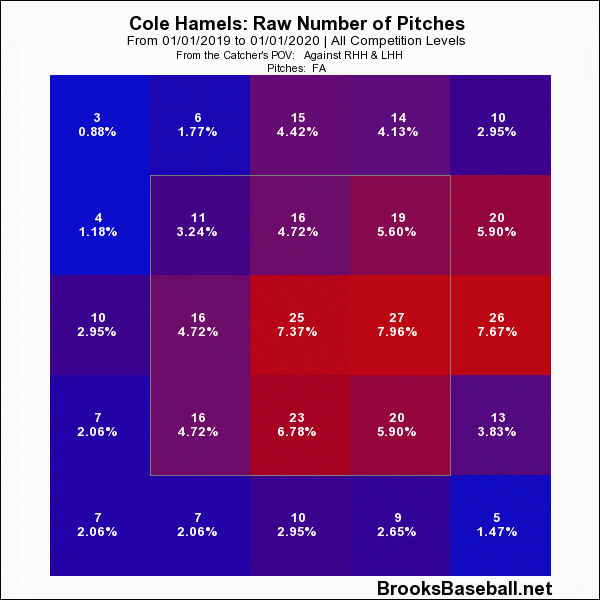
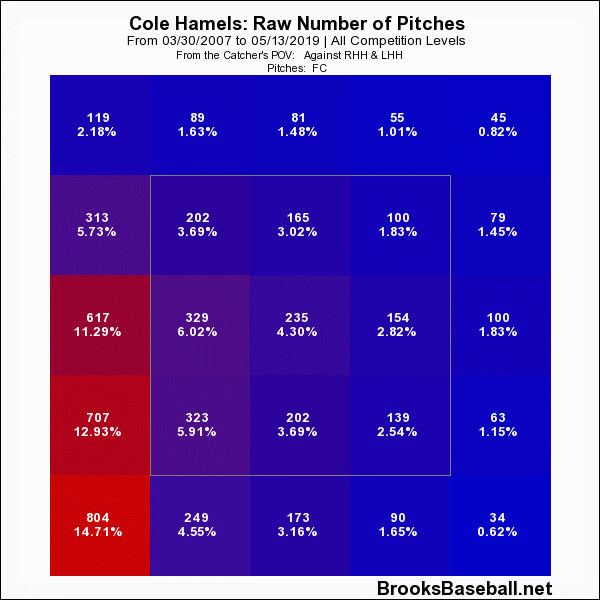
Here’s where Hamels has thrown his four-seamer throughout his career:

And here’s what he’s doing this year so far:

So as you can see, he’s gone a bit Lester in that he’s just hammering the outside corner to righties. Which gets balls rolled over, or hitters stretching, and that’s how you get a lot of grounders. That idea has spread to his cutter as well, even though he’s using it less. Here’s where his career usage has gone and where he’s throwing it this year:

He still uses it to get inside on righties, just enough to keep them off the fastball outside, but hasn’t been shy about throwing it outside as he was either.

Perhaps more impressive than the ground-ball rate is that the amount of loud contact Hamels is giving up has fallen off a cliff. He’s only giving up a 16% line-drive rate, which is top-1o in baseball. His hard-contact rate has dropped from 41% last year to a much more manageable 33%, and even most of that hard-contact has still been on the ground.

The question is whether Hamels is benefitting too much from a .234 BABIP, which isn’t going to stick around much. But considering the soft and grounded nature of what he’s surrendering, and the Cubs plus-defense (5th best in ground-ball defensive efficiency), it also might not rise dramatically. The last time Hamels gave up anywhere near this many grounders, 2011 with Philly, he had a .255 BABIP, as Utley, Rollins, and Polanco gobbled everything up back when they were still young.

Stamina will be a question, as he’s 35 now and wasn’t as good in September of last year. And control has been an issue of late. But when you give up soft contact and most of it on the ground, good things tend to happen.

Everything Else

As the playoffs continue to roll on without the Hawks, those of us hoping to get any morsel of hope have to wait for them to end. The Hawks have done a couple things around the margins this week, in what we would call “depth-building” if we felt like being charitable. Which would be a real upset, but hey it’s finally getting warm so maybe our hearts have turned a little. A very little.

The first droplet was Alex Wedin deciding to sign with the Hawks. They had competition from other teams, and this is where the Hawks’ success with other European signings certainly plays a role. Wedin is 26 and had a breakout season in Sweden with his team getting promoted to the top division there for the first time this season. Wedin isn’t  very big, not clearing 6-0, but he is fast according to reports, and I’m always on board when the Hawks choose speed and skill over size. He averaged nearly a point-per-game in hist first season in Sweden’s top division.

That doesn’t mean there aren’t problems, and there’s a chance Wedin is just doing the Rockford-Chicago shuttle all year. He wouldn’t have signed with the Hawks if he wasn’t promised every chance in the world at training camp, so he’ll get that. But players who break out at 26 generally aren’t all that highly regarded and don’t go on to do much. There is some hope that his late-blooming was due to previous injuries, but we’ll have to see.

Still, when it comes to European signings, the Hawks should be given most of the benefit of the doubt. Not every one of them has worked out, but most have. Next year David Kampf and Dominik Kahun will be prime examples, and Dominik Kubalik and Wedin look to join in next year. There’s certainly nothing wrong with fortifying your bottom six, though the hope was that the Hawks would do that by pushing other guys down after getting top six help.

Right now, you’ve got Kane, Toews, Strome, Saad, and Top Cat definitely in your top six. Possibly Anisimov if he isn’t traded, Caggiula, Kampf, Perlini, Kahun, Kubalik, and now Wedin are vying for bottom six roles, along with Dylan Sikura, and maybe even MacKenzie Entwhistle if he comes up for air at some point. If the Hawks want to move forward they can’t do that by force-feeding one of these guys into the top-six just because. but depth is certainly a nice thing to have. The case for trading Anisimov certainly gets better, especially if the Hawks are truly convinced Caggiula is built for a #3 or #4 center role, which they crowed about when he was acquired.

-The other note is Slater Koekkoek being re-upped for a year, which isn’t encouraging. I would say “Rockford depth,” but the Hawks have four guys that are Rockford depth in Koekkoek, Dahlstrom, Forsling (if re-signed), and honestly that’s Seabrook’s skill-level now. What’s disheartening is that the Hawks have made so much noise about being able to improve this group with just a training camp under Coach Cool Youth Pastor, that I’m beginning to think they believe it.

And even Rockford depth is complicated, where you might have Nicolas Beaudin needing all the minutes he can get if the Hawks do force most or all of those guys back into the AHL. And they didn’t just bring Chad Krys in to sit around either. We know that Keith, Seabrook, Murphy, Gustaffson, and Jokiharju are going to be on the team next year (or we hope with the last name there), which really only leaves one spot for any kind of signing or trade (assuming the Hawks don’t grow a pair and move Jokiharju for something, or get some bayou shaman to curse another team to take on Seabrook).

On a lower level, Koekkoek showed absolutely nothing that warrants getting another look, and as we’ve just illustrated depth really isn’t a problem. His $925K hit is a nothing, so that’s not the problem. Thinking he’s anything is. And if you think Stan Bowman will simply discard a player he likes, I’ll remind you how many games we sat through David Rundblad. At least Koekkoek didn’t cost a 2nd round pick.

Everything Else

As a pretty damn good fantasy sports player (mostly self-proclaime, admittedly) I love a good “Buy Low, Sell High” move. If you’re a beliver in regression, and you should be, nothing can make you look quite as smart as offloading a player who is performing above what you expected and cashing in, especially if you can take advantage of someone looking to offload a player that is underwhelming compare to expectations. It appears Stan Bowman thinks the same way, because there is no better example of a successful Buy Low trade that ended up being a major home run than when Stan acquired Dylan Strome as the headliner return for Nick Schmaltz. Let’s get right to it:

Stats with Hawks

58 GP – 17 G – 34 A

46.18 CF% – 29.2 xGF % [5v5]

It Comes With A Free Frogurt

Despite being hailed as some kind of analytics hero, John Chayka gave up on Strome after a relatively small sample size of NHL experience. A huge part of it may have been that the Coyotes had lofty expectations for Strome after taking him third overall in the same draft as Connor McDavid, but Strome had appeared in just 48 NHL games over portions of three seasons (including this one) in the desert. The production was limited, but it’s not like he was playing with much impressive talent out there either. The Hawks ultimately decided that Schmaltz’ contract demands were just too damn high and that his ceiling of being a 2C might not even be long term, so they gambled on Strome and what is hopefully still a 1C ceiling, though an increasingly unlikely one he will hit.

Strome stepped into a much better situation in Chicago, being able to to slot with Alex DeBrincat, his longtime linemate from their time at OHL Erie, and Patrick Kane. And when the pressure was off his shoulders, Strome thrived. As you can see above, he had 51 points in 58 games, which is damn close to a point per game pace and projects out to a 72 point season if he played all 82. He also contributed well on the PP, with 3 goals and 9 assists coming on the extra man unit. I don’t think anyone ever doubted the vision and skill of Strome, and it’s not like it would be exactly a shock if he busted big time when you look at what his brother did, but the technical ability he had really came to the forefront when he arrived here.

The Frogurt is Also Cursed

That all being said, there are still a few things to be a little concerned about with Strome that could lead to a potential production. falloff. Let’s start with those boldened CF% and xGF% numbers above, which are certainly somewhat alarming. The Hawks weren’t a great team in either category, but Strome still had a -3.2 CF%Rel and and a -3.26 xGF%Rel. I am sure that a huge part of that could be attributed to the defense, because we know the blue line was awful, but the center still bears some responsibility for that. To be that far below team rate is troubling.

I think something that could be playing a big role in that is the well documented skating issues that have followed him (and his entire family, really) throughout much of his career. He’s strong in his lower half, and had good enough size to stand his ground, but he isn’t fast by any stretch of the imagination, and that certainly plays against him in today’s NHL. It also makes him something of a misfit in Coach Cool Youth Pastor’s speed-obsessed man-t0-man system. I tend to believe that his skill will play way above this concern, but if there is one thing that is likely to drag him down and keep him from reaching his potential, it’s that.

Moving forward, Strome gives the Hawks a good amount of comfort in terms of the center depth. Even if he falls off slightly next year, he still could be a 60 point guy, which is perfect for a 2C, and if he steps up the production you could be seeing a full point per game pace and some 1C numbers. Either way, it looks like the Hawks won big with Strome.

Previous Player Reviews

Corey Crawford

Cam Ward

Collin Delia

Duncan Keith

Connor Murphy

Henri Jokiharju

Gustav Forsling

Erik Gustafsson

Carl Dahlstrom

Brendan Perlini

Alex DeBrincat

Chris Kunitz

Artem Anisimov

Marcus Kruger